Categories
Education CRM

Best CRM for Education in India: Features, Use Cases & Selection Checklist

Education in India has changed fast. Schools, colleges, coaching institutes, edtech startups, and training centers now operate more like service businesses than traditional institutions. Leads come from websites, WhatsApp, ads, walk-ins, referrals, and counsellors handle dozens of conversations every day. Without a system, things fall apart quickly. That’s where an education-focused CRM comes in.

But not every CRM fits Indian education workflows. Some are built for generic sales teams. Others look good in demos but break when real admissions pressure starts. This guide breaks down what the best CRM for education in India actually needs to do, how different institutions use it, and how to choose one without overthinking. No buzzwords. Just how it works in real life.

Why Education Institutes in India Need a CRM Now

Ten years ago, Excel sheets and phone registers were enough. Today, they’re not.

Here’s what most education teams deal with daily:

    • Hundreds of leads from multiple sources

    • Parents calling during working hours, students messaging late nights

    • Counselors juggling follow-ups, walk-ins, and fee discussions

    • Admission heads needing daily performance clarity

    • Marketing teams wanting ROI answers

Without a CRM, lead leakage becomes normal. Follow-ups are missed. Enquiries go cold. Teams blame marketing. Marketing blames counselors. It becomes messy.

A CRM doesn’t solve everything. But it gives structure. And structure matters when volumes increase.
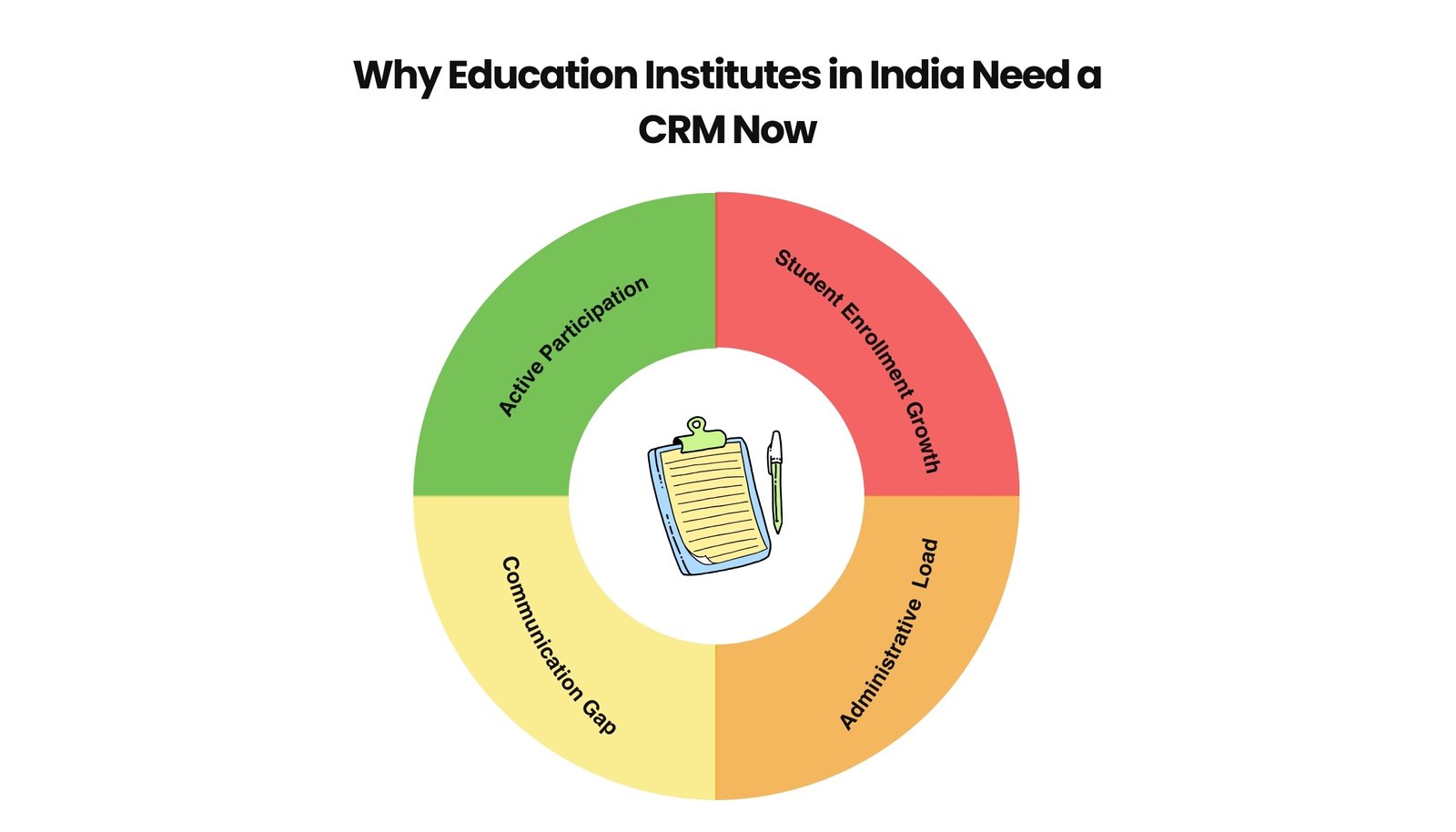
Why Education Institutes in India Need a CRM Now

What Makes The Best CRM for Education Different From Regular CRMs

Education is not standard sales. The buying cycle is emotional, slow, and involves multiple decision-makers. A parent might enquire today and decide after two months. Or never reply again. Or suddenly show up at the center.

A good education CRM understands this behavior.

Key differences:

    • Lead stages are admission-focused, not sales-focused

    • Follow-ups are time-sensitive and repetitive

    • Communication is multi-channel (calls, WhatsApp, SMS, email)

    • Data needs to be simple for counselors, not complex dashboards

Generic CRMs often feel heavy. Education teams need speed, not complexity.

Core Features Every Education CRM Must Have

Let’s break this down properly. Not feature lists for marketing pages, but features that actually get used.

Lead Capture From All Sources

The best CRM for education in India must pull leads from:

    • Website forms

    • Facebook and Google Ads

    • WhatsApp enquiries

    • Walk-ins (manual entry)

    • Referral leads

If counselors still manually copy leads from emails, that’s already a red flag.

Platforms like Sensation CRM focus heavily on centralized lead capture because that’s where most education teams struggle first.

Lead Distribution and Ownership

Once a lead enters the system, someone must own it.

The CRM should:

    • Auto-assign leads to counselors

    • Balance lead load fairly

    • Track who contacted the lead and when

Without ownership, follow-ups become optional. That’s when conversion drops.

Follow-Up Management That Actually Works

This is where most CRMs fail in real use.

A good education CRM should:

    • Allow quick follow-up creation

    • Show overdue follow-ups clearly

    • Support daily calling workflows

    • Send reminders that don’t get ignored

Counselors don’t want fancy calendars. They want to know who to call next. CRM for Educational Institutions proves that simple follow-up systems consistently outperform complex ones.

Multi-Channel Communication

In India, admissions don’t happen only on email.

The CRM must support:

    • Click-to-call

    • WhatsApp messaging (official or integrated)

    • SMS alerts

    • Email (secondary, but still useful)

Conversation history matters. When a parent calls after two weeks, the counselor should see past notes instantly.

Admission Pipeline Visibility

Education CRMs need custom stages like:

    • New enquiry

    • Contacted

    • Interested

    • Visit scheduled

    • Admission confirmed

    • Not interested / Lost

The ability to customize stages is critical. Each institute works slightly differently. The best CRM adapts to the institute, not the other way around.

Counselor Performance Tracking

This part is uncomfortable but necessary.

CRM should show:

    • Calls made per counselor

    • Follow-ups completed

    • Conversions achieved

    • Drop-off points

Not for micromanagement, but for clarity. Without data, performance discussions become emotional. Sensation CRM handles this well by keeping reports readable, not overwhelming.

Admission and Fee Tracking (Basic Level)

Not every CRM needs full ERP-level finance features. But basic tracking helps:

    • Admission status

    • Course selected

    • Fee committed vs paid

    • Admission date

This avoids confusion later and helps lead management forecast revenue accurately.
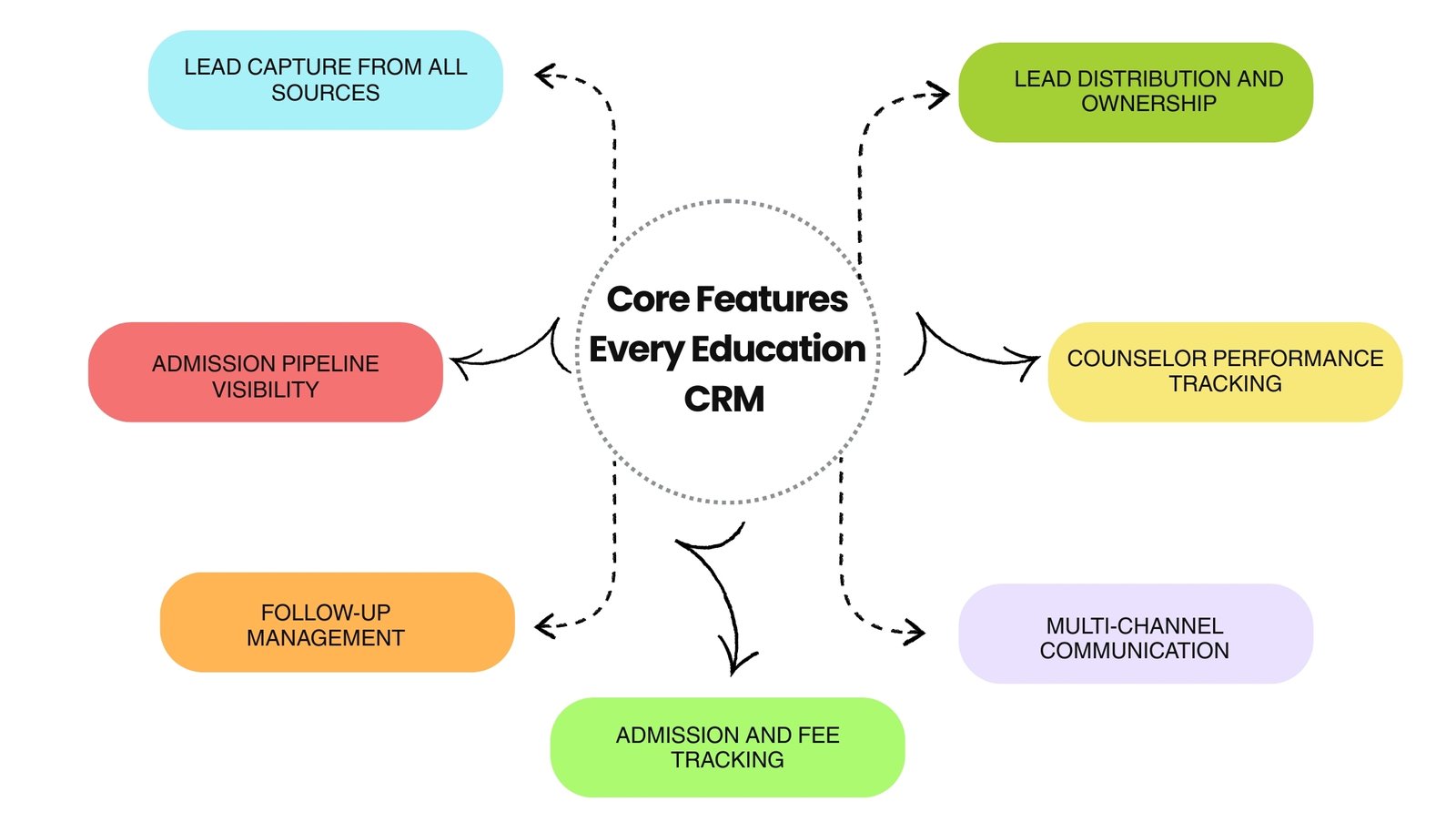
Core Features Every Education CRM

Common Use Cases of CRM in Indian Education

Let’s look at how different education segments use CRM daily.

Coaching Institutes (NEET, JEE, UPSC, CAT)

High enquiry volume, seasonal spikes, intense follow-ups.

CRM helps with:

    • Managing campaign leads during peak months

    • Assigning leads quickly

    • Tracking conversion per counselor

    • Re-engaging cold leads

Without CRM, most coaching institutes lose leads simply due to delay.

Schools (Private, CBSE, ICSE, International)

Decision cycles are longer. Parents ask more questions.

CRM is used for:

    • Enquiry tracking across academic years

    • Visit and demo scheduling

    • Parent communication history

    • Admission funnel reporting

Schools benefit most from structured follow-ups and visit tracking.

Colleges and Universities

Larger teams, more layers.

CRM supports:

    • Department-wise lead handling

    • Course-based segmentation

    • Central admission visibility

    • Long-term enquiry nurturing

Here, scalability and role-based access matters.

EdTech and Online Training Platforms

Speed is everything.

CRM is used to:

    • Instantly contact leads

    • Automate reminders

    • Track ad ROI

    • Convert trials to paid users

Fast response equals higher conversion.

Mistakes Institutes Make While Choosing a CRM

This is important. Many teams choose wrong and regret later.

Choosing Based on Brand Name Alone

Big CRM brands don’t always mean better education workflows.

Overbuying Features

If your team won’t use automation rules, don’t pay for them.

Ignoring Counselor Feedback

If counselors hate using it, CRM adoption fails. Simple.

Not Checking Support Quality

Indian institutes need quick support, not ticket delays.

Sensation CRM gained popularity largely because it focused on education-specific needs instead of generic sales logic.

Selection Checklist: How to Choose The Best CRM for Education in India

Use this checklist before finalizing.

Lead Management

    • Does it capture leads automatically?

    • Can it handle high lead volume?

    • Can leads be reassigned easily?

Follow-Ups

    • Are reminders simple and visible?

    • Can counselors update follow-ups quickly?

Communication

    • Call, WhatsApp, SMS integration?

    • Can history be seen instantly?

Reporting

    • Daily counselor activity reports?

    • Source-wise lead performance?

    • Conversion tracking?

Ease of Use

    • Can a new counselor learn it in 1–2 days?

    • Is mobile usage smooth?

Support

    • Indian support team?

    • Fast response?

    • Training provided?

If a CRM checks most of these boxes, you’re on the right track.

Why Many Institutes Prefer Sensation CRM

Sensation CRM is built specifically for Indian education workflows. Not adapted later. Built with them in mind.

Institutes choose it because:

    • Lead handling is fast

    • Follow-ups don’t get lost

    • Counselors find it easy

    • Reporting is practical

It doesn’t try to be everything. It focuses on what admissions teams actually need day to day. That focus matters more than feature count. Contact us to see how the right CRM can simplify admissions, improve follow-ups, and support your team with clarity and consistency.

CRM Implementation: What to Expect in The First 30 Days

Let’s be honest. CRM adoption takes time.

Week 1:

    • Data setup

    • Lead source integration

    • Basic training

Week 2:

    • Counselor usage begins

    • Initial resistance (normal)

Week 3:

    • Follow-ups improve

    • Missed leads reduce

Week 4:

    • Clearer reporting

    • Better team coordination

If implementation feels perfect from day one, something is probably being ignored.

CRM Is a Tool, Not a Magic Fix

This needs saying.

A CRM won’t:

    • Fix bad counselors

    • Improve weak marketing

    • Replace training

But it will:

    • Reduce chaos

    • Improve visibility

    • Increase consistency

And consistency is what improves admissions numbers over time.

Choosing The best CRM for education

Choosing the best CRM for education isn’t about buying the most expensive software. It’s about choosing a system your team will actually use.

Indian education institutes work under pressure. Admissions are time-sensitive. Follow-ups matter. Data clarity matters.

A CRM like Sensation CRM, built with education workflows in mind, helps bring order to that pressure. Not by promising miracles, but by making daily work manageable.

And that, honestly, is what most teams need.

Frequently Asked Question
Which is the best CRM for education in India?

The best CRM depends on your institute size and workflow. Education-focused platforms like Sensation CRM are designed specifically for Indian admissions teams.

Yes. Even small teams benefit from lead tracking and follow-up reminders.

Basic setup usually takes 1-2 weeks. Full adoption may take a month.

Most modern education CRMs support WhatsApp integration directly or via approved APIs.

Yes, but if the CRM is simple, counselors adapt quickly.

Indirectly, yes. Faster follow-ups and better tracking improve conversion rates.

Categories
Education CRM

How to Choose the Right CRM for Educational Institutions (Without Overpaying)

Choosing the right CRM for educational institutions has become a real decision point for schools, colleges, and coaching centers. With so many options available, it’s easy to feel pulled toward software that looks impressive but doesn’t actually solve everyday problems.

Many institutions end up spending more than they should, not because they lack planning, but because the CRM they choose isn’t designed for how education truly works or effective CRM lead management. Over time, this leads to unused features, confused staff, and processes that feel harder instead of easier.

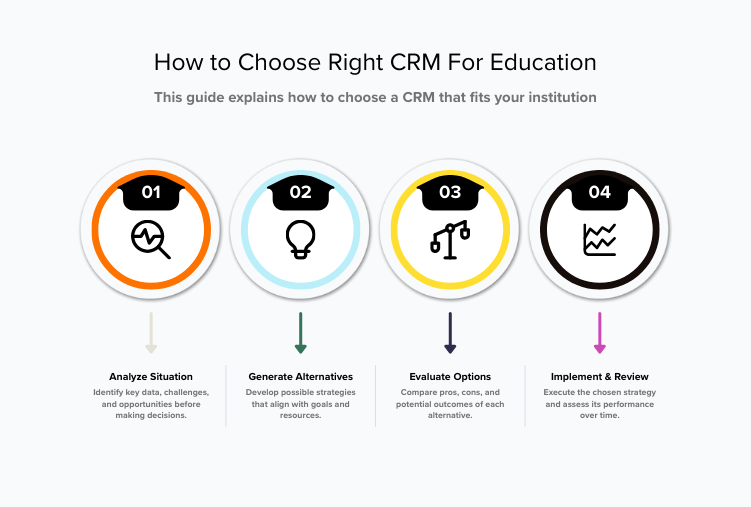
This guide explains how to choose a CRM that fits your institution, supports growth, and avoids unnecessary costs. No exaggeration. No buzzwords. Just practical thinking.

Why Educational Institutions Often Overpay for CRM Software

Overpaying usually doesn’t happen at the start. It happens slowly. An institution signs up for a CRM that promises automation, analytics, and scalability. On paper, everything looks fine. But once implementation begins, teams realize the system is built for sales pipelines, not student admissions.

Education works differently. Inquiry cycles are longer. Decisions involve parents and counselors. Follow-ups are informational, not aggressive. Generic CRMs don’t reflect this reality, so institutions pay extra for customization, training, and ongoing adjustments.

That’s where costs quietly add up.

Education Has Different CRM Requirements Than Business Sales

A CRM designed for education needs to understand how students move through the system. This includes inquiry, counseling, documentation, fee discussion, enrollment, and post-admission communication.

In many institutions, the same student interacts with multiple staff members over weeks or months. A proper CRM for educational institutions keeps that entire history visible and accessible. Generic CRMs usually don’t do this well without heavy modification.

If a system treats students like short-term sales leads, it’s not a good match.

Start With Your Actual Admission Process

Before evaluating CRM software, institutions should map their own process honestly.

    • How do inquiries arrive?

    • Through website forms, phone calls, walk-ins, or social media?

    • Who responds first?

    • How are follow-ups tracked?

    • Where do delays happen?

A good CRM should reflect these steps clearly. It shouldn’t force staff to adapt to unnatural workflows just to fit the software. When systems align with real operations, adoption becomes easier and outcomes improve.

Don’t Pay for Features That Sound Good but Go Unused

Many CRM vendors bundle features like:

    • Advanced sales forecasting

    • Revenue pipelines

    • AI deal scoring

    • Complex automation chains

Most institutions need reliability more than innovation. Clear inquiry tracking, follow-up reminders, communication logs, and basic reporting usually deliver the biggest impact.

Paying for features no one uses is one of the most common ways institutions overspend on CRM education platforms.

Ease of Use Is More Important Than Feature Volume

Even the most advanced CRM fails if staff don’t use it properly. Admissions teams are busy. If a CRM requires too many steps to log a call or update a status, people will avoid it. Data becomes incomplete. Reports become unreliable.

The best CRM for Higher education feels intuitive. Staff should be able to learn it quickly, without long training sessions. When the system feels simple, consistency follows.

Customization Should Support, Not Complicate

Some CRM vendors promote deep customization as a benefit. Some CRMs require heavy customization just to fit admissions workflows. That means:

    • Extra setup costs

    • Consultants

    • Long implementation timelines

    • Ongoing dependency

If a CRM needs constant changes to function properly, it’s probably not designed for education in the first place.

Reporting Should Be Clear and Actionable

Reports should answer real questions, not just display numbers. Institutions typically want to know how many inquiries are active, where students drop off, which programs perform well, and how counselors are managing follow-ups.

A good CRM for educational institutions presents this information in simple language. If reports require interpretation or technical knowledge, they won’t be used consistently.

Integration Should Feel Natural

Most institutions already rely on email, phone systems, websites, and spreadsheets. A CRM should integrate with these tools smoothly.

Trying to replace everything at once creates resistance and confusion. Gradual integration works better and costs less over time.

CRM education software should support existing workflows, not disrupt them unnecessarily.

Data Security Is Non-Negotiable

Student and parent data must be protected. Any CRM solution should include secure hosting, strong access controls, detailed activity logs, and regular backups to ensure data privacy and compliance.

Security shouldn’t be treated as an optional feature. It should be standard. Institutions that ignore this risk not just operational issues, but trust as well.

Pricing Transparency Prevents Long-Term Cost Surprises

Low pricing can be misleading.  Some CRMs charge low entry fees but add costs later:

    • User limits

    • Storage caps

    • Feature upgrades

    • Support fees

Clear, predictable pricing is safer than aggressive discounts. Over time, transparency saves more money than cheap entry plans.

Support and Onboarding Matter More Than Demos

CRM success depends on implementation. Strong onboarding, workflow setup, and ongoing support are essential.

Vendors who disappear after the sale leave institutions struggling to adapt. Education institutions should value long-term partnership over flashy demos. Support quality often determines whether a CRM succeeds or fails.

Choosing a CRM That Grows With You

Institutions grow gradually. New programs. More counselors. Higher inquiry volume.

A CRM should scale smoothly without forcing system changes every year. Scalability doesn’t mean complexity. It means stability under growth.

Why Education-Focused CRM Platforms Make Sense

Education CRMs are built with real institutional workflows in mind.

They understand:

    • Admission seasons

    • Multiple stakeholders

    • Long decision cycles

    • Counselor accountability

    • Parent communication

This reduces friction. Less friction means better outcomes.

Sensation CRM: Designed for Education, Not Sales Pipelines

For institutions seeking a practical and education-focused solution, Sensation CRM is built around actual academic workflows. It supports inquiry management, admissions tracking, counselor coordination, and reporting without unnecessary complexity.

Instead of adapting sales tools for education, Sensation CRM provides structure that fits schools, colleges, and coaching institutes helping teams stay organized, accountable, and scalable without overpaying for features they don’t need.

Choosing The Right CRM

Choosing the right CRM for educational institutions isn’t about buying the most advanced software. It’s about selecting a system that matches how education actually operates.

Institutions that prioritize usability, clarity, and education-specific design avoid wasted spending and operational stress. A good CRM supports people, processes, and growth without getting in the way, while making it easy for prospects to contact us and receive timely responses.

FAQ’s

What is a CRM for educational institutions?

A CRM for educational institutions is software designed to manage student inquiries, communication history, admissions workflows, and engagement across the student lifecycle.

Education CRMs focus on inquiries, counseling, enrollment, and student communication, whereas sales CRMs are built around short sales cycles and revenue pipelines.

Generic CRMs require heavy customization, don’t follow education workflows out of the box, and often force institutions to overpay for features they will not use.

Schools should look for ease of use, built-in education workflows, simple reporting, secure data handling, predictable pricing, and support tailored to admissions teams.

Yes. Many education-focused CRMs can integrate with these platforms, inquiry forms, and communication tools to streamline information flow.

Categories
Education CRM

Education CRM Software vs Generic CRM: Key Differences Explained

Built for The Student Lifecycle

Education CRM software is designed around the full student journey, starting from the first inquiry and continuing through counseling, enrollment, and even post-admission communication. This lifecycle is longer and more layered than a typical sales journey. A student may take weeks or months to decide, ask repeated questions, or pause the process entirely before coming back. Education CRM systems account for this naturally, while generic CRMs are built for short sales cycles and quick closures, which doesn’t align well with how education decisions are actually made.

Admissions Workflow Support

Admissions workflows involve more than just “open” and “closed” stages. There are document checks, eligibility confirmations, fee discussions, seat availability concerns, and academic approvals. Education CRM software includes these workflows by default, so teams can move students through each stage without confusion. Generic CRMs usually require heavy customization to replicate this, and even then, the process often feels forced or incomplete.

Parent Student Communication Handling

In education, communication is rarely one-to-one. Parents, guardians, and sometimes sponsors are involved in the decision-making process. Education CRM software allows institutions to manage multiple contacts linked to a single student profile. This ensures that updates reach the right people at the right time. Generic CRMs usually treat each contact as an individual buyer, which can result in fragmented communication and missing context.

Counselor Management Structure

Education CRM software is built to support counselors rather than sales representatives. It tracks counselor assignments, follow-ups, workloads, and response times in a way that reflects academic counseling rather than sales pressure. This helps institutions ensure fair distribution of inquiries and consistent follow-ups. Generic CRMs focus on deal ownership and sales quotas, which don’t translate well to counseling environments.

Counselor Management Structure

Academic Reporting and Insights

Education-focused reporting looks very different from sales reporting. Institutions need to understand which programs attract the most interest, where students drop off in the admission process, how long decisions take, and which counselors need support. An education CRM software CRM solution provides these insights in a usable, institution-ready format. Generic CRMs mainly report on revenue forecasts and pipeline velocity, which offer limited value in academic decision-making.

Compliance and Data Sensitivity

Educational institutions handle sensitive student information that must be protected carefully. Education CRM software is designed with this responsibility in mind, offering role-based access, audit trails, and controlled data visibility. This ensures that staff members only see the information relevant to their role. Generic CRMs can be secured, but compliance is not their primary design focus, making them riskier if not managed carefully.

Reduced Customization Dependency

One common issue with generic CRMs is the need for extensive customization to fit education workflows. Over time, this creates dependency on technical teams and increases maintenance costs. Education CRM software already understands academic structures, making it a Guide for Schools, Colleges & Coaching Institutes that need stability rather than constant configuration.

Higher User Adoption Rates

Admissions teams are more likely to use a system that feels intuitive and aligned with their daily tasks. Education CRM software mirrors how counselors already work, which leads to higher adoption and better data quality through effective user management. Generic CRMs often feel foreign to academic staff, lacking proper user management controls and causing teams to fall back on spreadsheets or personal notes, which defeats the purpose of having a CRM at all.

Scalability Without Operational Chao

As institutions grow, they face higher inquiry volumes, more programs, and larger counseling teams. Education CRM software scales without disrupting existing workflows, maintaining structure even as complexity increases. Generic CRMs can scale technically, but without proper academic logic, they often create confusion as the institution grows.

Cost vs Long-Term Value

Long-term CRM benefits

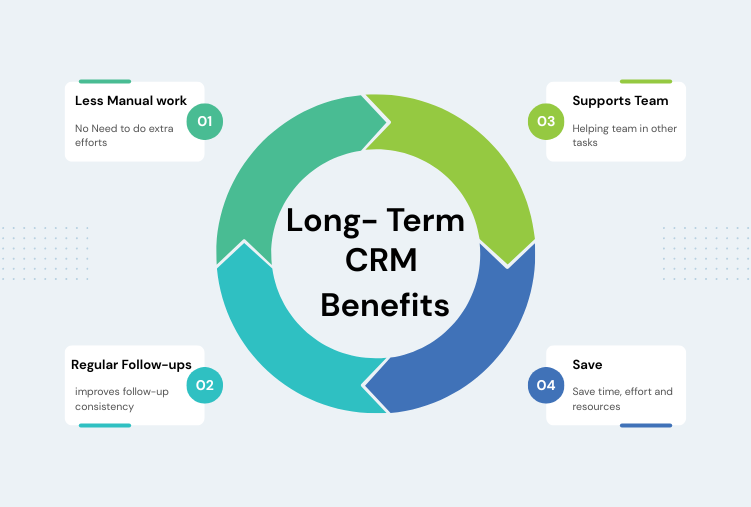
While generic CRMs may appear cheaper initially, the long-term costs of customization, training, and inefficiency often outweigh the savings. Education CRM software delivers better value over time because it reduces manual work, improves follow-up consistency, and supports admissions teams more effectively. Institutions end up saving time, effort, and resources in the long run.

Why This Difference Matters in Practice

Choosing between a generic CRM and education CRM software isn’t just a technical decision. It directly affects how smoothly admissions teams operate, how effectively lead management is handled, how students experience the institution, and how leadership makes decisions. A system built for education reduces friction and supports sustainable growth.

Final Thought

Education institutions don’t need to force their processes into a sales-oriented system. They need tools that respect how education actually works.

Sensation CRM is designed specifically for academic environments, supporting admissions workflows, counselor operations, and institutional reporting without unnecessary complexity. For schools, colleges, and coaching institutes that value clarity, accountability, and long-term scalability, using an education-focused CRM makes everyday work simpler and more effective.

FAQs

What is the difference between education CRM software and generic CRM?

Education CRM software is tailored around student lifecycles and admissions processes, while generic CRMs focus on sales pipelines and deal closures. 

They can be adapted, but they usually require heavy customization and may not fit natural education workflows.

Education CRMs include inquiry management, counselor assignments, admissions stage tracking, parent-student relationship mapping, and academic reporting.

Education-focused reporting highlights admissions funnels, follow-ups, conversions, and counselor performance rather than sales revenue.

Not necessarily. While education CRMs can be priced similarly, they save money long-term by reducing customization and increasing adoption.

Yes. By tracking interactions and follow-ups consistently, CRMs help institutions engage students more effectively throughout the admissions process.

See Sensation CRM in Action

Let our team walk you through your customized admissions workflow and show how automation saves hours every week.

Get in Touch with Us