Categories
Lead management

Lead Management Challenges Faced by Education Consultants (And How CRM Solves Them)

The education industry in India has become increasingly competitive as schools, universities, coaching institutes, edtech platforms, and overseas education consultants manage growing volumes of student inquiries across multiple digital channels. Students today interact through websites, social media advertisements, WhatsApp, Google search, webinars, education fairs, and referral platforms before making admission decisions.

As inquiry volumes continue increasing, managing student communication manually is becoming difficult for many organizations. Delayed follow-ups, scattered data, missed counseling calls, duplicate inquiries, and inconsistent communication often reduce enrollment conversions and operational efficiency.

This growing complexity has increased the demand for structured Lead Management CRM systems and intelligent lead management software across the Indian education sector. Educational organizations are now investing in CRM-based automation platforms to centralize inquiries, improve counselor productivity, automate communication, and streamline admission workflows.

According to recent education technology trends in India, institutions implementing CRM-driven lead management processes often improve inquiry response speed and admission conversion rates because students increasingly expect fast, personalized, and digitally connected communication experiences.

Why Lead Management Has Become a Major Challenge for Education Consultants

Education consulting businesses operate in a communication-heavy environment where every inquiry represents a potential admission opportunity. During peak admission seasons, consultants often manage thousands of leads simultaneously across multiple channels.

Most organizations generate leads through:

  • Google Ads campaigns
  • Social media marketing
  • Organic website traffic
  • WhatsApp inquiries
  • Referral programs
  • Education portals
  • Seminars and webinars
  • Offline counseling events

Without a centralized lead management crm, tracking student interactions and follow-ups becomes extremely difficult.

Many organizations still depend on spreadsheets or disconnected tools that cannot support modern admission workflows efficiently. This often creates communication gaps, operational confusion, and reduced conversion visibility.

What Are Common Lead Management Challenges?

One of the most common questions education businesses ask is: “What are common lead management challenges?”

Educational consultants across India frequently struggle with operational inefficiencies while managing large inquiry pipelines.

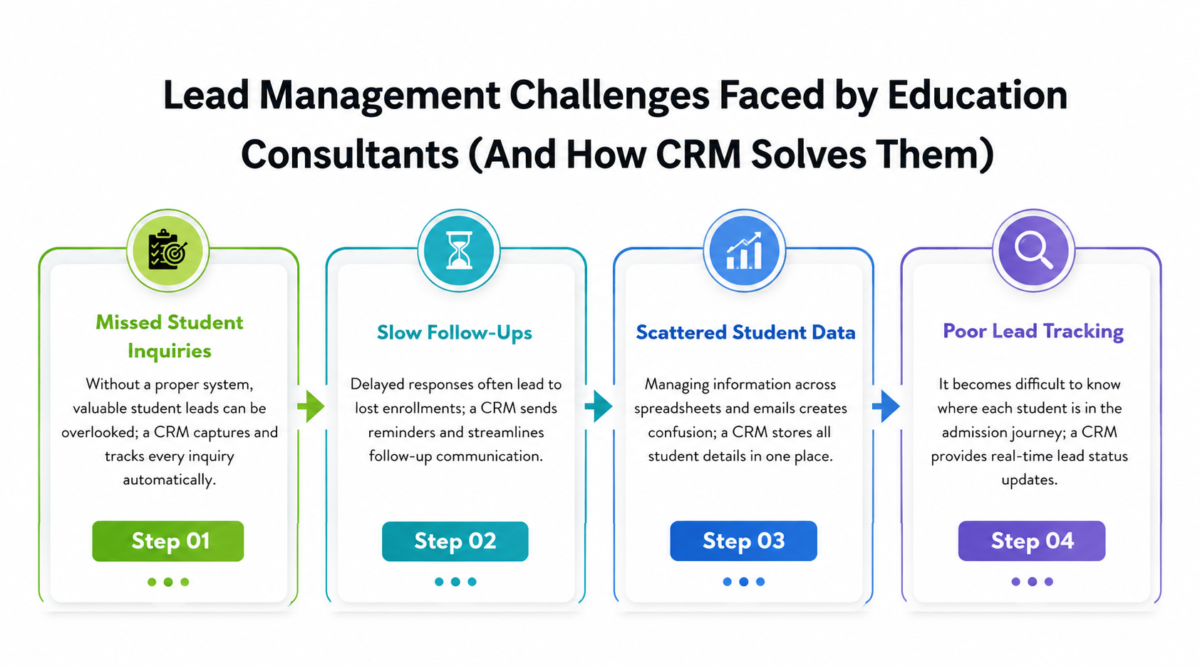
Delayed Lead Response Time

Students usually contact multiple consultants before finalizing admission decisions. Delayed responses often result in high-intent students choosing competitors who respond faster. Manual lead tracking systems make it difficult for counselors to prioritize urgent inquiries effectively.

Scattered Student Data

Many organizations manage student information across spreadsheets, emails, WhatsApp chats, and separate communication platforms. This creates fragmented records and makes it difficult for counselors to track student history, previous interactions, and application progress accurately.

Poor Follow-Up Management

Consistent follow-up remains one of the biggest challenges in lead generation in India for education businesses. Counselors handling large inquiry volumes often miss reminders, callbacks, or long-term nurturing opportunities. Without automation systems, valuable inquiries frequently become inactive due to communication delays.

Duplicate Leads and Data Errors

Educational organizations generating inquiries from multiple platforms often face duplicate entries and inconsistent data collection. This affects reporting quality, counselor coordination, and operational decision-making.

Lack of Reporting Visibility

Management teams often struggle to monitor:

  • Counselor productivity
  • Conversion rates
  • Lead source performance
  • Follow-up quality
  • Marketing ROI

Without structured reporting dashboards, optimizing admission strategies becomes difficult.

What Is the Difference Between Lead Management and CRM?

Another common question businesses ask is: “What is the difference between lead management and CRM?”

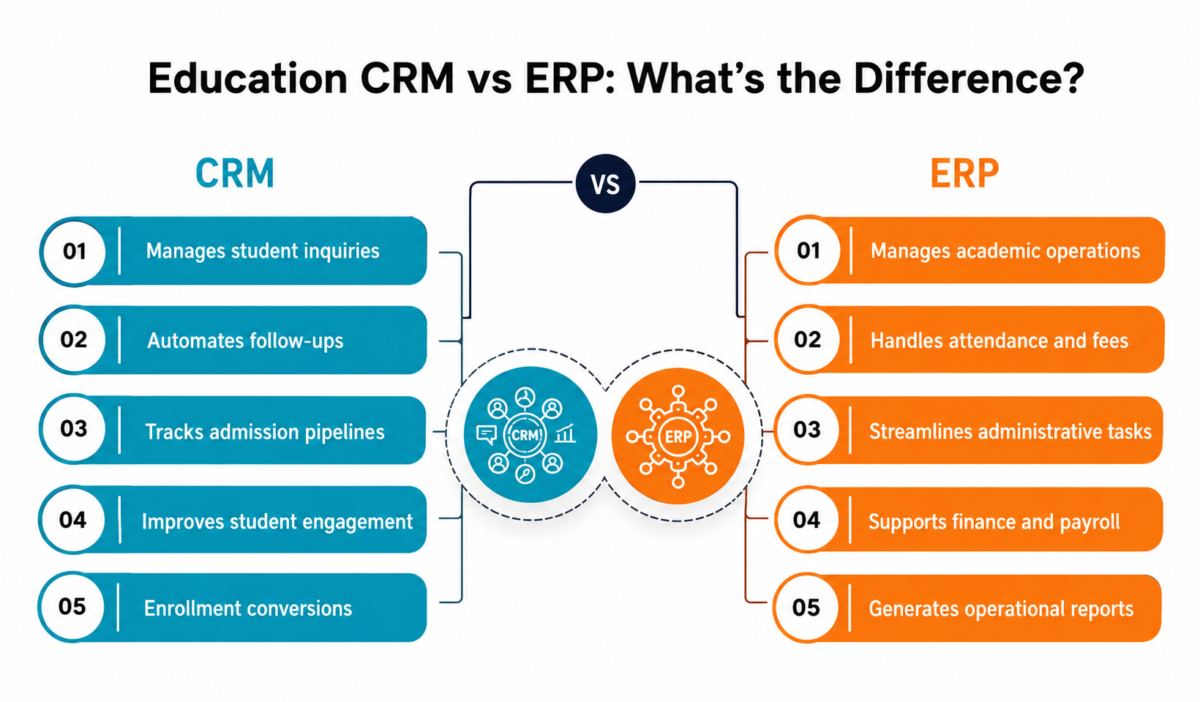
Lead management specifically focuses on capturing, organizing, tracking, nurturing, and converting inquiries into enrollments or customers. CRM, or Customer Relationship Management, is a broader operational framework designed to manage complete customer interactions, communication workflows, reporting systems, automation processes, and long-term engagement.

In simple terms:

  • Lead management handles inquiry tracking and conversion workflows
  • CRM manages broader relationship and operational processes

A modern lead management crm combines both functionalities by supporting inquiry management while also maintaining long-term communication and student engagement history.

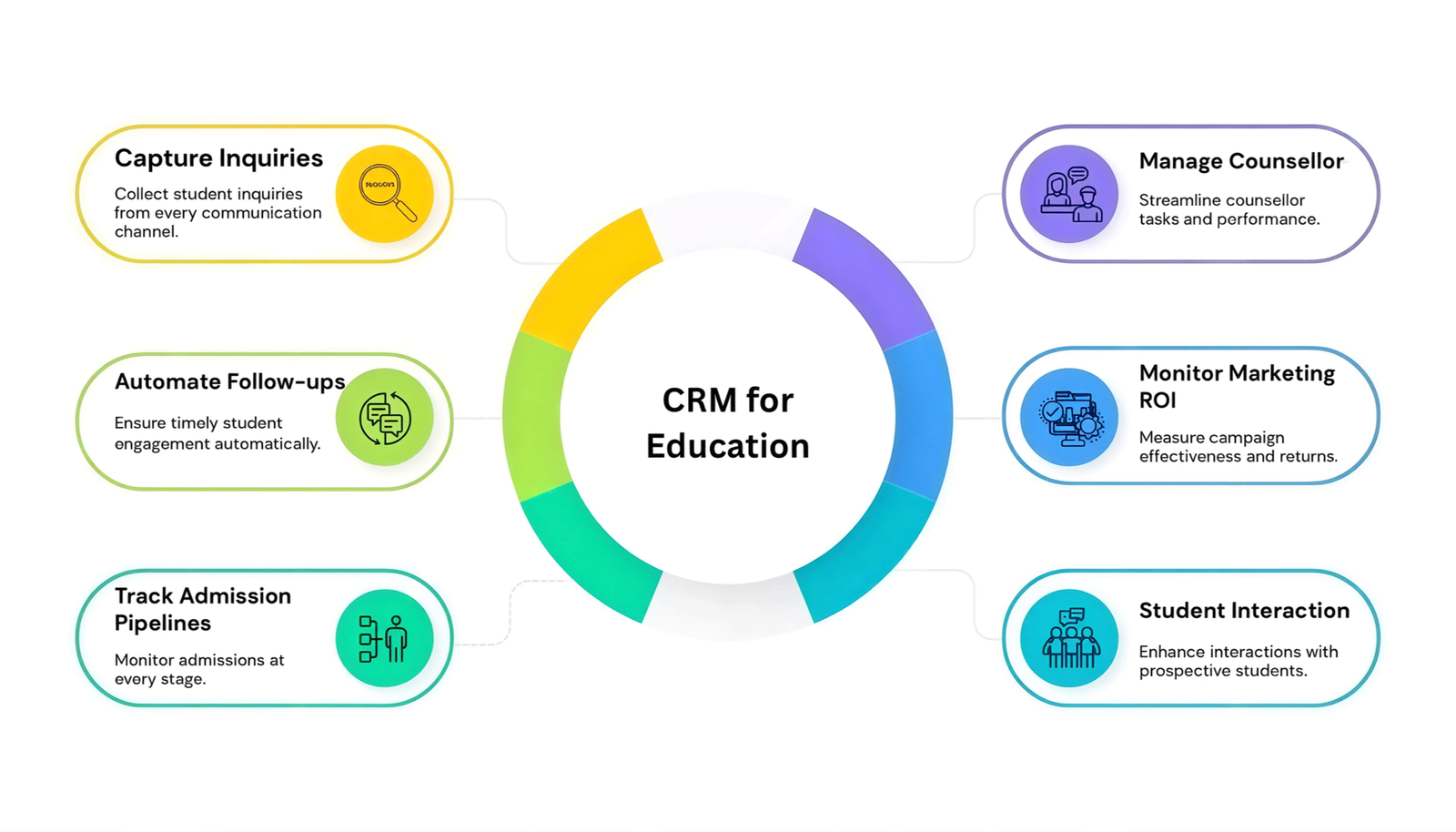
For educational organizations, CRM systems often become centralized platforms connecting admissions, counseling, communication, marketing, reporting, and workflow automation.

Why Education Consultants in India Are Adopting Lead Management CRM Systems

Educational organizations across India are increasingly investing in lead management software because student expectations and competition levels continue growing rapidly.

Students today expect:

  • Instant responses
  • Personalized counseling
  • Real-time communication
  • Fast document coordination
  • Multi-channel engagement

Managing these expectations manually becomes difficult as inquiry volumes increase.

Modern lead management software india solutions help organizations automate repetitive tasks while improving communication consistency and operational efficiency. This allows counselors to focus more on student guidance and enrollment support rather than manual administrative coordination.

How Does CRM Software Help in Lead Management?

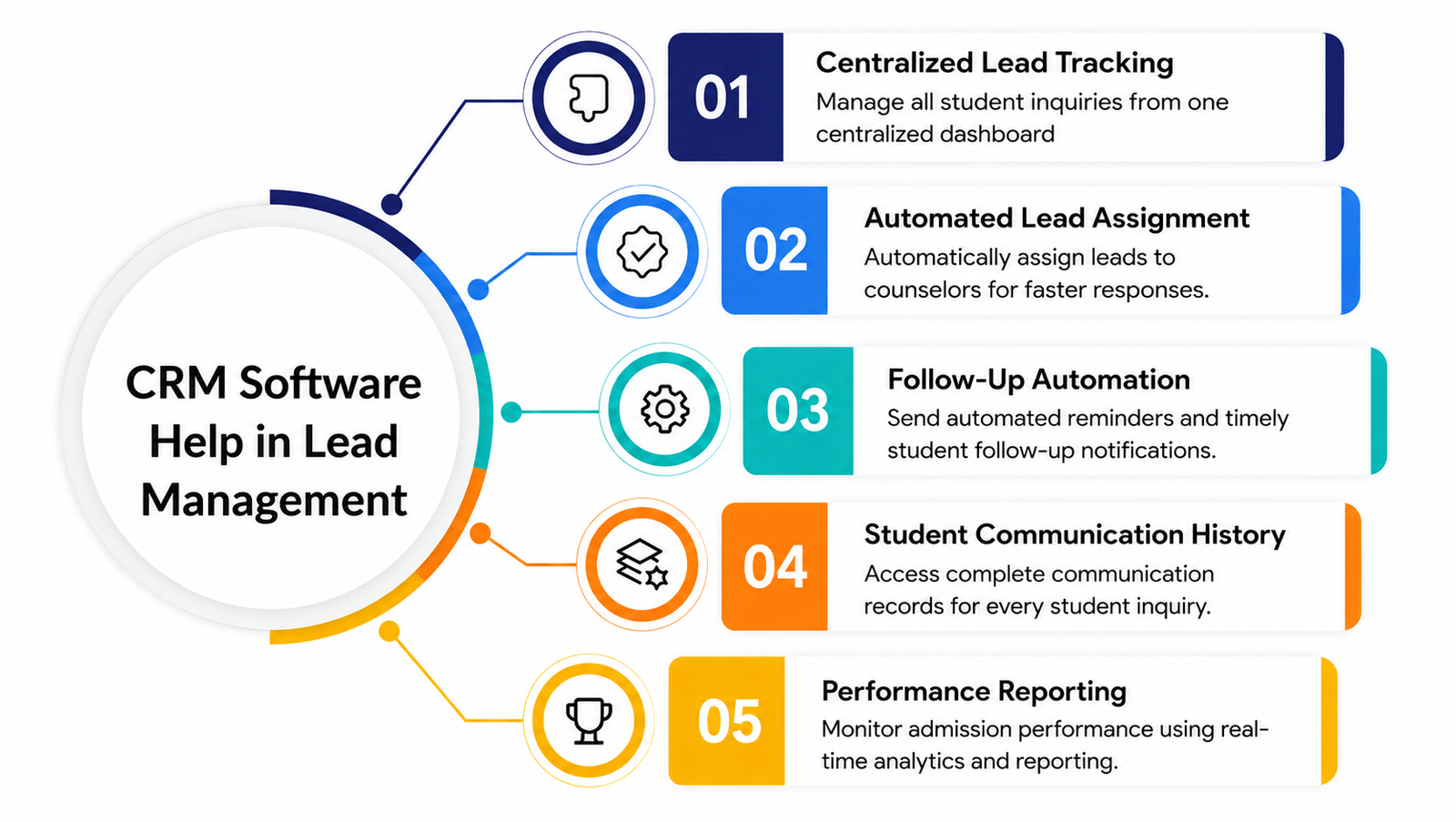
CRM Software Help in Lead Management

One of the most important operational questions businesses ask is: “How does CRM software help in lead management?”

Modern CRM systems streamline the complete inquiry lifecycle from lead generation to final enrollment.

Centralized Lead Tracking

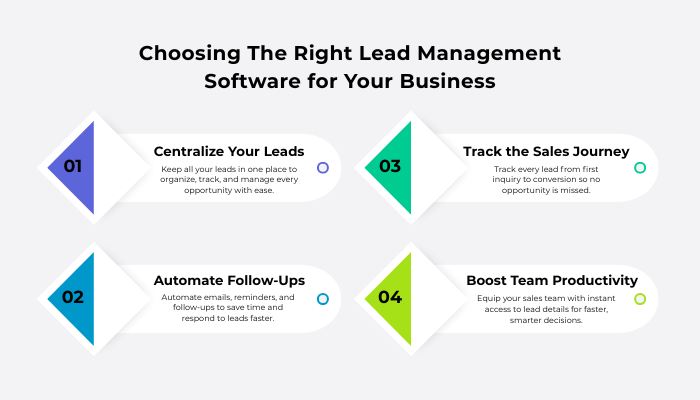
CRM platforms collect inquiries from websites, social media campaigns, advertisements, WhatsApp, webinars, and offline campaigns into one centralized dashboard.

This improves visibility and reduces communication gaps across teams.

Automated Lead Assignment

Lead management software automatically assigns inquiries to counselors based on:

  • Course interest
  • Branch preference
  • Location
  • Availability
  • Inquiry priority

This improves response speed and operational coordination.

Follow-Up Automation

Automated reminders, email workflows, WhatsApp notifications, and counseling schedules help consultants maintain consistent communication with students.

Automation significantly reduces missed follow-ups and inactive leads.

Student Communication History

CRM systems maintain complete interaction records including:

  • Calls
  • Emails
  • WhatsApp conversations
  • Counseling notes
  • Application updates

This helps counselors personalize conversations more effectively.

Performance Reporting

CRM dashboards provide insights into:

  • Lead source performance
  • Counselor productivity
  • Conversion ratios
  • Follow-up trends
  • Marketing campaign performance

These reports help management teams improve operational planning and lead generation performance.

What Is the Lead Management Process in CRM?

Businesses frequently ask: “What is the lead management process in CRM?”

The lead management process usually follows several structured stages designed to improve inquiry handling and conversion tracking.

Lead Capture: The CRM collects inquiries from websites, ads, social media, WhatsApp, education portals, webinars, and offline campaigns.

Lead Qualification: The system categorizes students based on course interest, intent level, location, budget, and enrollment probability.

Lead Assignment: Qualified inquiries are assigned to appropriate counselors automatically or manually.

Follow-Up and Lead Nurturing: Counselors communicate with students through calls, emails, counseling sessions, webinars, and WhatsApp while tracking interactions inside the CRM.

Enrollment and Application Tracking: CRM systems monitor application progress, documentation, payment updates, and admission workflows.

Conversion Analysis: Management teams analyze inquiry performance, conversion trends, counselor productivity, and operational bottlenecks using reporting dashboards.

Why Lead Generation Services in India Need CRM Integration

Many educational organizations invest heavily in lead generation services in India but still struggle with low conversions because inquiry management workflows remain unorganized.

Lead generation alone is not enough. Institutions also require structured systems for:

  • Lead nurturing
  • Communication management
  • Follow-up automation
  • Conversion tracking
  • Inquiry prioritization

Without CRM integration, many generated leads eventually become inactive or untracked.

This is why lead generation and CRM systems increasingly operate together as connected operational strategies.

AI and Automation Are Changing Lead Management in India

AI-powered CRM systems are transforming how educational organizations manage inquiries and counseling operations.

Modern sales lead management software increasingly includes:

  • AI-based lead scoring
  • Automated WhatsApp communication
  • Predictive conversion analytics
  • Smart follow-up reminders
  • Behavioral inquiry analysis
  • Automated reporting systems

These features help organizations improve response quality while reducing repetitive administrative workload. AI-driven lead prioritization also helps counselors focus more effectively on high-intent inquiries.

Why Indian Education Consultants Prefer Custom CRM Solutions

Many organizations prefer customized CRM platforms instead of generic software because educational workflows differ significantly between institutions.

For example:

  • Overseas consultants manage visa workflows
  • Coaching institutes prioritize lead nurturing
  • Universities manage multi-department admissions
  • Edtech companies focus heavily on digital engagement

Custom CRM systems allow businesses to build workflows aligned with operational requirements instead of adapting processes to rigid software limitations.

Comparison Between Manual Lead Tracking and CRM-Based Lead Management

FeatureManual Lead TrackingLead Management CRM
Inquiry OrganizationScatteredCentralized
Follow-Up ManagementManualAutomated
Reporting VisibilityLimitedReal-time dashboards
Lead AssignmentUnorganizedAutomated workflows
Communication TrackingDifficultComplete history
Conversion MonitoringInconsistentStructured analytics
ScalabilityLimitedHighly scalable

Future of Lead Management in the Indian Education Sector

The Indian education industry is becoming increasingly digital, communication-driven, and competitive. Educational organizations are expected to continue investing heavily in CRM platforms, automation systems, AI-powered engagement tools, and centralized inquiry management infrastructure.

Future trends are likely to include:

  • AI-powered counseling automation
  • WhatsApp-first communication systems
  • Predictive enrollment analytics
  • Voice-assisted CRM platforms
  • Automated student engagement workflows
  • Multi-campus CRM management

As student expectations continue evolving, educational organizations will increasingly depend on intelligent lead management systems to improve operational efficiency and admission performance.

Organizations exploring scalable inquiry management solutions can also learn more about professional Lead Management CRM Solutions designed specifically for education-focused counseling workflows, admission automation, and student engagement management.

Frequently Asked Questions

What are common lead management challenges?

Common challenges include delayed responses, poor follow-up tracking, scattered student data, duplicate leads, communication gaps, and lack of reporting visibility.

Lead management focuses on inquiry tracking and conversions, while Sensation CRM manages broader customer relationships, communication workflows, automation, and operational processes.

Sensation CRM software centralizes inquiries, automates follow-ups, tracks communication history, improves counselor coordination, and provides real-time analytics dashboards.

The process typically includes lead capture, qualification, assignment, follow-up, nurturing, enrollment tracking, and conversion analysis.

Lead management software helps consultants organize inquiries, improve response speed, automate communication, track conversions, and manage counseling workflows efficiently.

Categories
Custom CRM Solutions

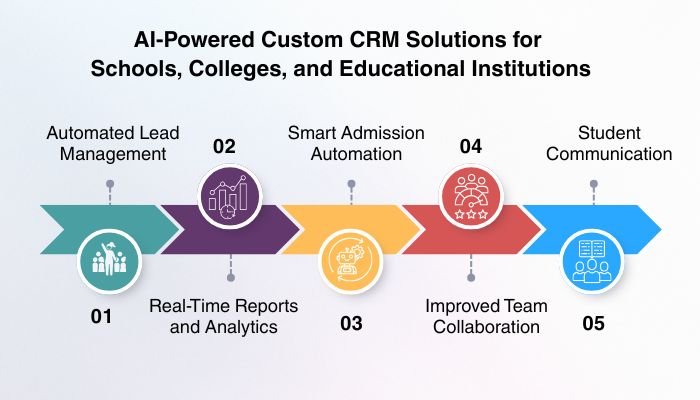
AI-Powered Custom CRM Solutions for Schools, Colleges, and Educational Institutions

Educational institutions are managing far more than student admissions today. Schools, colleges, universities, coaching institutes, and education consultancies now deal with complex communication channels, inquiry management, fee tracking, lead nurturing, academic workflows, and parent engagement systems. Traditional spreadsheets and disconnected software no longer support the operational scale modern institutions require.

Custom CRM is Essential

This is where AI-powered Custom CRM Solutions are becoming increasingly important for the education sector. Instead of using rigid software with limited flexibility, institutions are moving toward tailored CRM platforms that align with their admission process, student lifecycle, departmental workflows, and communication requirements.

Why Educational Institutions Need Custom CRM Solutions

Educational organizations operate differently from retail businesses or standard sales companies. Their workflow includes inquiry management, counseling sessions, application tracking, document verification, enrollment processing, student communication, and long-term engagement.

Generic CRM Systems Often Fail

Generic CRM systems often fail to accommodate these unique processes. A custom CRM allows institutions to build workflows around their actual operational structure rather than adapting their business process to software limitations.

For example, a university may require multi-department admission workflows, while a coaching institute may focus heavily on lead nurturing through WhatsApp and email campaigns. Similarly, study abroad consultancies may need document management, visa tracking, and counselor performance analytics within a single dashboard.

It Support Educational Operations

Custom CRM solutions make these workflows possible through personalized modules, automation rules, role-based access, and AI-driven reporting systems.

According to recent education technology market reports, institutions implementing CRM-based student engagement systems often report improved lead response times and higher enrollment conversion rates. Faster response management has become especially important as students increasingly expect instant communication across digital channels.

How AI Is Transforming CRM Software Solutions for Education

AI is changing how educational institutions manage communication, engagement, and operational efficiency. Modern crm software solutions are no longer limited to contact management. They now support predictive analytics, smart lead scoring, automated communication, and conversational assistance.

AI-powered CRM platforms can identify high-intent student inquiries, automate repetitive admission tasks, and personalize communication based on user behavior. This significantly reduces administrative workload while improving student experience.

Educational institutions are also using AI to:

  • Predict admission conversion probability
  • Automate inquiry routing to counselors
  • Send intelligent follow-up reminders
  • Analyze student engagement trends
  • Generate performance reports automatically
  • Improve response time across channels

For institutions managing thousands of inquiries during admission seasons, AI-assisted CRM workflows help maintain operational consistency without increasing staffing costs unnecessarily.

Key Features to Include in a Custom Sales CRM

A modern custom CRM for educational institutions should go beyond simple contact storage. The platform must support the entire student lifecycle from inquiry to enrollment and ongoing engagement.

Inquiry and Lead Management

Educational institutions receive inquiries through websites, social media, paid advertisements, events, referral programs, and third-party platforms. A centralized lead management system improves sales accuracy by helping institutions track every inquiry source and manage responses efficiently.

An effective CRM should capture inquiry details automatically and assign leads based on course interest, location, or counselor availability.

AI-Based Lead Scoring

AI-driven lead scoring helps admission teams prioritize students who show higher intent to enroll. The system can analyze interaction behavior, email engagement, counseling attendance, and application activity to rank leads intelligently.

This improves counselor productivity and prevents valuable inquiries from being overlooked.

Student Communication Automation

Communication remains one of the biggest operational challenges for educational organizations. A custom CRM should support automated email campaigns, SMS notifications, WhatsApp integration, and follow-up reminders.

Automation ensures consistent communication while reducing manual coordination work.

Admission Workflow Management

Institutions often manage complex admission processes involving document verification, eligibility review, fee confirmation, and approval workflows.

A custom CRM can automate these processes while maintaining visibility for both management and admission teams.

Reports and Analytics Dashboard

Real-time analytics are essential for understanding inquiry trends, campaign performance, counselor productivity, and enrollment conversions.

Advanced dashboards help institutions make faster operational decisions while identifying bottlenecks in the admission funnel.

Multi-Branch and Multi-Department Access

Schools, colleges, and universities operating across multiple campuses require centralized data visibility with role-based permissions.

A scalable CRM should allow administrators, counselors, faculty, finance teams, and management to access relevant data securely.

How to Choose a Custom CRM Development Company in India

Choosing the right CRM software development company in India can directly impact long-term operational efficiency and scalability. Many organizations invest in CRM systems without evaluating industry experience, customization capability, or post-launch support.

Educational institutions should prioritize CRM partners that understand admission workflows, communication challenges, and student engagement requirements.

Evaluate Industry Experience

A development company with experience in education CRM systems will understand operational pain points more effectively. This reduces development delays and improves workflow planning.

Institutions should review case studies, platform demos, and implementation experience before finalizing a vendor.

Focus on Scalability

A CRM system should support future expansion. As institutions grow, they may need additional branches, integrations, automation modules, or analytics capabilities.

Scalable architecture prevents expensive redevelopment later.

Check AI and Automation Capabilities

Modern custom crm development India services increasingly include AI-based workflow automation, predictive analytics, and smart communication systems.

Institutions should ensure the CRM architecture supports future AI upgrades and third-party integrations.

Prioritize User Experience

Complex dashboards often reduce adoption among staff members. CRM systems should maintain a clean interface, mobile accessibility, and simplified navigation for different user roles.

Ease of use significantly impacts long-term operational success.

Best Custom CRM Solutions for Small Businesses

Small educational institutions and training centers often assume custom CRM platforms are expensive enterprise tools. However, affordable and modular CRM development options are now widely available in India.

Many small schools, coaching institutes, and education startups prefer lightweight custom CRM solutions that focus on lead management, communication automation, and admission tracking without unnecessary complexity.

The advantage of custom systems over generic SaaS platforms is flexibility. Institutions can start with core modules and expand functionality later based on operational growth.

Comparison Between Generic CRM and Custom CRM Solutions

Feature Generic CRM Software Custom CRM Solutions
Workflow Flexibility Limited Fully customizable
Education-Specific Features Usually unavailable Built for institution needs
Integration Options Restricted Flexible API integration
AI Automation Basic Advanced AI workflows
Scalability Platform dependent Highly scalable
User Roles Standard Customized access control
Reporting Generic reports Institution-specific analytics
Educational institutions looking for long-term operational efficiency often prefer tailored CRM systems despite slightly higher initial development investment.

Consultants Specializing in Tailored CRM Strategy

Beyond software development, CRM implementation strategy also plays a major role in project success. Many institutions require consultation support to define workflows, automate operations, and optimize student engagement processes.

CRM consultants specializing in education technology help organizations:

  • Map inquiry-to-enrollment workflows
  • Identify automation opportunities
  • Improve counselor productivity
  • Reduce response delays
  • Structure admission pipelines
  • Build communication strategies
  • Improve reporting visibility

Strategic planning ensures the CRM system aligns with operational goals rather than becoming another disconnected software platform.

Affordable Custom CRM Software Providers in India

India has emerged as a strong destination for affordable custom CRM development due to its large technology talent pool and cost-effective software ecosystem.

Educational institutions increasingly prefer Indian CRM development companies because they offer:

  • Competitive development pricing
  • Flexible customization
  • Dedicated support teams
  • AI integration capabilities
  • Faster development cycles
  • Ongoing maintenance services

At the same time, affordability should not compromise scalability, security, or user experience. Institutions should evaluate long-term technical support and upgrade flexibility before choosing a CRM partner.

Organizations searching for scalable CRM implementation can also explore tailored education-focused platforms through Sensation CRM custom CRM solutions for workflow-specific development and automation support.

Custom CRM Development India Trends in 2026

The CRM development landscape in India continues evolving rapidly with AI adoption, cloud infrastructure growth, and automation demand increasing across industries.

In the education sector, some major CRM trends include:

  • AI-powered admission assistance
  • WhatsApp-first communication systems
  • Predictive enrollment analytics
  • Integrated student lifecycle management
  • Cloud-native CRM architecture
  • Mobile-first dashboards
  • Automated document workflows
  • Voice-enabled communication systems

As competition among educational institutions increases, CRM systems are becoming operational infrastructure rather than optional software tools.

Why Educational Institutions Are Moving Toward AI-Powered CRM Platforms

Institutions are no longer evaluating CRM systems only for contact management. They are investing in platforms that improve operational speed, student engagement quality, and internal coordination. AI-powered CRM solutions reduce repetitive work, improve communication consistency, and provide data-driven visibility across departments. This helps admission teams focus more on student counseling and relationship building rather than administrative tasks. Contact us today to learn how the right CRM solution can support your institution’s growth and efficiency.

Educational organizations also benefit from centralized reporting and automation, especially during peak admission periods when inquiry volumes rise significantly. For institutions managing multi-campus operations or large-scale admission workflows, custom CRM development provides long-term flexibility that generic platforms often cannot deliver.

Frequently Asked Questions

What is a custom CRM solution for educational institutions?

A custom CRM solution is a tailored software platform designed specifically for managing student inquiries, admissions, communication workflows, counseling processes, and institutional operations based on the unique needs of schools, colleges, and education businesses.

Custom CRM platforms offer workflow flexibility, education-specific automation, AI integration, and scalable architecture that generic CRM systems often lack. Institutions can personalize modules according to operational requirements.

The cost depends on project complexity, features, AI integration requirements, user roles, and scalability needs. Small educational institutions may start with modular systems, while universities often require enterprise-level platforms.

A school CRM should include inquiry management, communication automation, student data management, admission workflows, reporting dashboards, AI lead scoring, and multi-user access controls.


Yes. AI can automate repetitive tasks, improve lead prioritization, personalize communication, predict enrollment behavior, and generate real-time insights for educational institutions.

CRM development timelines vary depending on project scope and customization requirements. Basic systems may take a few weeks, while enterprise-level CRM platforms can require several months of development and testing.

Categories
CRM Automation

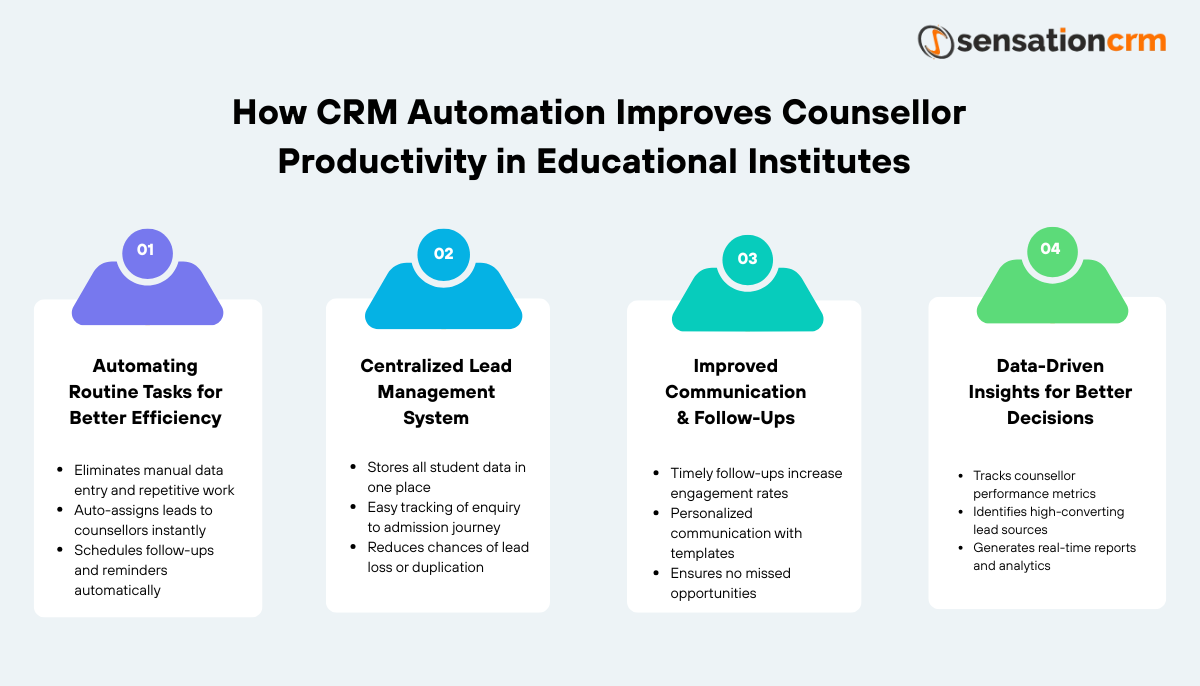
How CRM Automation Improves Counsellor Productivity in Educational Institutes

Admission season in educational institutes is honestly, quite hectic. Counsellors are handling hundreds (sometimes thousands) of inquiries, follow-ups, applications, and student queries all at the same time. 

And this is exactly where CRM Automation becomes not just useful, but necessary. 

With the help of tools like CRM WhatsApp automation, student management, admissions workflow automation, and automated status tracking, institutes can reduce manual work and help counsellors focus on what actually matters converting and guiding students.


What is CRM Automation in Education? 

CRM Automation refers to using technology to automate repetitive and time-consuming tasks involved in managing student leads and admissions. 

Instead of manually tracking everything, a CRM system handles: 

  • Lead capture 
  • Follow-ups 
  • Application tracking 
  • Communication 

As discussed in our blog, platforms like Sensation CRM are specifically designed for educational institutes, making it easier to manage the entire admission lifecycle in one place.


Why Counsellor Productivity is a Challenge? 

Before understanding automation, it’s important to see where time actually goes. 

Counsellors usually spend a lot of time on: 

  • Repetitive follow-ups 
  • Managing data across Excel, WhatsApp, and emails 
  • Tracking application status manually 
  • Responding to common queries 

The result? 

  • Delayed responses 
  • Missed follow-ups 
  • Lead leakage 
  • Burnout among counsellors 

Automation helps fix these problems at the root level. 

CRM WhatsApp Automation for Faster Communication 

Students today prefer quick responses and mostly on WhatsApp. 

With CRM WhatsApp automation, institutes can: 

  • Send instant replies to inquiries 
  • Automate follow-up messages 
  • Share course details and updates 
  • Send reminders for deadlines 


How it improves productivity? 

  • Counsellors don’t have to reply manually every time 
  • Faster response = higher chances of conversion 
  • Consistent communication across all leads 

Instead of typing the same answers again and again, counsellors can focus on meaningful conversations. 

Admissions Workflow Automation 

Admissions involve multiple steps, and managing them manually can get messy. 

Admissions workflow automation helps streamline the entire process. 

What gets automated? 

  • Lead assignment to counsellors 
  • Follow-up scheduling 
  • Application movement through stages 
  • Notification triggers 


Example Workflow: 

Stage 

Action 

Inquiry 

Auto-assign to counsellor 

Follow-up 

Automated reminders 

Application 

Status update 

Enrollment 

Final confirmation 


Benefits: 

  • Clear process flow 
  • No confusion or overlap 
  • Faster progression of leads 
 
Application Automation Simplifies the Process 

Handling applications manually is time-consuming and error-prone. 

With application automation, institutes can: 

  • Collect applications digitally 
  • Auto-fill data from lead profiles 
  • Track document submissions 
  • Send alerts for incomplete applications 


Key advantages: 

  • Reduced paperwork 
  • Faster processing 
  • Fewer errors 

This allows counsellors to handle more applications without increasing workload. 

Automated Status Tracking for Better Visibility 

One of the biggest challenges is knowing where each lead stands. 

With automated status tracking, every lead is updated in real-time. 

What it tracks: 

  • Inquiry stage 
  • Application progress 
  • Payment status 
  • Enrollment confirmation 


Why it matters 

  • Counsellors don’t need to check manually 
  • Managers get full visibility 
  • No lead is forgotten 

It creates a “single source of truth” for the entire team. 

Role of Automation Tools in Daily Operations 

Modern automation tools are not just about saving time they improve overall efficiency. 

Key areas where automation tools help: 

  • Communication (emails, WhatsApp, SMS) 
  • Task management 
  • Reporting and analytics 
  • Lead tracking 

This reduces dependency on manual processes and improves team coordination. 

How CRM Automation Directly Improves Counsellor Productivity? 

When all these automation features work together, the impact is very clear. 

Productivity Improvements: 

  • Less manual work: Repetitive tasks are automated 
  • Faster responses: Leads are handled instantly 
  • Better focus: Counsellors spend more time on conversions 
  • Higher efficiency: More leads managed in less time
     

Before vs. After Automation: 

Task 

Before CRM 

After CRM Automation 

Follow-ups 

Manual 

Automated 

Lead tracking 

Excel sheets 

Real-time dashboard 

Communication 

Scattered 

Centralized 

Productivity 

Low 

High 

Why Institutes Are Adopting CRM Automation? 

Educational institutes are moving toward automation because: 

  • Admissions are becoming more competitive 
  • Lead volumes are increasing 
  • Students expect quick responses 


Using solutions like Sensation CRM, institutes can: 

  • Manage leads efficiently
  • Improve counsellor performance
  • Increase conversion rates

Best Practices to Maximize CRM Automation

To get the best results, automation needs to be used correctly. 

Recommended practices: 

  • Set clear workflows 
  • Train counsellors properly 
  • Keep data updated 
  • Monitor performance regularly 
  • Use automation smartly (not blindly) 

Automation works best when combined with human judgment. 

Final Thoughts 

CRM Automation is not just about saving time it’s about working smarter. 

By using tools like: 

  • CRM WhatsApp automation 
  • Admissions workflow automation 
  • Application automation 
  • Automated status tracking 

Institutes can significantly improve counsellor productivity and overall admission performance. 

Platforms like Sensation CRM make it easier to implement these systems without complexity. When counsellors spend less time managing data and more time engaging with students, conversions naturally improve. 

Frequently Asked Questions

What is CRM automation in education?

CRM automation helps automate tasks like lead management, follow-ups, and application tracking in educational institutes. 

It automates communication, reduces manual replies, and ensures faster responses to student inquiries. 

It is the automation of the entire admission process, from lead capture to enrollment. 

It updates the status of each lead in real-time, giving full visibility to counsellors and management. 

Yes, faster responses and better follow-ups significantly improve conversion rates. 

To reduce manual work, improve efficiency, and manage large volumes of leads effectively. 

Categories
Education Consultancy

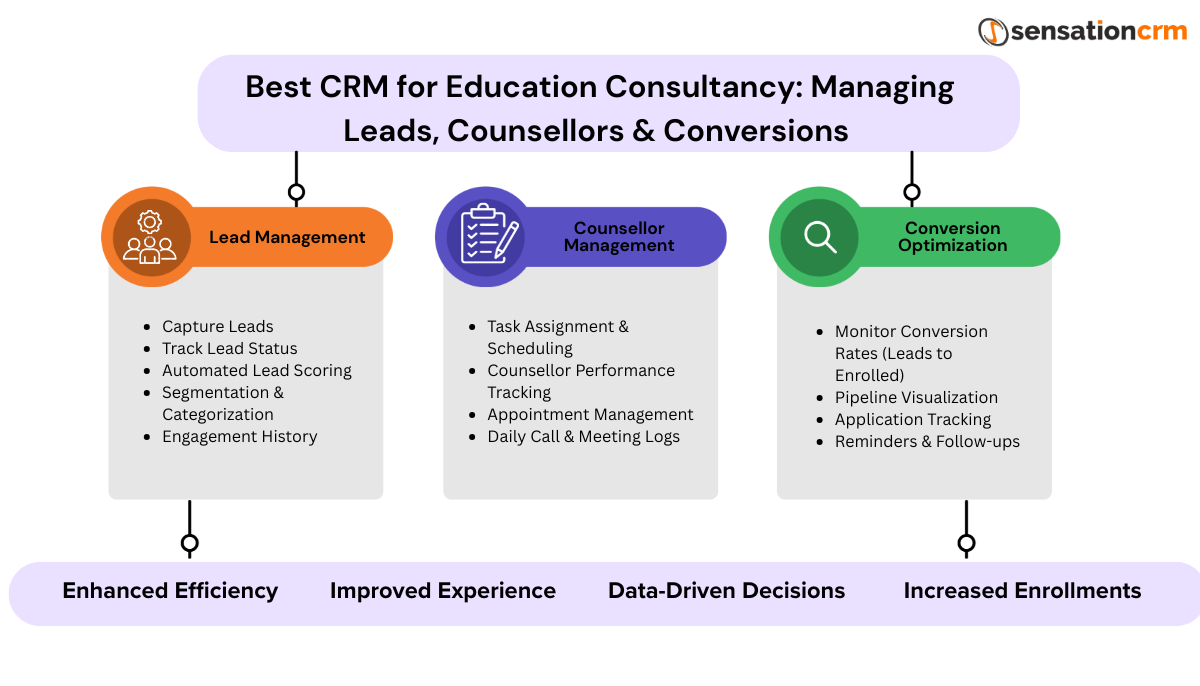
Best CRM for Education Consultancy: Managing Leads, Counsellors & Conversions 

In today’s admission-driven ecosystem, education consultancies are not struggling to get leadsthey are struggling to manage them properly. 

Leads come from: 

  • Website forms 
  • WhatsApp 
  • Calls
  • Social media 
  • Walk-ins 

And without a structured system, things quickly become messymissed follow-ups, confused counsellors, and lost admissions. 

That’s exactly where an Education CRM becomes essential. 

And if you’re looking for a solution built specifically for this space, Sensation CRM stands out as one of the most practical and conversion-focused tools available. 

Shape 

Why Education Consultancies Need a CRM (Not Optional Anymore) 

Let’s be real. 

Most consultancies still use: 

  • Excel sheets 
  • WhatsApp chats 
  • Manual tracking 

This leads to: 

  • Scattered data 
  • Delayed responses 
  • Zero visibility into lead status 

According to industry insights, managing inquiries across multiple channels without a system leads to missed follow-ups and poor conversion rates  

And in admission season, even a small delay can cost you a student. 

Shape 

What Makes an Education CRM Different? 

A normal CRM is built for sales pipelines. 

But CRM in higher education works differently. 

  • Longer decision cycles 
  • Multiple stakeholders (student + parents) 
  • Complex admission stages 

Education CRM systems are designed around the complete student lifecycle from inquiry to enrollmentThis is where Sensation CRM is specifically built to perform. 

Shape 

Why Sensation CRM is the Best CRM for Education Consultancy 

1. Centralized Lead Management (No More Lost Leads) 

With Sensation CRM: 

  • Leads from website, calls, WhatsApp, and forms are captured automatically 
  • Everything is stored in one dashboard 

No duplication, no missing data 

This creates a true lead management CRM system where every inquiry is tracked properly. 

Shape 

2. Smart Lead Distribution to Counsellors 

One of the biggest problems in consultancies:

Some counsellors get overloaded, others idle 

Sensation CRM solves this by: 

  • Auto-assigning leads 
  • Balancing workload 
  • Tracking ownership 

This improves accountability and ensures faster response time. 

Shape 

3. Complete Student Profile & Timeline 

Each lead has: 

  • Call logs
  • WhatsApp chats 
  • Email history 
  • Notes and documents 

Everything is visible in one place. 

This helps counsellors have better, more personalized conversations. 

Shape 

4. Automation That Actually Works 

Manual follow-ups are unreliable. 

With Sensation CRM: 

  • Auto WhatsApp replies
  • Email drip campaigns 
  • Call reminders 
  • Follow-up scheduling 

Automation ensures: 

  • Faster responses 
  • Consistent communication 
  • Higher conversions 

In fact, automation removes dependency on memorywhich is a major cause of lead loss. 

Shape 

5. Full Admission Funnel Tracking 

You can track every stage: 

Stage 

Meaning 

New Lead 

Fresh inquiry 

Contacted 

First interaction 

Interested 

Considering options 

Applied 

Application submitted 

Enrolled 

Final conversion 

This structured funnel removes guesswork and improves decision-making. 

Shape 

6. Real-Time Dashboard & Analytics 

Sensation CRM provides: 

  • Lead source tracking 
  • Conversion rates 
  • Counsellor performance 
  • ROI insights 

This helps consultancies: 
Identify what’s working 
Fix what’s not 

And make data-driven decisions, not assumptions. 

Shape 

7. Built for Education (Not Generic Sales) 

Unlike generic CRMs: 

  • It supports admission workflows 
  • Handles parent-student communication 

Tracks counsellor performance 

This reduces the need for heavy customization and improves adoption rates 

Shape 

8. Scalable for Growth 

As your consultancy grows: 

  • More leads 
  • More counsellors 
  • More programs 

Sensation CRM scales without complexity and keeps everything structured  

Shape 

Key Benefits of Using Sensation CRM 

For Education Consultancies: 

  • No lead leakage 
  • Faster response time 
  • Better team coordination 
  • Higher conversion rates 

Shape 

For Counsellors: 

  • Clear lead ownership 
  • Easy follow-up tracking 
  • Less manual work 

Shape 

For Management: 

  • Full visibility
  • Data-driven decisions 
  • Better ROI tracking 

Shape 

Before vs. After Using Sensation CRM 

Without CRM 

With Sensation CRM 

Excel + WhatsApp chaos 

Centralized system 

Missed follow-ups 

Automated tracking 

No visibility 

Real-time dashboards 

Low conversions 

Higher conversions 

Shape 

Why it’s perfect for Education Consultancies 

Education consultancies deal with: 

  • High lead volume 
  • Multi-channel communication 
  • Long decision cycles 

Sensation CRM is designed exactly for this. 

It: 

  • Captures every lead 
  • Tracks every interaction 
  • Converts more students 

That’s what actually matters. 


ShapeChoosing the Right Education CRM 

Choosing the right Education CRM is not just about managing leadsit about improving your entire admission process. Most consultancies lose students not because of lack of leads… but because of poor management. Contact us today to streamline your admission process and start converting more leads into students.

Sensation CRM solves this by bringing: 

  • Structure 
  • Automation 
  • Visibility 

Key Note:  

If you want to scale your education consultancy, you don’t just need more leads-you need a system that converts them.
 

Frequently Asked Question’s

What is an Education CRM?

An Education CRM is a system designed to manage student inquiries, track admissions, and improve conversions across the entire student journey. 

It captures leads from multiple sources, tracks them in one system, and ensures timely follow-ups through automation. 

Yes, it offers scalable plans, making it suitable for both small and large education businesses. 

By assigning leads, tracking follow-ups, and monitoring response time, it increases accountability. 

Yes, it integrates communication channels and stores all interactions in one place. 

It is built specifically for education workflows, unlike generic CRMs that require heavy customization. 

Yes, through automation, faster response time, and structured tracking, it significantly improves conversions. 

Categories
Education CRM

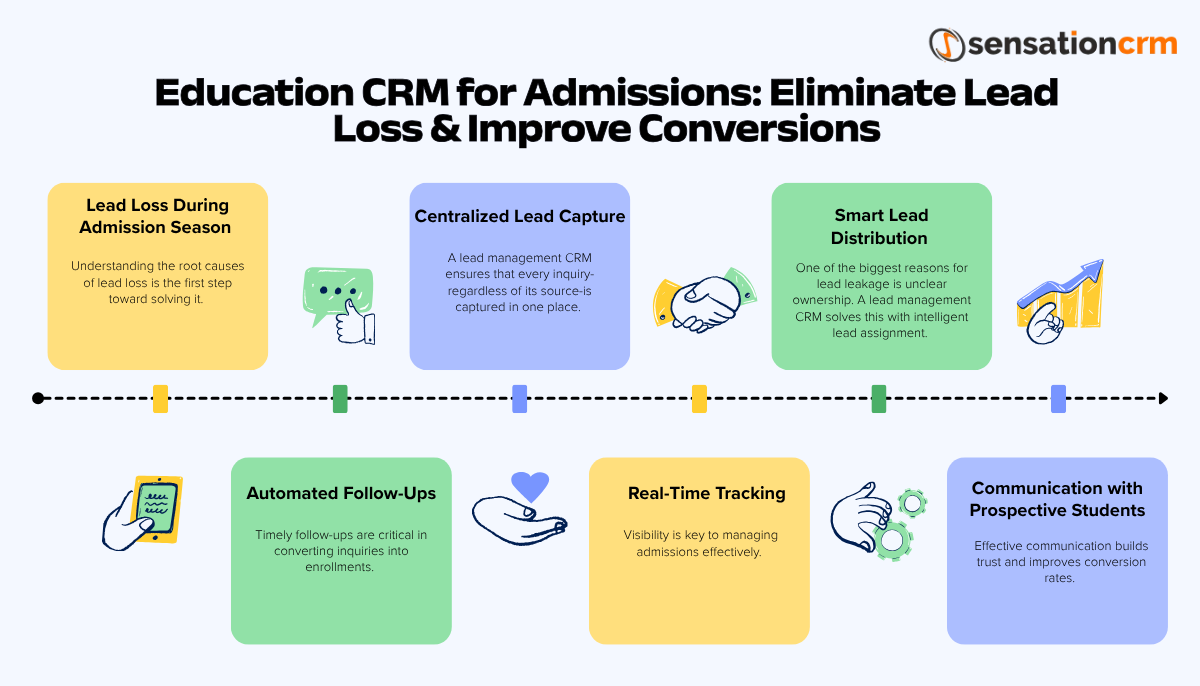
Education CRM for Admissions: Eliminate Lead Loss & Improve Conversions

Admission season is one of the most critical-and chaotic-periods for educational institutions. Thousands of inquiries come in from multiple channels within a short span of time. Admission teams are under pressure to respond quickly, track every interaction, and convert interested students into enrolled candidates. 

However, this surge often exposes operational gaps: 

  • Missed follow-ups 

  • Scattered student data across platforms 

  • Delayed responses 

  • Lack of coordination between counsellors 

These issues directly lead to lead loss, which means potential students slipping through the cracks. 

This is where an Education CRM becomes essential. A well-implemented CRM in higher education centralizes processes, automates communication, and ensures no lead is ignored-helping institutions manage high volumes efficiently and convert more inquiries into admissions.

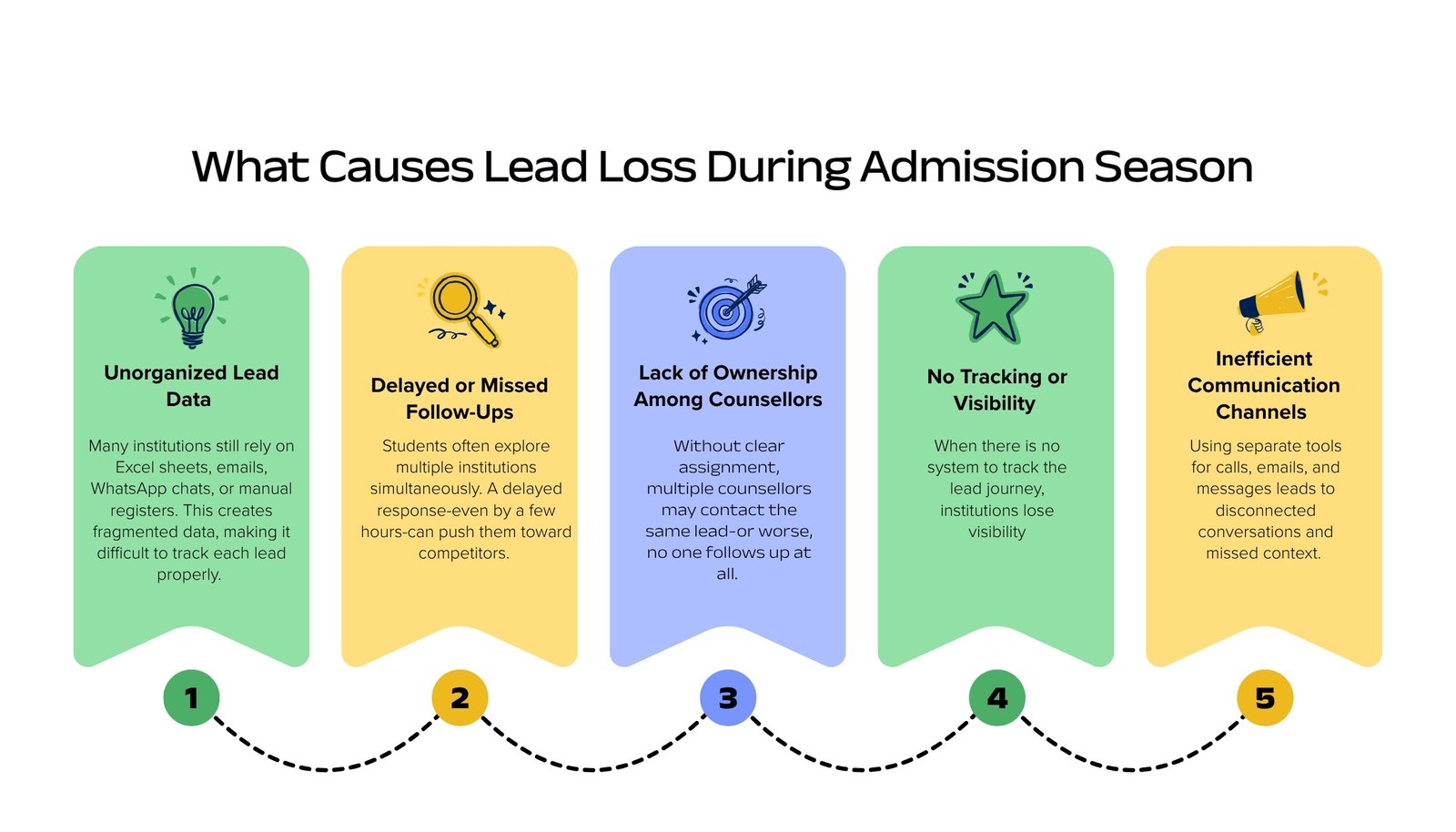
What Causes Lead Loss During Admission Season

Lead Loss During Admission Season

Understanding the root causes of lead loss is the first step toward solving it. 

Unorganized Lead Data 

Many institutions still rely on Excel sheets, emails, WhatsApp chats, or manual registers. This creates fragmented data, making it difficult to track each lead properly. 

Delayed or Missed Follow-Ups 

Students often explore multiple institutions simultaneously. A delayed response-even by a few hours-can push them toward competitors. 

Lack of Ownership Among Counsellors 

Without clear assignment, multiple counsellors may contact the same lead-or worse, no one follows up at all. 

No Tracking or Visibility 

When there is no system to track the lead journey, institutions lose visibility into: 

  • Which stage the student is in 

  • What actions have been taken 

  • What needs to happen next 

Inefficient Communication Channels 

Using separate tools for calls, emails, and messages leads to disconnected conversations and missed context. 

All these challenges create friction in the admission process, resulting in lost opportunities. 

What is an Education CRM?

An Education CRM is a specialized software designed to manage the entire student lifecycle-from initial inquiry to enrollment and beyond. 

Unlike generic CRM tools, an Education CRM is tailored specifically for academic institutions, and an Education CRM App further enhances accessibility by allowing teams to manage admissions on the go. It understands the admission funnel and includes features such as:

  • Lead capture and tracking 

  • Admission workflow management 

  • Counsellor assignment 

  • Communication automation 

  • Reporting and analytics 

In the context of CRM in higher education, it acts as a centralized system that brings together marketing, admissions, and communication processes into one platform. 

The key advantage is automation combined with centralization, ensuring efficiency and accuracy during high-pressure admission cycles. 

Centralized Lead Capture with Lead Management CRM

A lead management CRM ensures that every inquiry-regardless of its source-is captured in one place. 

Lead Sources Integrated: 

  • Website forms 

  • Phone calls 

  • Social media platforms 

  • Email inquiries 

  • Walk-ins 

Instead of scattered data, all leads flow into a single dashboard, creating a single source of truth

Key Benefits: 

  • No duplication of leads 

  • No missing data 

  • Easy access for the entire team 

  • Better tracking from day one 

With centralized lead capture, institutions eliminate the risk of losing leads due to manual errors or system gaps. 

Smart Lead Distribution and Ownership

One of the biggest reasons for lead leakage is unclear ownership. A lead management CRM solves this with intelligent lead assignment. 

How It Works: 

  • Leads are automatically assigned to counsellors 

  • Distribution can be based on rules (location, course, workload) 

  • Role-based access ensures accountability 

Impact: 

  • Faster response times 

  • Clear responsibility for each lead 

  • No overlap or confusion 

When every lead has a defined owner, follow-ups become consistent, and the chances of conversion increase significantly. 

Automated Follow-Ups and Reminders

Timely follow-ups are critical in converting inquiries into enrollments. 

An Education CRM automates this process through: 

Automation Features: 

  • Scheduled email campaigns 

  • SMS reminders 

  • Call follow-up alerts 

  • Task notifications for counsellors 

Why It Matters: 

  • Ensures no lead is forgotten 

  • Maintains consistent communication 

  • Keeps prospects engaged throughout the decision-making process 

Automation reduces dependency on manual effort and ensures every lead is nurtured at the right time. 

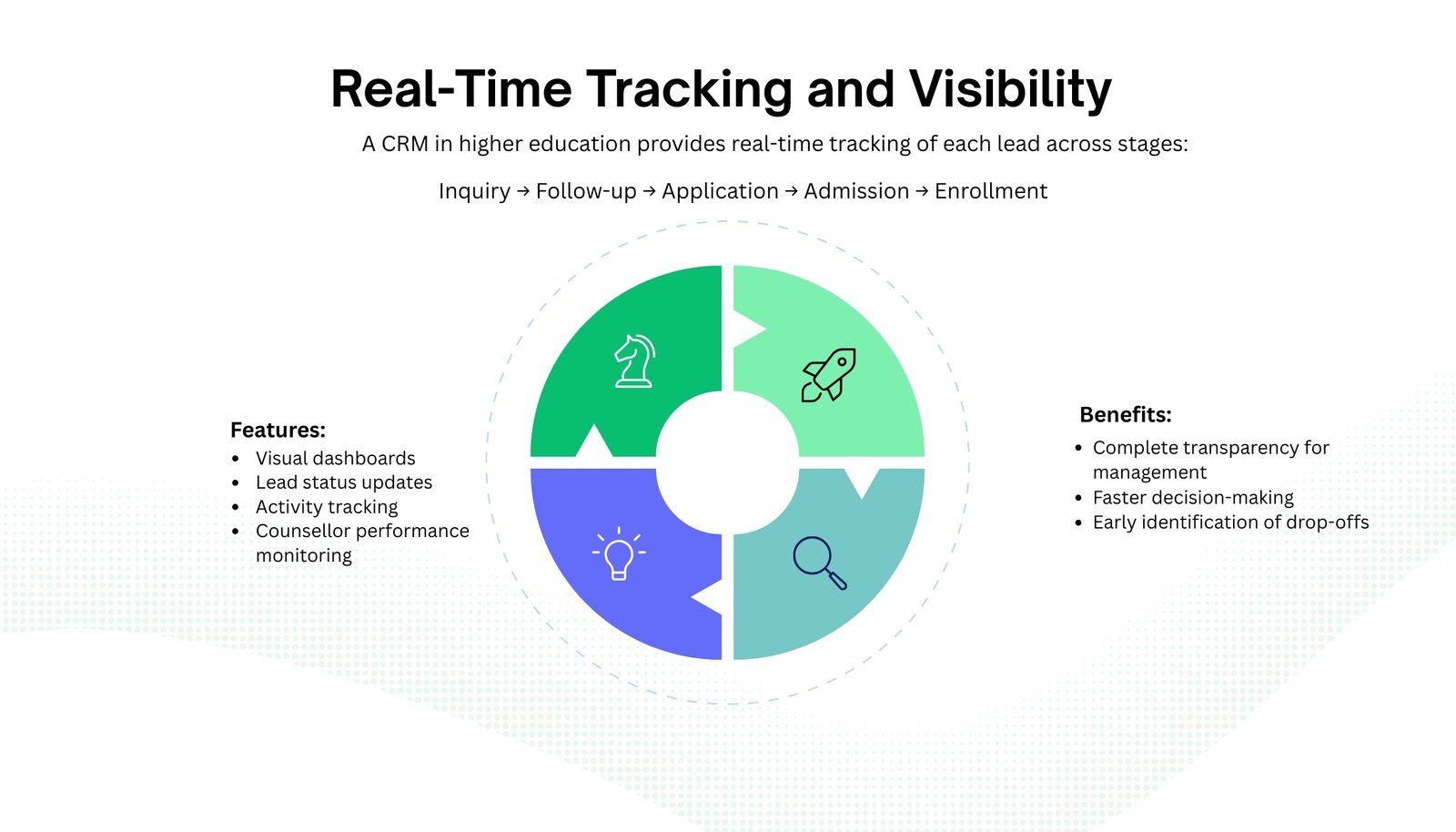
Real-Time Tracking and Visibility

Real-Time Tracking and Visibility

Visibility is key to managing admissions effectively. 

A CRM in higher education provides real-time tracking of each lead across stages: 

Inquiry → Follow-up → Application → Admission → Enrollment 

Features: 

  • Visual dashboards 

  • Lead status updates 

  • Activity tracking 

  • Counsellor performance monitoring 

Benefits: 

  • Complete transparency for management 

  • Faster decision-making 

  • Early identification of drop-offs 

Institutions can instantly see where leads are getting stuck and take corrective actions. 

Improved Communication with Prospective Students

Effective communication builds trust and improves conversion rates. 

An Education CRM centralizes all communication channels: 

Unified Communication Includes: 

  • Call logs 

  • Email history 

  • WhatsApp messages 

  • Notes from counsellors 

Advantages: 

  • Personalized interactions 

  • Context-aware conversations 

  • Consistent messaging across channels 

Students receive timely, relevant information, which enhances their experience and increases the likelihood of enrollment. 

Data-Driven Insights to Reduce Lead Loss

Data is one of the most powerful tools in preventing lead loss. 

A lead management CRM provides actionable insights through detailed reports: 

Key Reports: 

  • Lead source performance 

  • Conversion rates 

  • Campaign effectiveness 

  • Counsellor productivity 

How It Helps: 

  • Identify which channels bring high-quality leads 

  • Detect bottlenecks in the admission funnel 

  • Optimize strategies in real time 

Instead of guessing, institutions can make informed decisions based on actual data. 

Benefits of Using CRM in Higher Education

Implementing a CRM in higher education delivers measurable improvements: 

Reduced Lead Leakage 

Centralized tracking ensures no inquiry is missed. 

Faster Response Time 

Automation and smart assignment enable quick responses. 

Higher Conversion Rates 

Consistent follow-ups and personalized communication improve outcomes. 

Better Team Coordination 

All departments work on the same system with shared visibility. 

Scalable Admission Process 

Institutions can handle increased lead volume without operational breakdown. 

Overall, a CRM transforms admission management from reactive to proactive. 

Best Practices to Maximize CRM Effectiveness

Simply implementing an Education CRM is not enough. To get maximum value, institutions must follow best practices: 

Train Your Admission Team 

Ensure counsellors understand how to use the CRM effectively. 

Set Clear Workflows 

Define processes for lead handling, follow-ups, and status updates. 

Monitor Dashboards Regularly 

Track performance metrics and take action when needed. 

Use Automation Smartly 

Automate repetitive tasks but maintain a human touch in communication. 

Keep Data Updated 

Accurate and updated data ensures reliable insights and smooth operations. 

When used correctly, a CRM becomes a powerful growth tool rather than just a management system. 

Admission Season is more Chaotic

Admission season doesn’t have to be chaotic or inefficient. Most lead loss happens due to poor systems, lack of visibility, and delayed communication-not because of a lack of interest from students. 

An Education CRM like Sensation CRM addresses these challenges by centralizing data, automating follow-ups, and providing real-time insights. It ensures every lead is tracked, nurtured, and converted systematically.

In today’s competitive environment, adopting a lead management CRM is no longer optional-it’s essential for institutions aiming to scale and improve conversion rates. 

The key takeaway:

Institutions that implement a strong CRM in higher education don’t just manage leads, they build structured, efficient systems that consistently convert them into enrollments. For more information, contact us to explore how the right solution can transform your admissions process.

FAQs

How does CRM improve admissions?

An Education CRM is a specialized system designed to manage student inquiries, track interactions, and streamline the admission process. During admission season, it helps institutions handle high volumes of leads efficiently, ensuring no inquiry is missed or delayed. 

A lead management CRM prevents lead loss by: 

  • Capturing all leads in one system 

  • Assigning them to the right counsellors 

  • Automating follow-ups 

  • Tracking every interaction 

This ensures that every lead is consistently nurtured until conversion. 

A CRM in higher education is tailored specifically for admission workflows. Unlike generic CRMs, it includes: 

  • Student lifecycle tracking 

  • Course/program-based segmentation 

  • Admission funnel management 

  • Education-specific automation 

This makes it more effective for managing student inquiries and enrollments. 

Yes, an Education CRM can integrate with various lead sources such as: 

  • Website forms 

  • Social media platforms 

  • Phone calls 

  • Email campaigns 

  • Walk-ins 

This ensures all leads are captured in a single system without duplication. 

Absolutely. A lead management CRM enables: 

  • Instant lead assignment 

  • Automated responses 

  • Real-time notifications 

This significantly reduces response time, which is critical for improving conversion rates. 

Categories
Education CRM

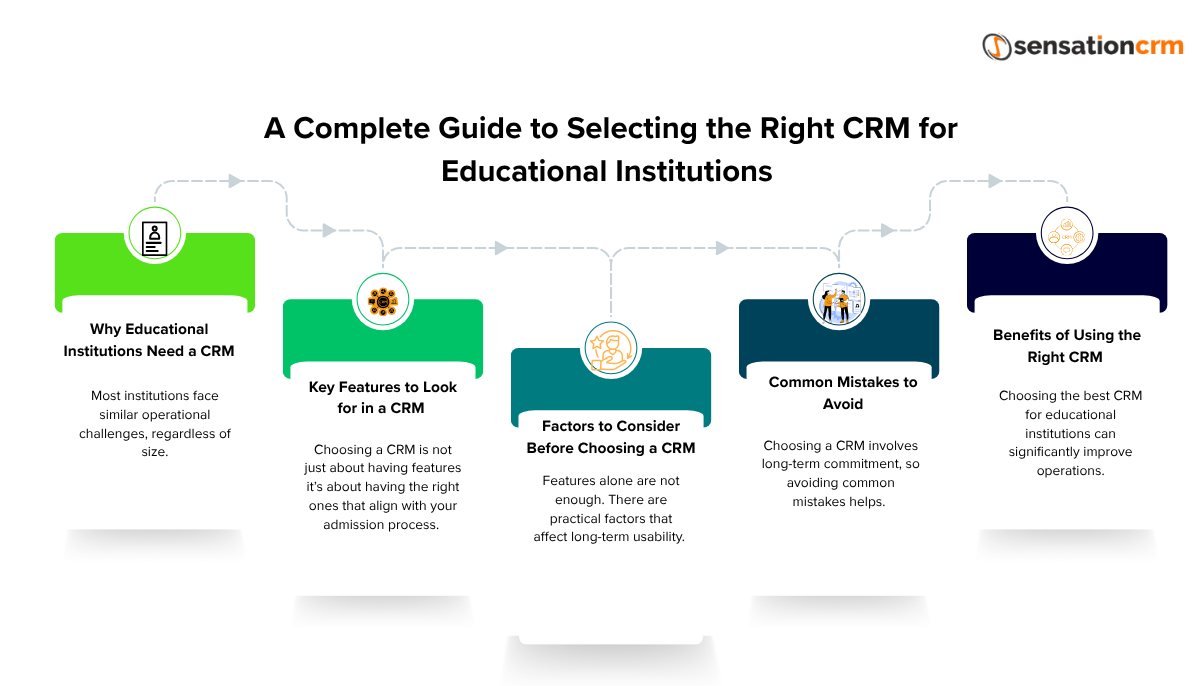
A Complete Guide to Selecting the Right CRM for Educational Institutions

Educational institutions today are handling more inquiries than ever before. Students reach out through websites, WhatsApp, calls, social media, and email, often across multiple touchpoints before making a decision.  Managing this volume manually is difficult. Leads get missed, follow-ups are delayed, and communication becomes inconsistent. In many cases, institutions don’t even have a clear view of how many inquiries actually convert into admissions.

This is where a CRM for educational institutions becomes important. A well-implemented CRM helps centralize data, track every interaction, and streamline the admission process. It doesn’t solve everything instantly, but it brings structure, and that alone improves outcomes over time.

Why Educational Institutions Need a CRM

Most institutions face similar operational challenges, regardless of size. 

Managing High Volumes of Inquiries
Admission teams often deal with hundreds or thousands of inquiries during peak seasons. Without a system, tracking each lead becomes inconsistent. 

A CRM helps store and organize all leads in one place, making it easier to manage volume without losing visibility. 

Streamlining Communication Across Teams
Admissions usually involve multiple people counselors, marketing teams, and administrators. 

Without a shared system: 

  • Communication gets fragmented 

  • Leads are duplicated 

  • Follow-ups overlap or get missed 

A CRM for colleges or a CRM for private schools ensures everyone works on the same data, reducing confusion. 

Improving Conversion Rates
Response time plays a big role in admissions. Studies across sales processes show that responding within the first 5–10 minutes can increase conversion chances significantly sometimes by 2–3x. 

A CRM helps by: 

  • Assigning leads instantly 

  • Triggering reminders 

  • Tracking follow-ups 

This improves consistency, even if teams are handling large volumes. 

Centralized Data Management
Instead of scattered spreadsheets or disconnected tools, a CRM provides a single source of truth. 

This includes: 

  • Student details 

  • Communication history 

  • Lead status 

  • Source of inquiry 

Having everything in one place makes reporting and decision-making more reliable. 

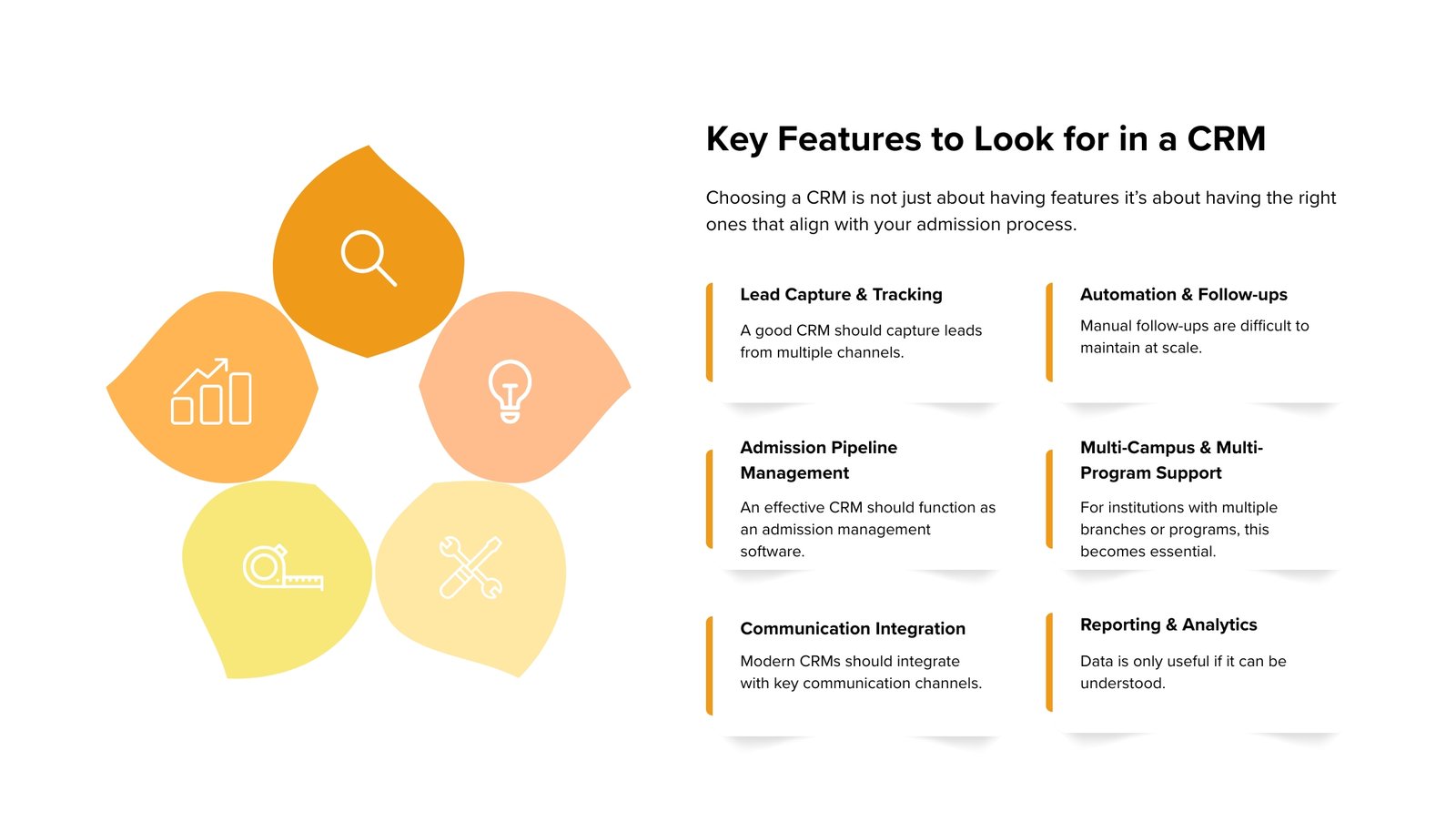
Key Features to Look for in a CRM

Key Features to Look for in a CRM

Choosing a CRM is not just about having features it’s about having the right ones that align with your admission process. 

 Lead Capture & Tracking 

A good CRM should capture leads from multiple channels: 

  • Website forms 

  • WhatsApp 

  • Calls 

  • Email campaigns 

All leads should be visible in a centralized dashboard. 

With strong CRM lead management, institutions can: 

  • Track lead sources 

  • Assign leads quickly 

  • Monitor status changes 

Without proper tracking, even a high number of inquiries doesn’t translate into admissions. 

 Automation & Follow-ups 

Manual follow-ups are difficult to maintain at scale. 

Automation helps by: 

  • Sending instant responses to new inquiries 

  • Scheduling reminders for counselors 

  • Triggering email or WhatsApp sequences 

This reduces manual effort and ensures no lead is forgotten, though some level of manual oversight is still needed. 

Admission Pipeline Management
An effective CRM should function as an admission management software. 

This means tracking the student journey across stages such as: 

  • Inquiry 

  • Contacted 

  • Interested 

  • Applied 

  • Enrolled 

This pipeline view helps teams understand where leads are dropping off and where improvements are needed. 

Multi-Campus & Multi-Program Support 

For institutions with multiple branches or programs, this becomes essential. 

The CRM should allow: 

  • Managing multiple campuses in one system 

  • Tracking leads by course or program 

  • Assigning counselors based on specialization 

Without this, scaling operations becomes complicated. 

Communication Integration 

Modern CRMs should integrate with key communication channels, including: 

  • WhatsApp 

  • Email systems 

  • Telephony or call tracking tools 

This ensures all interactions are recorded and accessible from one platform. 

Switching between tools slows things down, and sometimes leads to missed context. 

Reporting & Analytics 

Data is only useful if it can be understood. 

A CRM should provide: 

  • Performance dashboards 

  • Lead source analysis 

  • Conversion tracking 

  • Counselor performance metrics 

For example: 

  • Which channel brings the most leads? 

  • Which counselor converts the most students? 

Institutions using CRM analytics often report 10–20% improvement in process efficiency, though it depends on how actively the data is used. 

Factors to Consider Before Choosing a CRM

Features alone are not enough. There are practical factors that affect long-term usability. 

Ease of Use and Interface 

If the CRM is difficult to use, adoption becomes a problem. 

Teams may: 

  • Avoid using it fully 

  • Enter incomplete data 

  • Revert to manual methods 

A clean and simple interface improves usage, even if the system is not feature-heavy. 

 Customization Options 

Every institution has slightly different workflows. 

A CRM should allow: 

  • Custom lead stages 

  • Flexible workflows 

  • Configurable fields 

Too much rigidity can limit usefulness. 

 Scalability for Future Growth 

Institutions grow more students, more programs, more campuses. 

The CRM should be able to handle: 

  • Increased data volume 

  • Additional users 

  • Expanded workflows 

Switching systems later is possible, but not easy. 

 Integration Capabilities 

The CRM should work well with existing tools such as: 

  • Marketing platforms 

  • Payment systems 

  • Learning management systems 

Lack of integration often creates extra manual work. 

 Customer Support and Training 

Implementation doesn’t end after purchase. 

Good CRM providers offer: 

  • Onboarding support 

  • Training sessions 

  • Ongoing assistance 

Without proper support, teams may not use the system effectively. 

Common Mistakes to Avoid

Choosing a Education CRM App involves a long-term commitment, so avoiding common mistakes helps ensure better efficiency, scalability, and return on investment.

 Choosing Based Only on Price 

Lower-cost options may lack important features or scalability. 

Initial savings can lead to higher costs later due to inefficiencies. 

 Ignoring Scalability 

A system that works for 500 leads may not work for 5,000. 

Planning ahead avoids the need for migration later. 

Not Checking Integration Options 

If the CRM cannot integrate with your existing tools, manual work increases. 

This reduces overall efficiency. 

 Overlooking User Adoption and Training 

Even a good CRM fails if the team doesn’t use it properly. 

Training and ease of use matter more than expected. 

Benefits of Using the Right CRM

Benefits of Using the Right CRM

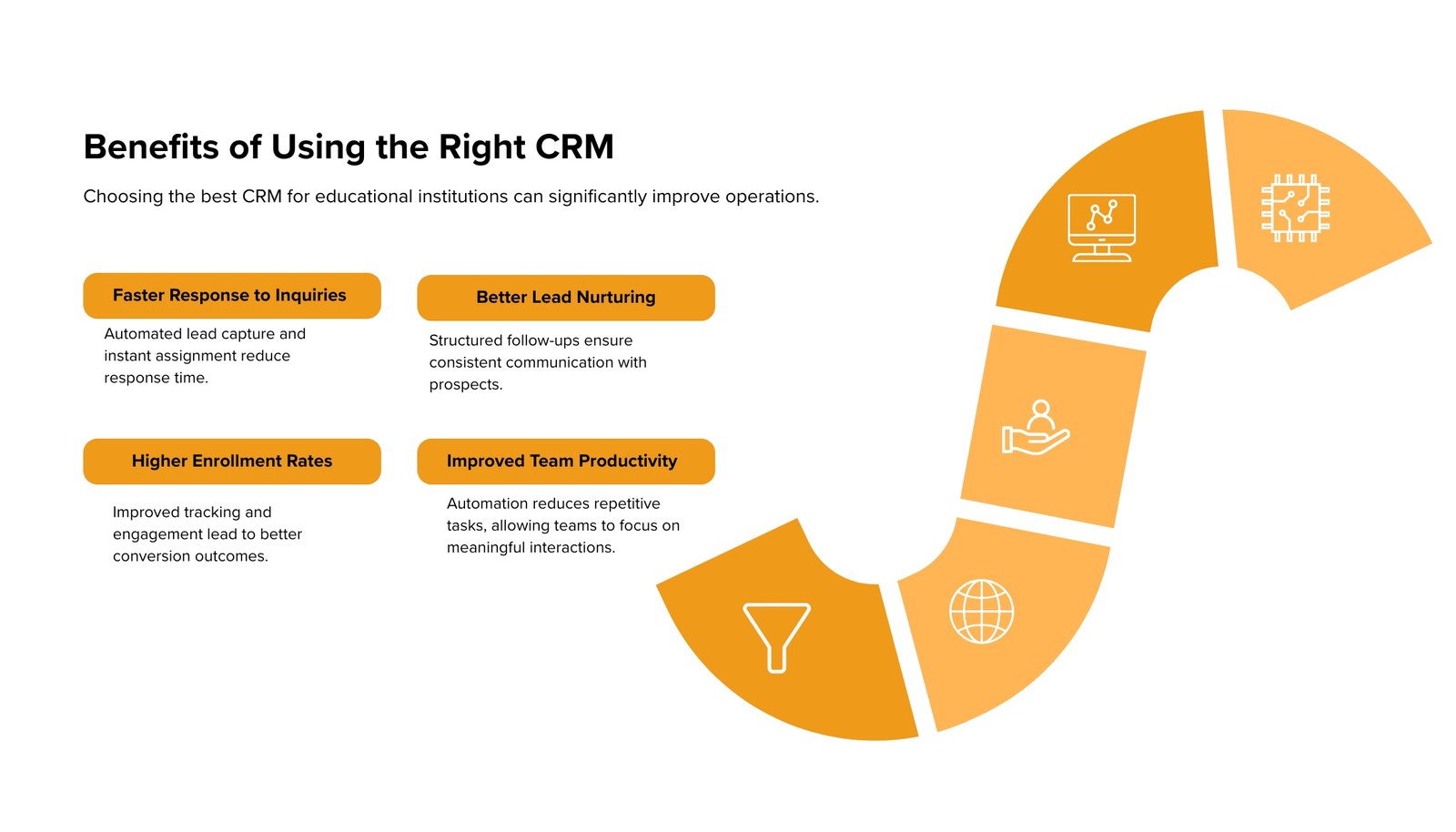
Choosing the best CRM for educational institutions can significantly improve operations. 

 Faster Response to Inquiries 

Automated lead capture and instant assignment reduce response time. 

 Better Lead Nurturing 

Structured follow-ups ensure consistent communication with prospects. 

 Higher Enrollment Rates 

Improved tracking and engagement lead to better conversion outcomes. 

Some institutions report 15–25% increase in enrollments after implementing CRM systems properly. 

 Improved Team Productivity 

Automation reduces repetitive tasks, allowing teams to focus on meaningful interactions. 

How CRM Improves Admission Process

A CRM brings structure to the entire admission workflow. 

 Organized Lead Funnel 

Leads are categorized clearly, making it easier to track progress. 

 Automated Follow-ups 

No need to rely on memory or manual tracking. 

 Better Counselor Performance Tracking 

Managers can monitor: 

  • Response times 

  • Conversion rates 

  • Engagement levels 

Data-Driven Decisions 

Instead of assumptions, decisions are based on actual data. 

This improves planning and resource allocation over time. 

Who Should Use a CRM

A CRM is useful across different types of educational institutions. 

Colleges and Universities 

Large volumes of inquiries and multiple departments make CRM essential. 

Coaching Institutes 

High competition and frequent intake cycles require efficient lead management. 

Private Schools 

Managing parent inquiries and follow-ups becomes easier with structured systems.
EdTech and Training Institutes 

Digital-first operations benefit from automation and centralized data. 

Final Checklist Before You Decide

Before selecting a CRM, it helps to evaluate a few key points: 

  • Does it support your admission workflow? 

  • Can it scale with your institution? 

  • Does it offer strong CRM lead management

  • Is it easy for your team to adopt? 

If the answer to most of these is yes, the system is likely a good fit. 

Choosing the right Education CRM

Choosing the right CRM for educational institutions like SensationCRM requires a balance between features, usability, and long-term scalability.

A well-chosen system helps: 

  • Organize lead management 

  • Improve communication 

  • Increase conversion rates 

  • Streamline the admission process 

It may take some time to evaluate options properly, but the impact is usually worth it. 

If you’re planning to improve your admission workflow, the next step would be to see how a CRM works in your context. 

Book a demo or get in touch to explore how a structured CRM system can support your institution’s growth. 

Frequently Asked Questions (FAQs) 

What is a CRM for educational institutions?

It is a software system designed to manage student inquiries, track leads, and streamline admissions processes.

It organizes leads, automates follow-ups, and provides insights that help improve conversion rates.

Yes, even smaller institutions benefit from better organization and faster response times.

Lead management, automation, communication integration, and reporting are key features.

Implementation can take a few days to a few weeks, depending on complexity and customization.

Categories
Lead management

Managing Admission Leads Across WhatsApp, Calls & Email Using an Education CRM 

Let’s be practical. 

Admission teams today are not struggling with generating inquiries.
They’re struggling with managing them. 

  • A WhatsApp message comes in.

  • A parent calls.

  • A student fills out a website form.

  • An email lands in the inbox. 

Now the real question: 

Is every inquiry getting a timely follow-up? 

Without a structured Admission lead management software, most institutions experience scattered communication, delayed responses, and missed opportunities. 

A modern system with WhatsApp CRM integration and a smart Lead tracking CRM for education brings everything into one centralized platform, making follow-ups faster, organized, and measurable. 

Let’s understand how. 


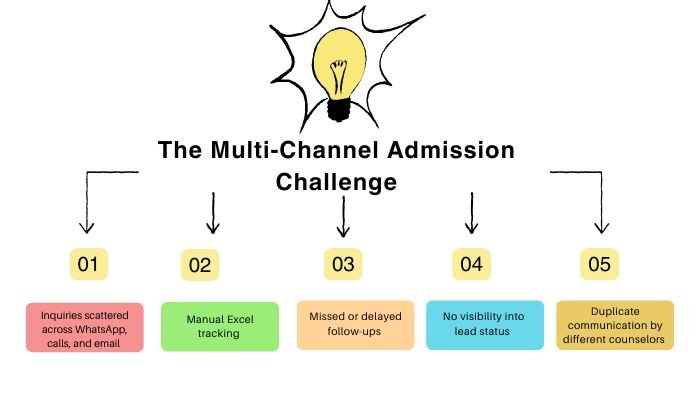
The Multi-Channel Admission Challenge

Multi-Channel Admission Challenge

Today’s students communicate across multiple channels. That’s convenient for them,  but chaotic for admission teams. 

Common Challenges Institutions Face:

  • Without centralization, admission management becomes reactive instead of structured. 

  • Inquiries scattered across WhatsApp, calls, and email 

  • Manual Excel tracking 

  • Missed or delayed follow-ups 

  • No visibility into lead status 

  • Duplicate communication by different counselors

Centralized Lead Capture from Every Channel

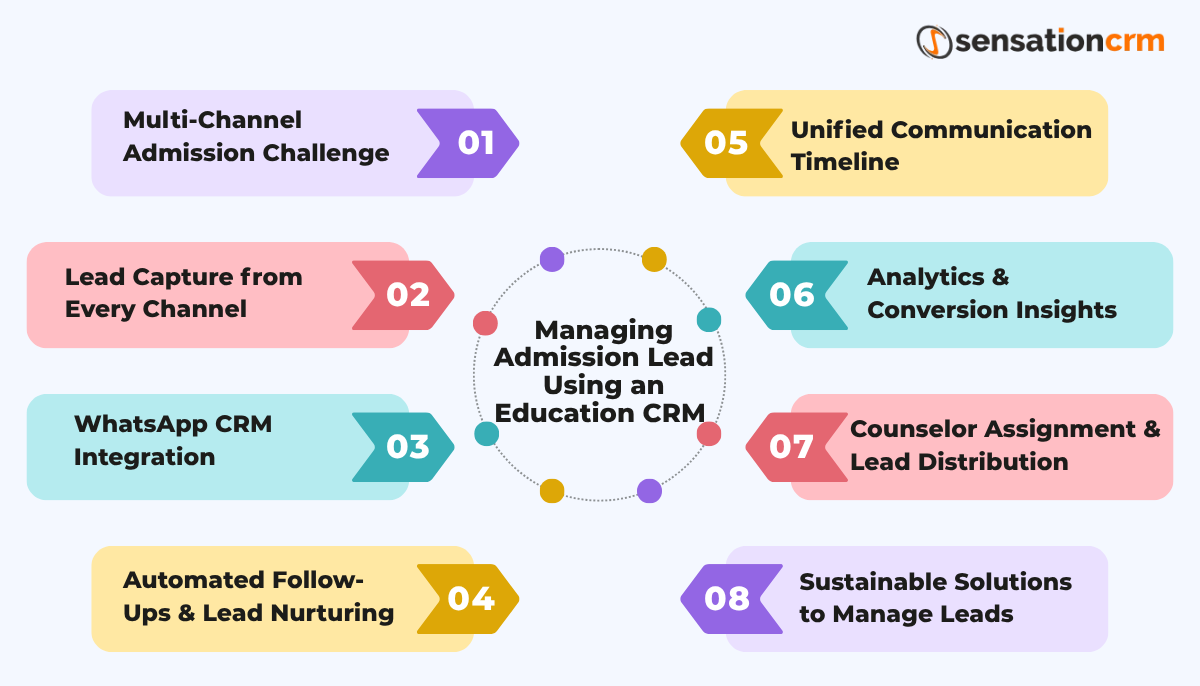
A smart Lead tracking CRM for education integrates every inquiry source into one system. 

What Gets Centralized? 

Channel What the CRM Does Benefit 
WhatsApp Captures chats automatically No lost conversations 
Phone Calls Logs inbound & outbound calls Complete call tracking 
Emails Stores email threads Organized communication 
Website Forms Auto-creates leads Instant lead capture 

 This ensures no inquiry is ignored. 

WhatsApp CRM Integration: Why It Matters

Students prefer messaging over calling. 

With WhatsApp CRM integration, institutions can: 

  • Capture WhatsApp inquiries automatically 

  • Store full chat history in CRM timeline 

  • Send quick replies using templates 

  • Enable auto-acknowledgment messages 

  • Track response time 

Instead of using personal devices, everything is managed professionally.  And that improves response consistency. 

Smart Lead Tracking CRM for Education

Once a lead enters the system, tracking begins. 

Admission Funnel Visibility 

Lead Stage What It Means Action Required 
New Fresh inquiry received Immediate response 
Contacted Counselor connected Qualification 
Interested Student exploring Follow-up & nurturing 
Applied Application submitted Admission processing 
Enrolled Fee paid & confirmed Conversion achieved 

This structured tracking eliminates guesswork. 

Management can instantly see: 

  • How many fresh leads today? 

  • Which stage has the highest drop-off? 

  • Which counselor is converting best? 

Automated Follow-Ups & Lead Nurturing

Manual follow-ups depend on memory. Automation removes that dependency. 

With modern Admission lead management software, you can: 

  • Send auto WhatsApp replies instantly 

  • Schedule call reminders for counselors 

  • Run drip email campaigns 

  • Share brochures automatically 

  • Personalize follow-ups based on course interest 

Automation ensures: 

  • Faster response 

  • Consistent messaging 

  • Reduced workload 

  • Higher engagement

  • Speed directly impacts conversion. 

Counselor Assignment & Lead Distribution 

Without structure, some counselors are overloaded while others remain underutilized, but an Education CRM App helps balance workloads by assigning and tracking leads more efficiently.

 An advanced CRM allows: 

  • Automatic lead assignment by course 

  • Location-based distribution 

  • Balanced workload sharing 

  • Performance tracking 

Management can monitor: 

  • Response time 

  • Follow-up frequency 

  • Conversion ratios

  • This increases accountability and improves team efficiency. 

Unified Communication Timeline

One of the most powerful features of a Lead tracking CRM for education is the unified timeline. 

Counselors can view: 

  • WhatsApp chats 

  • Call logs 

  • Email threads 

  • Follow-up notes 

  • All in one dashboard.  

Before calling a student, they know: 

  • What was discussed earlier 

  • Which course the student prefers 

  • What concerns were raised 

  • This leads to personalized conversations and better conversions.

Analytics & Conversion Insights

Beyond tracking, institutions need data-driven decisions. 

A structured CRM provides: 

  • Channel-wise performance comparison 

  • Response time analysis 

  • Conversion rate tracking 

  • Admission pipeline forecasting 

  • Instead of guessing which campaign works, you see actual numbers. 

 Before vs After Implementing an Education CRM 

Without CRM With Education CRM 
Scattered WhatsApp chats Centralized communication 
Manual Excel tracking Automated lead capture 
Missed follow-ups Task reminders 
No funnel visibility Real-time admission dashboard 
Unbalanced counselor workload Smart lead distribution 

The difference is operational clarity. 

Conclusion 

Managing inquiries manually across WhatsApp, calls, and emails is no longer sustainable.

A modern Admission lead management software like Sensation CRM, with WhatsApp CRM integration and a structured Lead tracking CRM for education, transforms admission operations from scattered to strategic while ensuring every inquiry is captured, tracked, and converted efficiently.

It helps institutions: 

  • Capture every inquiry 

  • Respond faster 

  • Track progress clearly 

  • Automate follow-ups 

  • Monitor performance 

  • Increase enrollment conversions 

In today’s competitive education environment, structured admission management is not optional; it’s essential. 

Frequently Asked Questions

What is Admission lead management software?

Admission lead management software is a CRM system designed specifically for educational institutions to capture, track, nurture, and convert student inquiries from multiple channels. 

WhatsApp CRM integration automatically captures WhatsApp inquiries, stores chat history, enables auto-replies, and tracks counselor response time, ensuring no student inquiry is missed. 

A Lead tracking CRM for education monitors every stage of the admission journey — from new inquiry to final enrollment,  providing structured funnel visibility and performance insights. 

Yes. Automated reminders, task assignments, and centralized dashboards ensure counselors follow up on time and consistently. 

Yes. Faster response time, structured nurturing, and data-driven insights significantly improve lead-to-enrollment conversion rates. 

Categories
Education CRM

How an Education CRM Helps Prevent Lead Loss during Admission Season 

Admission season defines the year for most educational institutions. Marketing budgets are spent, campaigns are live, counselors are prepared, and inquiry numbers begin to rise. For a few weeks or months, the pipeline looks full. But what often goes unnoticed is how fragile that pipeline can be.  An inquiry is not an enrollment. Between the first form submission and final fee payment, there are multiple touchpoints, calls, reminders, clarifications, document checks, follow-ups. If even one of those steps is missed, momentum drops. 

In many institutions, admission season exposes operational gaps. Systems that seemed manageable during regular months begin to strain. Spreadsheets grow complicated. Counselors work longer hours. Response times stretch. Some leads quietly go cold. This is where an Education CRM becomes more than a software tool. It becomes a control system for the entire admission process. 

Below, we break down how CRM for education helps prevent lead loss, especially during peak admission cycles when every inquiry matters. 

1. Admission Season and the Risk of Lead Loss 

Admission season is when inquiry volumes can increase by 2x to 4x compared to regular periods. Institutions receive leads from: 

  • Website forms 
  • Social media campaigns
  • Google ads
  • Education fairs
  • Walk-ins
  • Phone inquiries
  • WhatsApp messages 

On the surface, this surge signals demand. But internally, managing that volume without structured systems becomes difficult. 

Industry research across service sectors shows that businesses can lose 10-25% of potential leads due to delayed response and poor tracking. In education, where decision timelines are limited, slow follow-ups can directly impact enrollment targets. 


If a student 
submits an inquiry and does not hear back within 24-48 hours, they often move on. Students today compare multiple institutions simultaneously. Speed influences perception.
 

Without CRM Education systems, admission teams rely heavily on manual coordination. That’s where breakdowns happen. 

Shape 

2. Understanding Lead Loss in Education Admissions 

Understanding Lead Loss in Education Admissions

Lead loss is rarely dramatic. It happens in small, unnoticed ways. 

Common Causes 

  • Inquiries coming from multiple channels with no central system 
  • Manual data entry errors 
  • Duplicate records 
  • Delayed follow-ups 
  • No clarityon counselor ownership 
  • Lack of structured reminders

For example, a counselor may intend to call a student back after checking course eligibility. Without a reminder system, that follow-up may never happen. During peak season, memory alone is unreliable. 


Impact of Delayed Responses 

Studies show that responding within the first hour significantly increases engagement probability. While education decisions are more complex, early response still builds trust. 

When institutions delay communication: 

  • Student interest weakens 
  • Competing institutions step in 
  • Conversion probability decreases 

Manual tracking systems simply cannot handle high volumes efficiently. 


Challenges During Peak Admission Period 

During admission rush: 

  • Daily inquiries may increase by 30–50% 

  • Counselors manage hundreds of active leads 

  • Reporting becomes inconsistent 

  • Funnel visibility reduces 

Without CRM for educational institutions, teams work harder but not always effectively. 

Shape 

3. What Is an Education CRM? 

An Education CRM is a platform designed to manage the complete student lifecycle,  from first inquiry to enrollment. An Education CRM App makes this process more accessible by allowing teams to track and manage leads on the go. 

Unlike generic CRM systems, CRM for higher education is built around admission workflows. It centralizes student data, automates tasks, tracks interactions, and provides reporting dashboards tailored to academic institutions. 

Core functions include: 

  • Lead capture from multiple channels 
  • Automated lead assignment 
  • Follow-up scheduling 
  • Communication tracking
  •  Funnel stage monitoring 
  • Performance reporting 

Its purpose is simple: ensure no inquiry is ignored. 

Automation reduces dependency on memory. Structured workflows replace manual guesswork. 

Shape 

4. Key Ways an Education CRM Prevents Lead Loss 

Education CRM Prevents Lead Loss

4.1 Centralized Lead Capture 

Admission inquiries come from different platforms. Without integration, data remains fragmented. A CRM for education, especially a CRM for higher education, integrates:

  • Website forms 
  • Landing pages 
  • Call logs 
  • Social media leads 
  • Event registrations 

All inquiries feed into one centralized dashboard.This prevents duplication and ensures no source is overlooked. Institutions gain full visibility into inquiry volumes and sources.Centralization alone can significantly reduce leakage. 

Shape 

4.2 Automated Lead Assignment 

One common issue during admission season is unclear ownership.If a lead sits unassigned for hours, response time increases.Education CRM systems assign leads automatically based on: 

  • Course preference 
  • Geographic location 
  • Counselor specialization 
  • Workload distribution 
Assignment happens instantly. Counselors receive immediate notifications.There is no confusion about who is responsible. 

Shape 

4.3 Timely Follow-Ups and Alerts 

Admission decisions rarely happen after one conversation. It often takes 5–8 follow-ups before a student commits. 

CRM Education systems provide: 

  • Automated call reminders 
  • Email scheduling 
  • Application deadline alerts 
  • Escalation notifications 
 If a lead remains untouched for a defined period, the system flags it. Even during heavy workloads, follow-up discipline remains intact. 

Shape 

4.4 Real-Time Lead Tracking 

Visibility reduces risk.  

CRM for higher education tracks each lead’s movement through the admission funnel: 

  • New Inquiry 
  • Contacted 
  • Interested 
  • Application Started 
  • Application Submitted
  •  Enrolled 
Leadership can monitor: 
  • Conversion ratios 
  • Stage drop-offs 
  • Counselor performance 
  • Daily inquiry numbers 
If 2,000 inquiries were received but only 1,500 contacted, the gap becomes visible immediately. Real-time dashboards enable faster corrective action. 

Shape 

4.5 Personalized Communication at Scale 

During peak seasons, communication often becomes generic due to workload pressure.But personalized engagement improves response rates by 20–30%, based on marketing benchmarks. CRM for educational institutions enables segmentation based on: 

  • Course interest 
  • Location 
  • Engagement behavior 
  • Academic background 

Institutions can send targeted emails, SMS, or WhatsApp messages relevant to each student group. Personalization builds stronger connection. 

Shape 

5. Benefits of Using CRM during Admission Season 

Reduced Lead Leakage 

Structured workflows reduce untracked inquiries.Even improving conversion by 5% can significantly impact revenue for mid-sized institutions. 


Faster Response Time 

Instant lead routing shortens response cycles.Students feel acknowledged quickly. 


Improved Counselor Productivity 

Automation reduces repetitive tasks. Counselors focus more on meaningful conversations rather than manual tracking. 


Higher Conversion Rates 

Consistent follow-ups and structured nurturing improve overall enrollment ratios.CRM does not guarantee admission success. But it ensures that opportunity is not lost due to internal inefficiency. 

Shape 

6. Use Case: Managing High Inquiry Volume 

Consider an institution receiving 3,000–4,000 inquiries in six weeks. 


Without CRM: 

  • 10–15% leads may go uncontacted 
  • Follow-ups inconsistent 
  • No real-time visibility
  • Reporting delays

With CRM Education: 

  • Inquiry captured automatically 
  • Auto acknowledgment sent 
  • Lead assigned instantly 
  • Reminder scheduled
  • Interaction logged
  • Funnel stage updated
  • Management monitors dashboard  

Every inquiry has accountability. 
Structure replaces chaos.

Shape 

7. Essential Features to Look for in an Admission CRM 

Institutions should prioritize: 

  • Multi-channel lead capture 
  • Automation workflows 
  • Lead scoring
  • Segmentation 
  • Reporting dashboards
  • Counselor performance tracking  

Without reporting and automation, CRM becomes just another database. 

Shape 

8. Best Practices to Maximize Lead Retention 

Technology alone is not enough.
 

Standardize Follow-Up Timelines 

Define clear rules for response and follow-up intervals.
 

Train Admission Teams 

Regular training ensures proper CRM usage. 


Monitor Metrics Weekly 

Track response time, conversion rates, and drop-offs. 

Data-driven adjustments improve outcomes. 

Shape 

9. What happens without CRM 

Admission season creates pressure. Inquiry volumes rise, expectations increase, and competition intensifies. 

Without structured systems, institutions risk losing valuable prospects due to operational gaps. Sensation CRM for higher education brings centralization, automation, and visibility. It ensures every inquiry is captured, assigned, nurtured, and tracked. Contact US to streamline your admission workflows and prevent lead loss during peak seasons.  

In competitive education markets, efficiency matters. Speed matters. Consistency matters. Because during admission season, every inquiry represents potential enrollment. And small improvements in process can create measurable growth over time. 


What is an Education CRM?

A system designed to manage student inquiries, automate follow-ups, and track admission funnel progress.

It centralizes data, assigns ownership automatically, and schedules reminders to ensure no inquiry is missed.

Yes. Automated routing and alerts significantly reduce delays.

Yes. Even moderate inquiry volumes benefit from structured tracking.

Response time, conversion rate, lead aging, stage drop-offs, and counselor productivity.

Categories
Lead management

How Lead Management Software Improves Sales Accuracy in Data-Driven Teams 

Sales teams today don’t lose deals because they lack effort. They lose deals because information slips. Leads get missed, follow-ups happen late, data lives in too many places, and decisions are made on partial signals. In a data-driven sales environment, accuracy matters just as much as activity. 

This is where lead management software plays a quiet but critical role. It doesn’t magically increase demand. What it does is improve how teams capture, organize, qualify, and act on leads. Over time, that accuracy compounds. Better data leads to better decisions. Better decisions lead to more consistent conversions. 

For teams scaling beyond spreadsheets or inbox-based tracking, a structured lead management system becomes less of a tool and more of a foundation. 

What Is a Lead Management System and How Does It Work? 

Lead Management System Works?

A lead management system is a centralized platform that captures leads from multiple sources, tracks their activity, and guides them through the sales funnel. It replaces fragmented tracking methods with a single source of truth. 

At a basic level, the system: 

    • Captures leads from forms, ads, emails, calls, and integrations 

    • Stores lead data in a structured format 

    • Tracks interactions over time 

    • Assigns leads to sales reps 

    • Updates lead status based on actions 

More advanced systems apply rules or scoring models to prioritize leads. For example, a lead that opens three emails and books a demo is treated very differently from one that just downloaded a brochure. 

In data-driven teams, this structure reduces guesswork. Instead of asking “Who should I call today?” reps see a prioritized list backed by data. 


Lead Management Software vs Traditional Lead Tracking Methods 

Many sales teams still rely on spreadsheets, shared inboxes, or basic CRMs not designed for active lead flow. These methods work at low volume, but accuracy drops fast as scale increases. 

Traditional lead tracking usually means: 

    • Manual data entry 

    • No real-time updates 

    • Limited visibility across teams 

    • High dependency on individual discipline 

In contrast, lead management software automates data capture and enforces consistency. Every interaction is logged. Every update is time-stamped. Nothing depends on memory alone. 

Teams using structured lead software report: 

    • 25–35% reduction in missed follow-ups 

    • 20% improvement in lead-to-opportunity accuracy 

    • Cleaner reporting with fewer manual corrections 

The difference isn’t effort. It’s system design. 

Key Features Every Lead Management App Should Have 

A modern lead management app should support sales teams wherever they work, not just at a desk. Mobility and simplicity matter. 

Core features to look for include: 

Centralized lead inbox: All leads from web forms, ads, calls, and emails flow into one place. No switching tabs or hunting spreadsheets. 

Real-time notifications: Speed matters. Responding within the first 5 minutes can increase conversion probability by nearly 8x compared to delayed follow-up. 

Lead scoring and tagging: Basic scoring helps reps focus on higher-intent leads first. Even simple rules improve prioritization. 

Activity timeline: A clear view of emails, calls, meetings, and notes prevents repetitive or awkward outreach. 

Mobile access: Sales doesn’t wait for laptops. A good lead management app works smoothly on mobile. 

Without these basics, even the best sales process starts breaking down. 

How Lead Software Helps Sales Teams Qualify Better Leads 

Qualification is where accuracy either improves or collapses. Poor qualification wastes time. Over-qualification delays deals. 

Lead software improves qualification by turning behaviour into signals. Instead of relying on gut feel, teams see patterns: 

    • Pages visited 

    • Emails opened 

    • Response time 

    • Engagement frequency 

This data helps sales reps ask better questions. They don’t start cold. They start informed. 

Teams using lead-based qualification models often see: 

    • 15–25% higher close rates 

    • Shorter sales cycles by 10–20% 

    • Fewer unproductive calls 

It’s not about filtering aggressively. It’s about focusing attention where it actually matters. 

Benefits of Using a Lead Management System for Faster Conversions 

Speed and accuracy are closely linked. When data is clean and accessible, decisions happen faster. 

A strong lead management system enables: 

    • Faster lead response times 

    • Clear ownership and accountability 

    • Better handoffs between marketing and sales 

    • Consistent follow-up sequences 

According to industry benchmarks, companies that respond to leads within one hour are 7x more likely to qualify them than those responding later. 

Over time, faster response combined with better qualification leads to: 

    • Higher win rates 

    • Predictable pipeline movement 

    • More reliable forecasting 

Conversions don’t spike overnight. They stabilize. And that stability matters more at scale. 

Benefits of Using a Lead Management System

Choosing The Right Lead Management Software for Your Business 

Not all lead management software fits every team. The “best” system is the one your team actually uses. 

When evaluating options, consider: 

    • Volume of leads per month 

    • Number of sales reps 

    • Complexity of your sales cycle 

    • Integration needs (email, ads, CRM, telephony) 

    • Reporting depth required 

Avoid overbuying features you won’t use. Complexity hurts adoption. A simple system focused on Essential Education CRM Features 2026 and used daily will always outperform a powerful platform that teams rarely touch. 

Ask practical questions: 

    • Can new reps learn this in a week? 

    • Does it reduce manual work or add to it? 

    • Does it show me what to do next, clearly? 

Accuracy improves when systems feel supportive, not heavy. 

Why Data-Driven Teams Rely on Lead Management Software 

Data-driven sales teams don’t rely on instincts alone. They test, measure, and refine. 

Lead management software provides: 

    • Clean datasets for analysis 

    • Visibility into conversion leaks 

    • Historical patterns across channels 

Over time, teams identify what actually drives conversions. Which campaigns bring qualified leads. Which reps follow up effectively? Which messages resonate. 

This feedback loop is hard to build without structured lead data. Spreadsheets rarely survive long enough to tell the full story. 

Common Mistakes Teams Make Without a Lead Management System 

Without a proper system, teams often face: 

    • Duplicate leads 

    • Inconsistent follow-ups 

    • Lost context between calls 

    • Inflated pipeline numbers 

These issues don’t always show up immediately. They show up in missed targets, unclear forecasts, and internal friction. Contact us to identify and resolve these challenges before they impact your growth.A lead management system doesn’t remove all problems. But it makes problems visible early, when they’re easier to fix. 

The Impact of Lead Management Software on Sales Accuracy 

Sales accuracy isn’t just about closing deals. It’s about knowing: 

    • Which leads are real 

    • Which opportunities are active 

    • Which numbers you can trust 

Teams using structured lead software often report: 

    • 30–40% improvement in forecast accuracy 

    • Reduced end-of-quarter surprises 

    • Better alignment between marketing and sales 

Accuracy builds confidence. Confidence improves execution. 

Lead Management Software Can replace 

Lead management software doesn’t replace good salespeople. It supports them. It removes noise, reduces manual effort, and brings structure to fast-moving pipelines. 

For data-driven teams, accuracy isn’t optional. It’s how decisions get made, resources get allocated, and growth stays predictable. 

A well-implemented lead management system becomes part of daily workflow, quietly improving how teams qualify, follow up, and convert leads. 

Platforms like Sensation CRM are designed with this reality in mind, helping sales teams maintain accuracy as lead volumes grow and processes mature. 

Frequently Asked Questions

What is lead management software used for?

It’s used to capture, track, qualify, and convert leads in a structured way.

A lead management app focuses more on early-stage lead handling and follow-ups.

Yes. Small teams often see faster gains because inefficiencies are easier to spot.

Indirectly, yes. Better data leads to better decisions and faster response.

Most teams notice workflow improvements within 30–60 days.

Categories
Education CRM

Best CRM for Education in India: Features, Use Cases & Selection Checklist

Education in India has changed fast. Schools, colleges, coaching institutes, edtech startups, and training centers now operate more like service businesses than traditional institutions. Leads come from websites, WhatsApp, ads, walk-ins, referrals, and counsellors handle dozens of conversations every day. Without a system, things fall apart quickly. That’s where an education-focused CRM comes in.

But not every CRM fits Indian education workflows. Some are built for generic sales teams. Others look good in demos but break when real admissions pressure starts. This guide breaks down what the best CRM for education in India actually needs to do, how different institutions use it, and how to choose one without overthinking. No buzzwords. Just how it works in real life.

Why Education Institutes in India Need a CRM Now

Ten years ago, Excel sheets and phone registers were enough. Today, they’re not.

Here’s what most education teams deal with daily:

    • Hundreds of leads from multiple sources

    • Parents calling during working hours, students messaging late nights

    • Counselors juggling follow-ups, walk-ins, and fee discussions

    • Admission heads needing daily performance clarity

    • Marketing teams wanting ROI answers

Without a CRM, lead leakage becomes normal. Follow-ups are missed. Enquiries go cold. Teams blame marketing. Marketing blames counselors. It becomes messy.

A CRM doesn’t solve everything. But it gives structure. And structure matters when volumes increase.

Why Education Institutes in India Need a CRM Now

What Makes The Best CRM for Education Different From Regular CRMs

Education is not standard sales. The buying cycle is emotional, slow, and involves multiple decision-makers. A parent might enquire today and decide after two months. Or never reply again. Or suddenly show up at the center.

A good education CRM understands this behavior.

Key differences:

    • Lead stages are admission-focused, not sales-focused

    • Follow-ups are time-sensitive and repetitive

    • Communication is multi-channel (calls, WhatsApp, SMS, email)

    • Data needs to be simple for counselors, not complex dashboards

Generic CRMs often feel heavy. Education teams need speed, not complexity.

Core Features Every Education CRM Must Have

Let’s break this down properly. Not feature lists for marketing pages, but features that actually get used.

Lead Capture From All Sources

The best CRM for education in India must pull leads from:

    • Website forms

    • Facebook and Google Ads

    • WhatsApp enquiries

    • Walk-ins (manual entry)

    • Referral leads

If counselors still manually copy leads from emails, that’s already a red flag.

Platforms like Sensation CRM focus heavily on centralized lead capture because that’s where most education teams struggle first.

Lead Distribution and Ownership

Once a lead enters the system, someone must own it.

The CRM should:

    • Auto-assign leads to counselors

    • Balance lead load fairly

    • Track who contacted the lead and when

Without ownership, follow-ups become optional. That’s when conversion drops.

Follow-Up Management That Actually Works

This is where most CRMs fail in real use.

A good education CRM should:

    • Allow quick follow-up creation

    • Show overdue follow-ups clearly

    • Support daily calling workflows

    • Send reminders that don’t get ignored

Counselors don’t want fancy calendars. They want to know who to call next. CRM for Educational Institutions proves that simple follow-up systems consistently outperform complex ones.

Multi-Channel Communication

In India, admissions don’t happen only on email.

The CRM must support:

    • Click-to-call

    • WhatsApp messaging (official or integrated)

    • SMS alerts

    • Email (secondary, but still useful)

Conversation history matters. When a parent calls after two weeks, the counselor should see past notes instantly.

Admission Pipeline Visibility

Education CRMs need custom stages like:

    • New enquiry

    • Contacted

    • Interested

    • Visit scheduled

    • Admission confirmed

    • Not interested / Lost

The ability to customize stages is critical. Each institute works slightly differently. The best CRM adapts to the institute, not the other way around.

Counselor Performance Tracking

This part is uncomfortable but necessary.

CRM should show:

    • Calls made per counselor

    • Follow-ups completed

    • Conversions achieved

    • Drop-off points

Not for micromanagement, but for clarity. Without data, performance discussions become emotional. Sensation CRM handles this well by keeping reports readable, not overwhelming.

Admission and Fee Tracking (Basic Level)

Not every CRM needs full ERP-level finance features. But basic tracking helps:

    • Admission status

    • Course selected

    • Fee committed vs paid

    • Admission date

This avoids confusion later and helps lead management forecast revenue accurately.

Core Features Every Education CRM

Common Use Cases of CRM in Indian Education

Let’s look at how different education segments use CRM daily.

Coaching Institutes (NEET, JEE, UPSC, CAT)

High enquiry volume, seasonal spikes, intense follow-ups.

CRM helps with:

    • Managing campaign leads during peak months

    • Assigning leads quickly

    • Tracking conversion per counselor

    • Re-engaging cold leads

Without CRM, most coaching institutes lose leads simply due to delay.

Schools (Private, CBSE, ICSE, International)

Decision cycles are longer. Parents ask more questions.

CRM is used for:

    • Enquiry tracking across academic years

    • Visit and demo scheduling

    • Parent communication history

    • Admission funnel reporting

Schools benefit most from structured follow-ups and visit tracking.

Colleges and Universities

Larger teams, more layers.

CRM supports:

    • Department-wise lead handling

    • Course-based segmentation

    • Central admission visibility

    • Long-term enquiry nurturing

Here, scalability and role-based access matters.

EdTech and Online Training Platforms

Speed is everything.

CRM is used to:

    • Instantly contact leads

    • Automate reminders

    • Track ad ROI

    • Convert trials to paid users

Fast response equals higher conversion.

Mistakes Institutes Make While Choosing a CRM

This is important. Many teams choose wrong and regret later.

Choosing Based on Brand Name Alone

Big CRM brands don’t always mean better education workflows.

Overbuying Features

If your team won’t use automation rules, don’t pay for them.

Ignoring Counselor Feedback

If counselors hate using it, CRM adoption fails. Simple.

Not Checking Support Quality

Indian institutes need quick support, not ticket delays.

Sensation CRM gained popularity largely because it focused on education-specific needs instead of generic sales logic.

Selection Checklist: How to Choose The Best CRM for Education in India

Use this checklist before finalizing.

Lead Management

    • Does it capture leads automatically?

    • Can it handle high lead volume?

    • Can leads be reassigned easily?

Follow-Ups

    • Are reminders simple and visible?

    • Can counselors update follow-ups quickly?

Communication

    • Call, WhatsApp, SMS integration?

    • Can history be seen instantly?

Reporting

    • Daily counselor activity reports?

    • Source-wise lead performance?

    • Conversion tracking?

Ease of Use

    • Can a new counselor learn it in 1–2 days?

    • Is mobile usage smooth?

Support

    • Indian support team?

    • Fast response?

    • Training provided?

If a CRM checks most of these boxes, you’re on the right track.

Why Many Institutes Prefer Sensation CRM

Sensation CRM is built specifically for Indian education workflows. Not adapted later. Built with them in mind.

Institutes choose it because:

    • Lead handling is fast

    • Follow-ups don’t get lost

    • Counselors find it easy

    • Reporting is practical

It doesn’t try to be everything. It focuses on what admissions teams actually need day to day. That focus matters more than feature count. Contact us to see how the right CRM can simplify admissions, improve follow-ups, and support your team with clarity and consistency.

CRM Implementation: What to Expect in The First 30 Days

Let’s be honest. CRM adoption takes time.

Week 1:

    • Data setup

    • Lead source integration

    • Basic training

Week 2:

    • Counselor usage begins

    • Initial resistance (normal)

Week 3:

    • Follow-ups improve

    • Missed leads reduce

Week 4:

    • Clearer reporting

    • Better team coordination

If implementation feels perfect from day one, something is probably being ignored.

CRM Is a Tool, Not a Magic Fix

This needs saying.

A CRM won’t:

    • Fix bad counselors

    • Improve weak marketing

    • Replace training

But it will:

    • Reduce chaos

    • Improve visibility

    • Increase consistency

And consistency is what improves admissions numbers over time.

Choosing The best CRM for education

Choosing the best CRM for education isn’t about buying the most expensive software. It’s about choosing a system your team will actually use.

Indian education institutes work under pressure. Admissions are time-sensitive. Follow-ups matter. Data clarity matters.

A CRM like Sensation CRM, built with education workflows in mind, helps bring order to that pressure. Not by promising miracles, but by making daily work manageable.

And that, honestly, is what most teams need.

Frequently Asked Question

Which is the best CRM for education in India?

The best CRM depends on your institute size and workflow. Education-focused platforms like Sensation CRM are designed specifically for Indian admissions teams.

Yes. Even small teams benefit from lead tracking and follow-up reminders.

Basic setup usually takes 1-2 weeks. Full adoption may take a month.

Most modern education CRMs support WhatsApp integration directly or via approved APIs.

Yes, but if the CRM is simple, counselors adapt quickly.

Indirectly, yes. Faster follow-ups and better tracking improve conversion rates.