Categories
Lead management

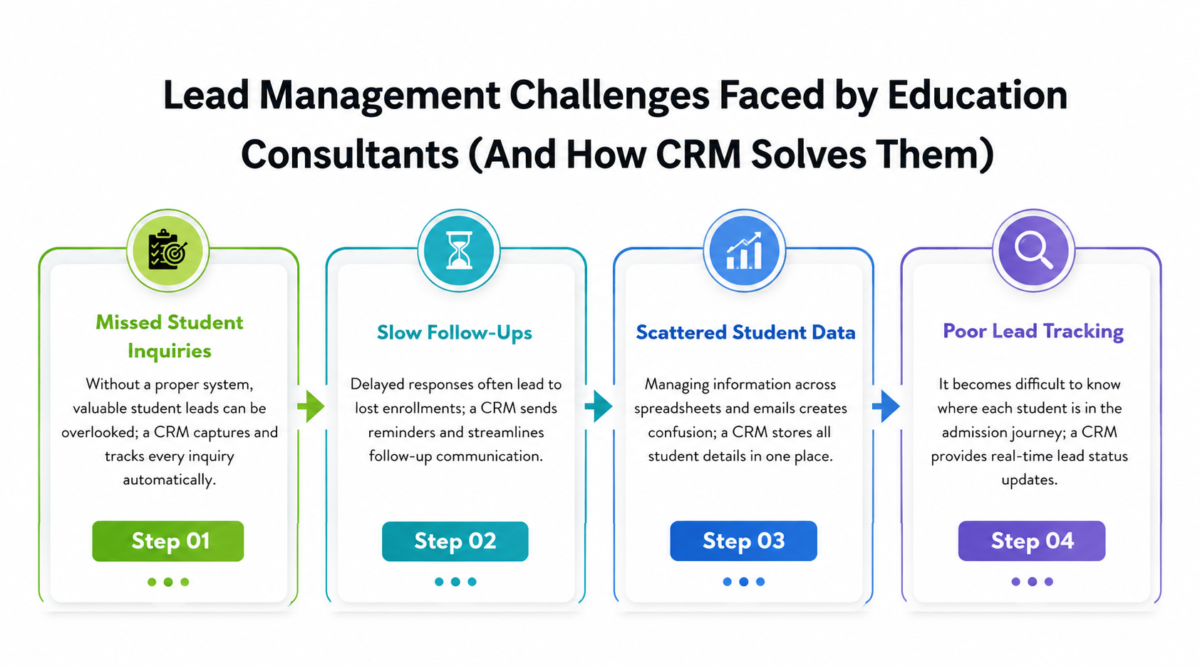
Lead Management Challenges Faced by Education Consultants (And How CRM Solves Them)

The education sector in India is becoming more competitive every year. Schools, universities, coaching institutes, and education consultants receive inquiries from multiple channels such as websites, social media, WhatsApp, and education portals. Managing these leads efficiently has become a major challenge.

As inquiry volumes continue increasing, managing student communication manually is becoming difficult for many organizations. Delayed follow-ups, scattered data, missed counseling calls, duplicate inquiries, and inconsistent communication often reduce enrollment conversions and operational efficiency.

This growing complexity has increased the demand for structured Lead Management CRM systems and intelligent lead management software across the Indian education sector. Many institutions now use CRM platforms to manage inquiries from one place. These systems help counselors respond faster, automate routine tasks, and improve the admission process.

According to recent education technology trends in India, institutions implementing CRM-driven lead management processes often improve inquiry response speed and admission conversion rates because students increasingly expect fast, personalized, and digitally connected communication experiences.

Why Lead Management Has Become a Major Challenge for Education Consultants

Education consulting businesses operate in a communication-heavy environment where every inquiry represents a potential admission opportunity. During peak admission seasons, consultants often manage thousands of leads simultaneously across multiple channels.

Most organizations generate leads through:

  • Google Ads campaigns
  • Social media marketing
  • Organic website traffic
  • WhatsApp inquiries
  • Referral programs
  • Education portals
  • Seminars and webinars
  • Offline counseling events

Without a centralized lead management crm, tracking student interactions and follow-ups becomes extremely difficult.

Many organizations still depend on spreadsheets or disconnected tools that cannot support modern admission workflows efficiently. This often creates communication gaps, operational confusion, and reduced conversion visibility.

What Are Common Lead Management Challenges?

One of the most common questions education businesses ask is: “What are common lead management challenges?

Educational consultants across India frequently struggle with operational inefficiencies while managing large inquiry pipelines.

Delayed Lead Response Time

Imagine a student submitting inquiries to three overseas education consultants. If one consultant responds within five minutes while another takes two days, the student is far more likely to continue the conversation with the faster responder.

Scattered Student Data

Many organizations manage student information across spreadsheets, emails, WhatsApp chats, and separate communication platforms. This creates fragmented records and makes it difficult for counselors to track student history, previous interactions, and application progress accurately.

Poor Follow-Up Management

Consistent follow-up remains one of the biggest challenges in lead generation in India for education businesses. Counselors handling large inquiry volumes often miss reminders, callbacks, or long-term nurturing opportunities. Without automation systems, valuable inquiries frequently become inactive due to communication delays.

Duplicate Leads and Data Errors

Educational organizations generating inquiries from multiple platforms often face duplicate entries and inconsistent data collection. This affects reporting quality, counselor coordination, and operational decision-making.

Lack of Reporting Visibility

Management teams often struggle to monitor:

  • Counselor productivity
  • Conversion rates
  • Lead source performance
  • Follow-up quality
  • Marketing ROI

Without structured reporting dashboards, optimizing admission strategies becomes difficult.

What Is the Difference Between Lead Management and CRM?

Another common question businesses ask is: “What is the difference between lead management and CRM?”

Lead management specifically focuses on capturing, organizing, tracking, nurturing, and converting inquiries into enrollments or customers. CRM, or Customer Relationship Management, is a broader operational framework designed to manage complete customer interactions, communication workflows, reporting systems, automation processes, and long-term engagement.

In simple terms:

  • Lead management handles inquiry tracking and conversion workflows
  • CRM manages broader relationship and operational processes

A modern lead management crm combines both functionalities by supporting inquiry management while also maintaining long-term communication and student engagement history.

For educational organizations, CRM systems often become centralized platforms connecting admissions, counseling, communication, marketing, reporting, and workflow automation.

Why Education Consultants in India Are Adopting Lead Management CRM Systems

Educational organizations across India are increasingly investing in lead management software because student expectations and competition levels continue growing rapidly.

Students today expect:

  • Instant responses
  • Personalized counseling
  • Real-time communication
  • Fast document coordination
  • Multi-channel engagement

Managing these expectations manually becomes difficult as inquiry volumes increase.

Modern lead management software india solutions help organizations automate repetitive tasks while improving communication consistency and operational efficiency. This allows counselors to focus more on student guidance and enrollment support rather than manual administrative coordination.

How Does CRM Software Help in Lead Management?
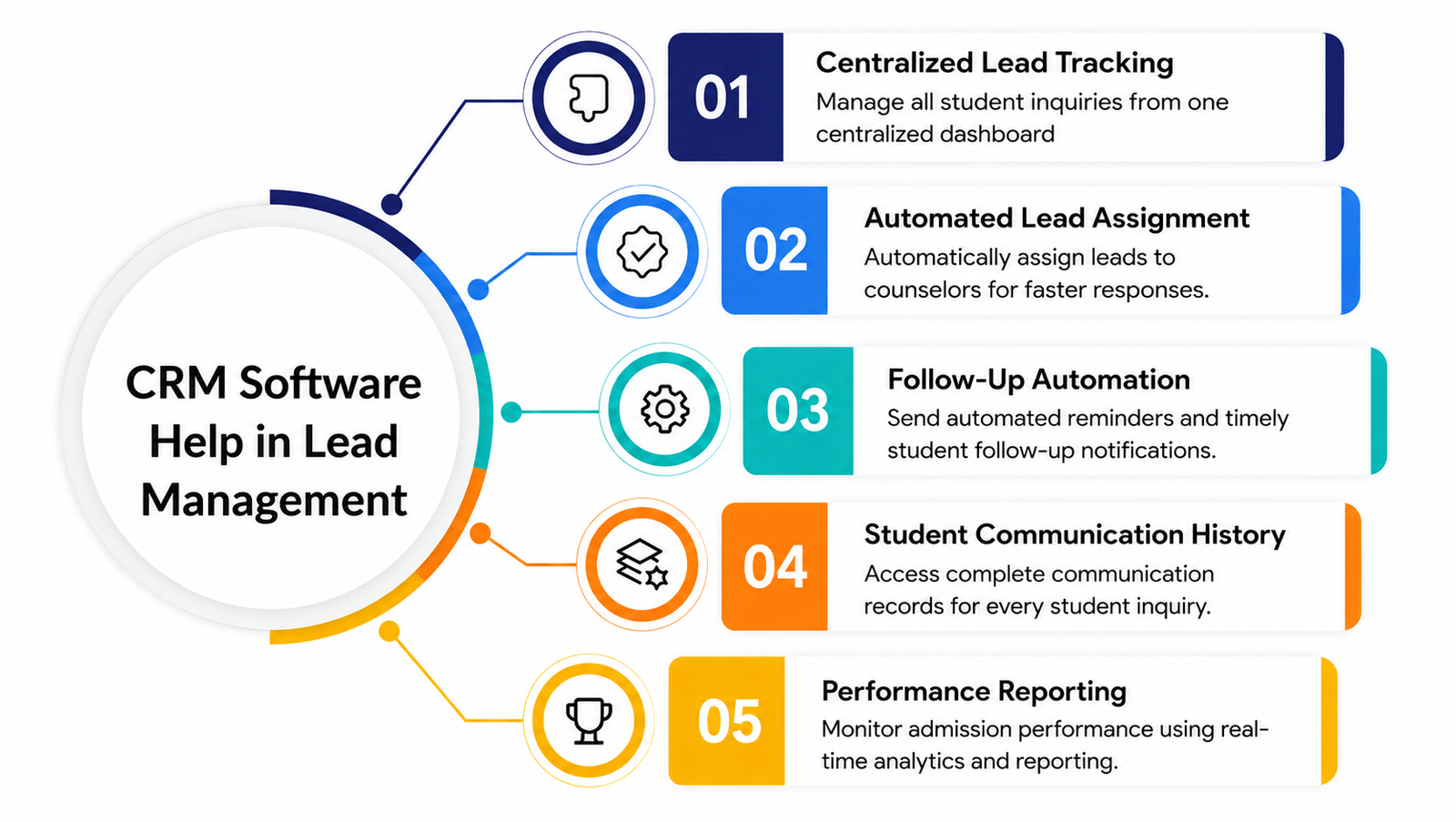
CRM Software Help in Lead Management

One of the most important operational questions businesses ask is: “How does CRM software help in lead management?”

Modern CRM systems streamline the complete inquiry lifecycle from lead generation to final enrollment.

Centralized Lead Tracking

CRM platforms collect inquiries from websites, social media campaigns, advertisements, WhatsApp, webinars, and offline campaigns into one centralized dashboard.

This improves visibility and reduces communication gaps across teams.

Automated Lead Assignment

Lead management software automatically assigns inquiries to counselors based on:

  • Course interest
  • Branch preference
  • Location
  • Availability
  • Inquiry priority

This improves response speed and operational coordination.

Follow-Up Automation

Automated reminders, email workflows, WhatsApp notifications, and counseling schedules help consultants maintain consistent communication with students.

Automation significantly reduces missed follow-ups and inactive leads.

Student Communication History

CRM systems maintain complete interaction records including:

  • Calls
  • Emails
  • WhatsApp conversations
  • Counseling notes
  • Application updates

This helps counselors personalize conversations more effectively.

Performance Reporting

CRM dashboards provide insights into:

  • Lead source performance
  • Counselor productivity
  • Conversion ratios
  • Follow-up trends
  • Marketing campaign performance

These reports help management teams improve operational planning and lead generation performance.

What Is the Lead Management Process in CRM?

Businesses frequently ask: “What is the lead management process in CRM?

The lead management process usually follows several structured stages designed to improve inquiry handling and conversion tracking.

Lead Capture: The CRM collects inquiries from websites, ads, social media, WhatsApp, education portals, webinars, and offline campaigns.

Lead Qualification: The system categorizes students based on course interest, intent level, location, budget, and enrollment probability.

Lead Assignment: Qualified inquiries are assigned to appropriate counselors automatically or manually.

Follow-Up and Lead Nurturing: Counselors communicate with students through calls, emails, counseling sessions, webinars, and WhatsApp while tracking interactions inside the CRM.

Enrollment and Application Tracking: CRM systems monitor application progress, documentation, payment updates, and admission workflows.

Conversion Analysis: Management teams analyze inquiry performance, conversion trends, counselor productivity, and operational bottlenecks using reporting dashboards.

Why Lead Generation Services in India Need CRM Integration

Many educational organizations invest heavily in lead generation services in India but still struggle with low conversions because inquiry management workflows remain unorganized.

Lead generation alone is not enough. Institutions also require structured systems for:

  • Lead nurturing
  • Communication management
  • Follow-up automation
  • Conversion tracking
  • Inquiry prioritization

Without CRM integration, many generated leads eventually become inactive or untracked.

This is why lead generation and CRM systems increasingly operate together as connected operational strategies.

AI and Automation Are Changing Lead Management in India

AI-powered CRM systems are transforming how educational organizations manage inquiries and counseling operations.

Modern sales lead management software increasingly includes:

  • AI-based lead scoring
  • Automated WhatsApp communication
  • Predictive conversion analytics
  • Smart follow-up reminders
  • Behavioral inquiry analysis
  • Automated reporting systems

These features help organizations improve response quality while reducing repetitive administrative workload. AI-driven lead prioritization also helps counselors focus more effectively on high-intent inquiries.

Why Indian Education Consultants Prefer Custom CRM Solutions

Many organizations prefer customized CRM platforms instead of generic software because educational workflows differ significantly between institutions.

For example:

  • Overseas consultants manage visa workflows
  • Coaching institutes prioritize lead nurturing
  • Universities manage multi-department admissions
  • Edtech companies focus heavily on digital engagement

Custom CRM solutions  allow businesses to build workflows aligned with operational requirements instead of adapting processes to rigid software limitations.

Comparison Between Manual Lead Tracking and CRM-Based Lead Management

FeatureManual Lead TrackingLead Management CRM
Inquiry OrganizationScatteredCentralized
Follow-Up ManagementManualAutomated
Reporting VisibilityLimitedReal-time dashboards
Lead AssignmentUnorganizedAutomated workflows
Communication TrackingDifficultComplete history
Conversion MonitoringInconsistentStructured analytics
ScalabilityLimitedHighly scalable

Future of Lead Management in the Indian Education Sector

The Indian education industry is becoming increasingly digital, communication-driven, and competitive. Educational organizations are expected to continue investing heavily in CRM platforms, automation systems, AI-powered engagement tools, and centralized inquiry management infrastructure.

Future trends are likely to include:

  • AI-powered counseling automation
  • WhatsApp-first communication systems
  • Predictive enrollment analytics
  • Voice-assisted CRM platforms
  • Automated student engagement workflows
  • Multi-campus CRM management

As student expectations continue evolving, educational organizations will increasingly depend on intelligent lead management systems to improve operational efficiency and admission performance.

Organizations exploring scalable inquiry management solutions can also learn more about professional Lead Management CRM Solutions designed specifically for education-focused counseling workflows, admission automation, and student engagement management.
Frequently Asked Questions

What are common lead management challenges?

Common challenges include delayed responses, poor follow-up tracking, scattered student data, duplicate leads, communication gaps, and lack of reporting visibility.

Lead management focuses on inquiry tracking and conversions, while Sensation CRM manages broader customer relationships, communication workflows, automation, and operational processes.

Sensation CRM software centralizes inquiries, automates follow-ups, tracks communication history, improves counselor coordination, and provides real-time analytics dashboards.

The process typically includes lead capture, qualification, assignment, follow-up, nurturing, enrollment tracking, and conversion analysis.

Lead management software helps consultants organize inquiries, improve response speed, automate communication, track conversions, and manage counseling workflows efficiently.

Categories
Lead management

Managing Admission Leads Across WhatsApp, Calls & Email Using an Education CRM 

Admission teams today are not struggling with generating inquiries.
They’re struggling with managing them. 

  • A WhatsApp message comes in.

  • A parent calls.

  • A student fills out a website form.

  • An email lands in the inbox. 

Now the real question: 

Is every inquiry getting a timely follow-up? 

Without a structured Admission lead management software, most institutions experience scattered communication, delayed responses, and missed opportunities. 

A modern system with WhatsApp CRM integration and a smart Lead tracking CRM for education brings everything into one centralized platform, making follow-ups faster, organized, and measurable. 

Let’s understand how. 

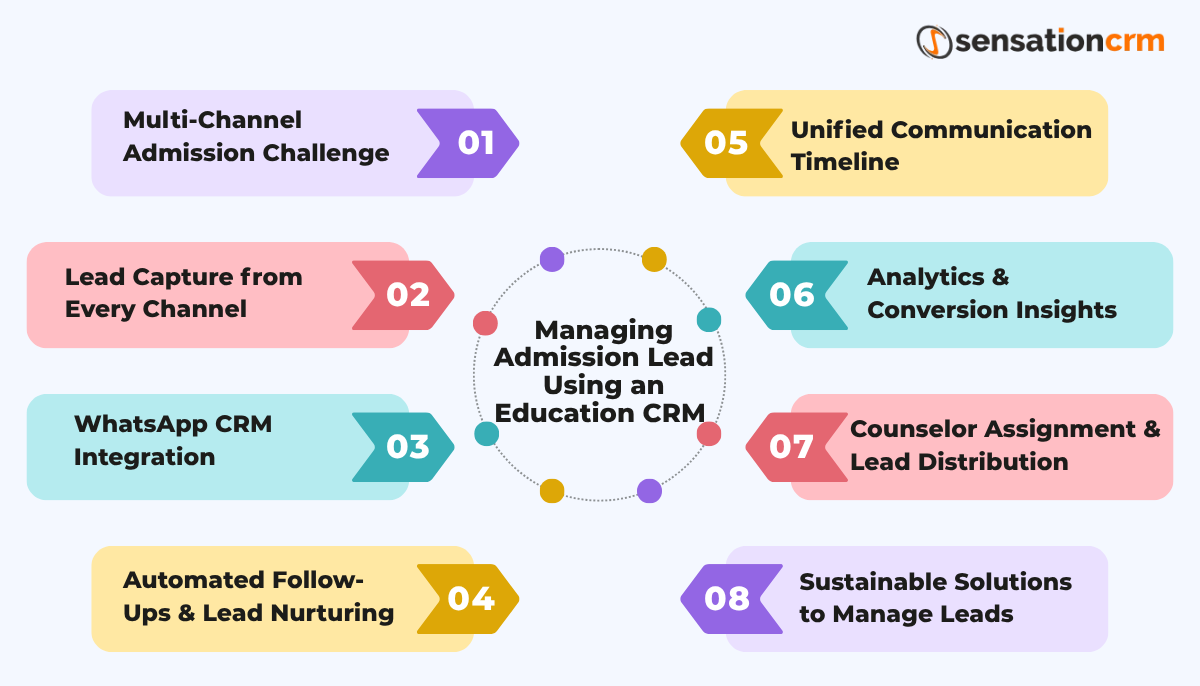
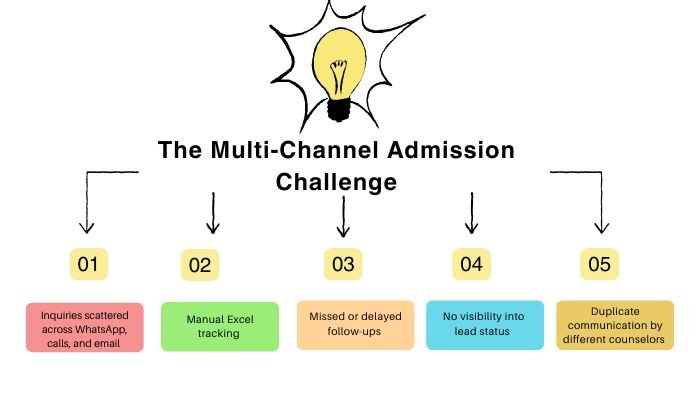
The Multi-Channel Admission Challenge

Multi-Channel Admission Challenge

Today’s students communicate across multiple channels. That’s convenient for them,  but chaotic for admission teams. 

Common Challenges Institutions Face:

  • Without centralization, admission management becomes reactive instead of structured. 

  • Inquiries scattered across WhatsApp, calls, and email 

  • Manual Excel tracking 

  • Missed or delayed follow-ups 

  • No visibility into lead status 

  • Duplicate communication by different counselors

Centralized Lead Capture from Every Channel

A smart Lead tracking CRM for education integrates every inquiry source into one system. 

What Gets Centralized? 

Channel What the CRM Does Benefit 
WhatsApp Captures chats automatically No lost conversations 
Phone Calls Logs inbound & outbound calls Complete call tracking 
Emails Stores email threads Organized communication 
Website Forms Auto-creates leads Instant lead capture 

 This ensures no inquiry is ignored. 

WhatsApp CRM Integration: Why It Matters

Students prefer messaging over calling. 

With WhatsApp CRM integration, institutions can: 

  • Capture WhatsApp inquiries automatically 

  • Store full chat history in CRM timeline 

  • Send quick replies using templates 

  • Enable auto-acknowledgment messages 

  • Track response time 

Instead of using personal devices, everything is managed professionally.  And that improves response consistency. 

Smart Lead Tracking CRM for Education

Once a lead enters the system, tracking begins. 

Admission Funnel Visibility 

Lead Stage What It Means Action Required 
New Fresh inquiry received Immediate response 
Contacted Counselor connected Qualification 
Interested Student exploring Follow-up & nurturing 
Applied Application submitted Admission processing 
Enrolled Fee paid & confirmed Conversion achieved 

This structured tracking eliminates guesswork. 

Management can instantly see: 

  • How many fresh leads today? 

  • Which stage has the highest drop-off? 

  • Which counselor is converting best? 

Automated Follow-Ups & Lead Nurturing

Manual follow-ups depend on memory. Automation removes that dependency. 

With modern Admission lead management software, you can: 

  • Send auto WhatsApp replies instantly 

  • Schedule call reminders for counselors 

  • Run drip email campaigns 

  • Share brochures automatically 

  • Personalize follow-ups based on course interest 

Automation ensures: 

  • Faster response 

  • Consistent messaging 

  • Reduced workload 

  • Higher engagement

  • Speed directly impacts conversion. 

Counselor Assignment & Lead Distribution 

Without structure, some counselors are overloaded while others remain underutilized, but an Education CRM App helps balance workloads by assigning and tracking leads more efficiently.

 An advanced CRM allows: 

  • Automatic lead assignment by course 

  • Location-based distribution 

  • Balanced workload sharing 

  • Performance tracking 

Management can monitor: 

  • Response time 

  • Follow-up frequency 

  • Conversion ratios

  • This increases accountability and improves team efficiency. 

Unified Communication Timeline

One of the most powerful features of a Lead tracking CRM for education is the unified timeline. 

Counselors can view: 

  • WhatsApp chats 

  • Call logs 

  • Email threads 

  • Follow-up notes 

  • All in one dashboard.  

Before calling a student, they know: 

  • What was discussed earlier 

  • Which course the student prefers 

  • What concerns were raised 

  • This leads to personalized conversations and better conversions.

Analytics & Conversion Insights

Beyond tracking, institutions need data-driven decisions. 

A structured CRM provides: 

  • Channel-wise performance comparison 

  • Response time analysis 

  • Conversion rate tracking 

  • Admission pipeline forecasting 

  • Instead of guessing which campaign works, you see actual numbers. 

 Before vs After Implementing an Education CRM 

Without CRM With Education CRM 
Scattered WhatsApp chats Centralized communication 
Manual Excel tracking Automated lead capture 
Missed follow-ups Task reminders 
No funnel visibility Real-time admission dashboard 
Unbalanced counselor workload Smart lead distribution 

The difference is operational clarity. 

Conclusion 

Managing inquiries manually across WhatsApp, calls, and emails is no longer sustainable.

A modern Admission lead management software like Sensation CRM, with WhatsApp CRM integration and a structured Lead tracking CRM for education, transforms admission operations from scattered to strategic while ensuring every inquiry is captured, tracked, and converted efficiently.

It helps institutions: 

  • Capture every inquiry 

  • Respond faster 

  • Track progress clearly 

  • Automate follow-ups 

  • Monitor performance 

  • Increase enrollment conversions 

In today’s competitive education environment, structured admission management is not optional; it’s essential. 

Frequently Asked Questions

What is Admission lead management software?

Admission lead management software is a CRM system designed specifically for educational institutions to capture, track, nurture, and convert student inquiries from multiple channels. 

WhatsApp CRM integration automatically captures WhatsApp inquiries, stores chat history, enables auto-replies, and tracks counselor response time, ensuring no student inquiry is missed. 

A Lead tracking CRM for education monitors every stage of the admission journey — from new inquiry to final enrollment,  providing structured funnel visibility and performance insights. 

Yes. Automated reminders, task assignments, and centralized dashboards ensure counselors follow up on time and consistently. 

Yes. Faster response time, structured nurturing, and data-driven insights significantly improve lead-to-enrollment conversion rates. 

Categories
Lead management

How Lead Management Software Improves Sales Accuracy in Data-Driven Teams 

Sales teams today don’t lose deals because they lack effort. They lose deals because information slips. Leads get missed, follow-ups happen late, data lives in too many places, and decisions are made on partial signals. In a data-driven sales environment, accuracy matters just as much as activity. 

This is where lead management software plays a quiet but critical role. It doesn’t magically increase demand. What it does is improve how teams capture, organize, qualify, and act on leads. Over time, that accuracy compounds. Better data leads to better decisions. Better decisions lead to more consistent conversions. 

For teams scaling beyond spreadsheets or inbox-based tracking, a structured lead management system becomes less of a tool and more of a foundation. 

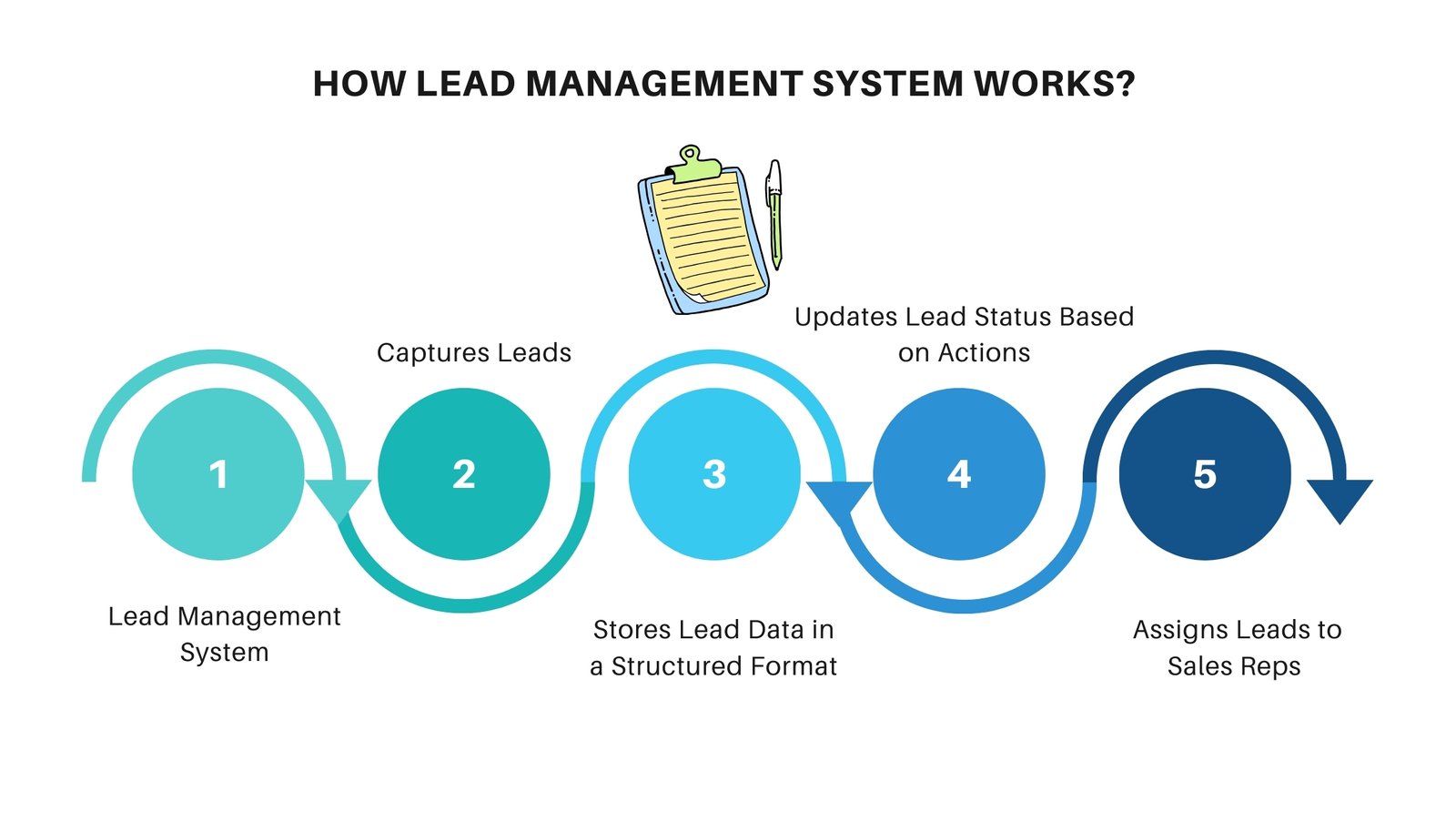
What Is a Lead Management System and How Does It Work? 

Lead Management System Works?

A lead management system is a centralized platform that captures leads from multiple sources, tracks their activity, and guides them through the sales funnel. It replaces fragmented tracking methods with a single source of truth. 

At a basic level, the system: 

    • Captures leads from forms, ads, emails, calls, and integrations 

    • Stores lead data in a structured format 

    • Tracks interactions over time 

    • Assigns leads to sales reps 

    • Updates lead status based on actions 

More advanced systems apply rules or scoring models to prioritize leads. For example, a lead that opens three emails and books a demo is treated very differently from one that just downloaded a brochure. 

In data-driven teams, this structure reduces guesswork. Instead of asking “Who should I call today?” reps see a prioritized list backed by data. 


Lead Management Software vs Traditional Lead Tracking Methods 

Many sales teams still rely on spreadsheets, shared inboxes, or basic CRMs not designed for active lead flow. These methods work at low volume, but accuracy drops fast as scale increases. 

Traditional lead tracking usually means: 

    • Manual data entry 

    • No real-time updates 

    • Limited visibility across teams 

    • High dependency on individual discipline 

In contrast, lead management software automates data capture and enforces consistency. Every interaction is logged. Every update is time-stamped. Nothing depends on memory alone. 

Teams using structured lead software report: 

    • 25–35% reduction in missed follow-ups 

    • 20% improvement in lead-to-opportunity accuracy 

    • Cleaner reporting with fewer manual corrections 

The difference isn’t effort. It’s system design. 

Key Features Every Lead Management App Should Have 

A modern lead management app should support sales teams wherever they work, not just at a desk. Mobility and simplicity matter. 

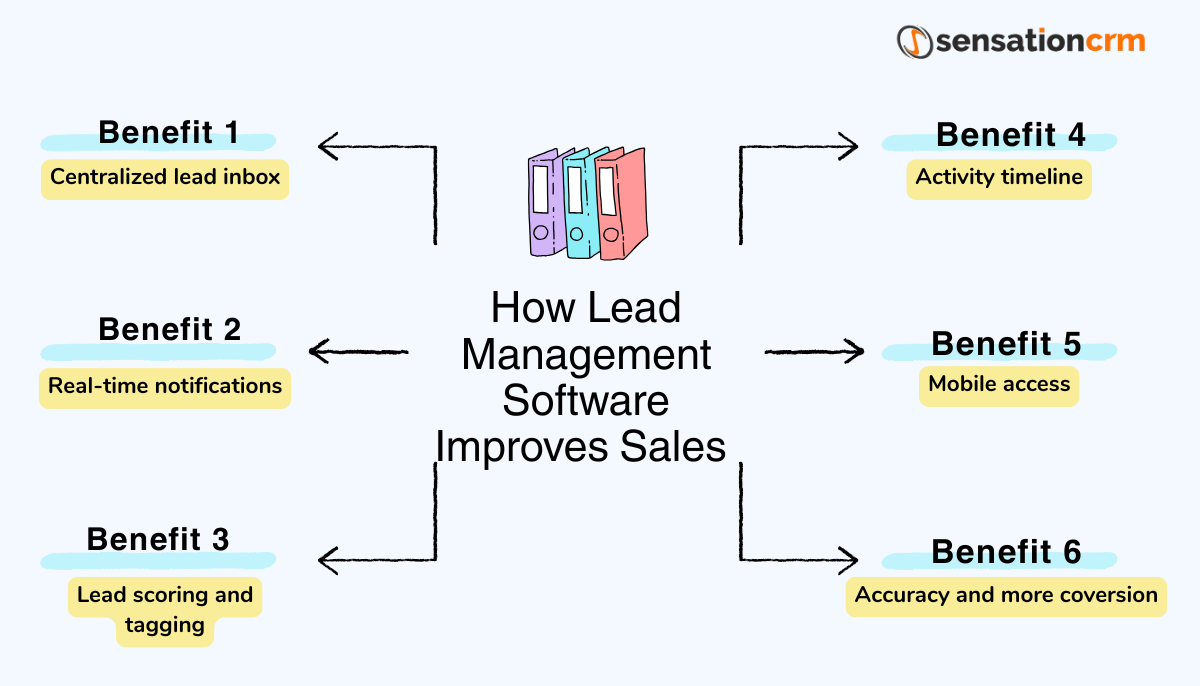
Core features to look for include: 

Centralized lead inbox: All leads from web forms, ads, calls, and emails flow into one place. No switching tabs or hunting spreadsheets. 

Real-time notifications: Speed matters. Responding within the first 5 minutes can increase conversion probability by nearly 8x compared to delayed follow-up. 

Lead scoring and tagging: Basic scoring helps reps focus on higher-intent leads first. Even simple rules improve prioritization. 

Activity timeline: A clear view of emails, calls, meetings, and notes prevents repetitive or awkward outreach. 

Mobile access: Sales doesn’t wait for laptops. A good lead management app works smoothly on mobile. 

Without these basics, even the best sales process starts breaking down. 

How Lead Software Helps Sales Teams Qualify Better Leads 

Qualification is where accuracy either improves or collapses. Poor qualification wastes time. Over-qualification delays deals. 

Lead software improves qualification by turning behaviour into signals. Instead of relying on gut feel, teams see patterns: 

    • Pages visited 

    • Emails opened 

    • Response time 

    • Engagement frequency 

This data helps sales reps ask better questions. They don’t start cold. They start informed. 

Teams using lead-based qualification models often see: 

    • 15–25% higher close rates 

    • Shorter sales cycles by 10–20% 

    • Fewer unproductive calls 

It’s not about filtering aggressively. It’s about focusing attention where it actually matters. 

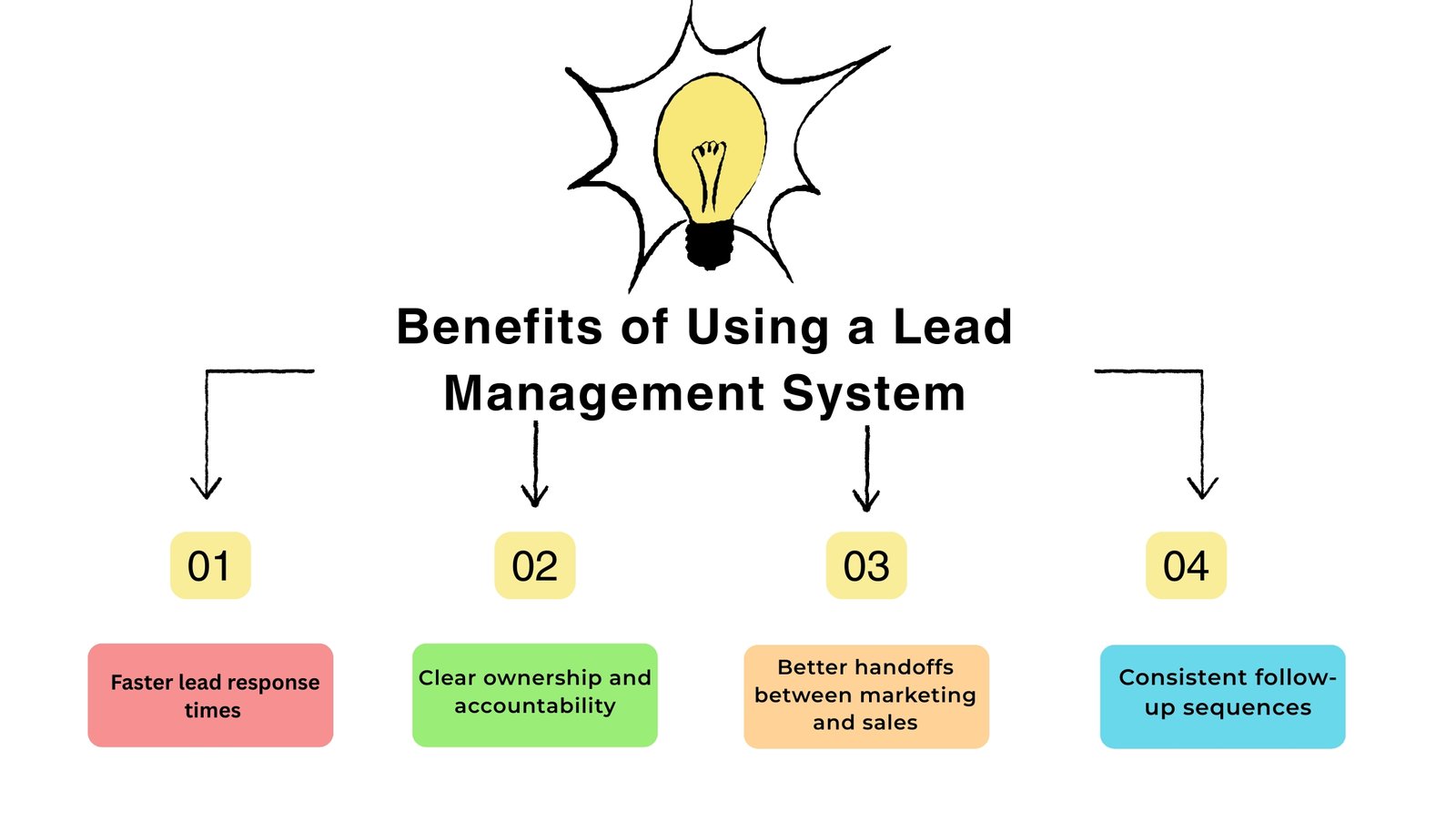
Benefits of Using a Lead Management System for Faster Conversions 

Speed and accuracy are closely linked. When data is clean and accessible, decisions happen faster. 

A strong lead management system enables: 

    • Faster lead response times 

    • Clear ownership and accountability 

    • Better handoffs between marketing and sales 

    • Consistent follow-up sequences 

According to industry benchmarks, companies that respond to leads within one hour are 7x more likely to qualify them than those responding later. 

Over time, faster response combined with better qualification leads to: 

    • Higher win rates 

    • Predictable pipeline movement 

    • More reliable forecasting 

Conversions don’t spike overnight. They stabilize. And that stability matters more at scale. 

Benefits of Using a Lead Management System

Choosing The Right Lead Management Software for Your Business 

Not all lead management software fits every team. The “best” system is the one your team actually uses. 

When evaluating options, consider: 

    • Volume of leads per month 

    • Number of sales reps 

    • Complexity of your sales cycle 

    • Integration needs (email, ads, CRM, telephony) 

    • Reporting depth required 

Avoid overbuying features you won’t use. Complexity hurts adoption. A simple system focused on Essential Education CRM Features 2026 and used daily will always outperform a powerful platform that teams rarely touch. 

Ask practical questions: 

    • Can new reps learn this in a week? 

    • Does it reduce manual work or add to it? 

    • Does it show me what to do next, clearly? 

Accuracy improves when systems feel supportive, not heavy. 

Why Data-Driven Teams Rely on Lead Management Software 

Data-driven sales teams don’t rely on instincts alone. They test, measure, and refine. 

Lead management software provides: 

    • Clean datasets for analysis 

    • Visibility into conversion leaks 

    • Historical patterns across channels 

Over time, teams identify what actually drives conversions. Which campaigns bring qualified leads. Which reps follow up effectively? Which messages resonate. 

This feedback loop is hard to build without structured lead data. Spreadsheets rarely survive long enough to tell the full story. 

Common Mistakes Teams Make Without a Lead Management System 

Without a proper system, teams often face: 

    • Duplicate leads 

    • Inconsistent follow-ups 

    • Lost context between calls 

    • Inflated pipeline numbers 

These issues don’t always show up immediately. They show up in missed targets, unclear forecasts, and internal friction. Contact us to identify and resolve these challenges before they impact your growth.A lead management system doesn’t remove all problems. But it makes problems visible early, when they’re easier to fix. 

The Impact of Lead Management Software on Sales Accuracy 

Sales accuracy isn’t just about closing deals. It’s about knowing: 

    • Which leads are real 

    • Which opportunities are active 

    • Which numbers you can trust 

Teams using structured lead software often report: 

    • 30–40% improvement in forecast accuracy 

    • Reduced end-of-quarter surprises 

    • Better alignment between marketing and sales 

Accuracy builds confidence. Confidence improves execution. 

Lead Management Software Can replace 

Lead management software doesn’t replace good salespeople. It supports them. It removes noise, reduces manual effort, and brings structure to fast-moving pipelines. 

For data-driven teams, accuracy isn’t optional. It’s how decisions get made, resources get allocated, and growth stays predictable. 

A well-implemented lead management system becomes part of daily workflow, quietly improving how teams qualify, follow up, and convert leads. 

Platforms like Sensation CRM are designed with this reality in mind, helping sales teams maintain accuracy as lead volumes grow and processes mature. 

Frequently Asked Questions

What is lead management software used for?

It’s used to capture, track, qualify, and convert leads in a structured way.

A lead management app focuses more on early-stage lead handling and follow-ups.

Yes. Small teams often see faster gains because inefficiencies are easier to spot.

Indirectly, yes. Better data leads to better decisions and faster response.

Most teams notice workflow improvements within 30–60 days.