

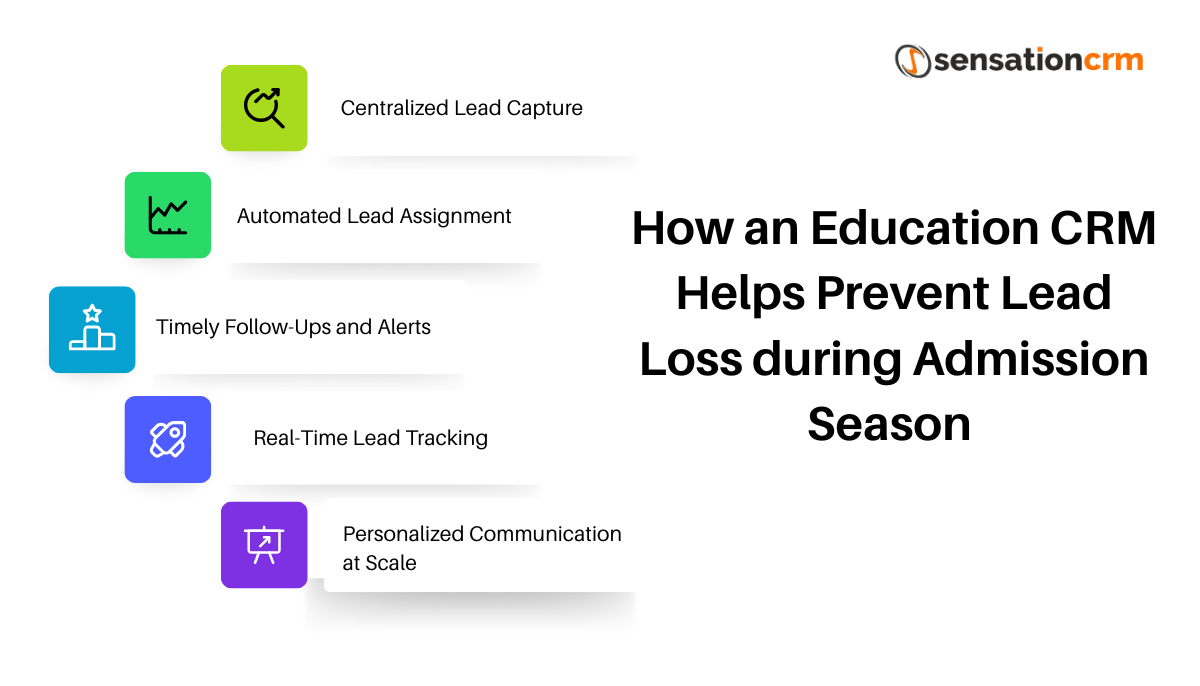
For most educational institutions, admission season is the most important time of the year. Marketing campaigns are running, inquiries start flowing in, and admission teams are busy engaging with prospective students. While the number of inquiries may look promising, converting those inquiries into enrollments is often more challenging than it appears. A single missed follow-up or delayed response can cause a potential student to lose interest and choose another institution.
In many institutions, admission season exposes operational gaps. Systems that seemed manageable during regular months begin to strain. Spreadsheets grow complicated. Counselors work longer hours. Response times stretch. Some leads quietly go cold. This is where an Education CRM becomes more than a software tool. It becomes a control system for the entire admission process.
Below, we break down how CRM for education helps prevent lead loss, especially during peak admission cycles when every inquiry matters.
Admission Season and the Risk of Lead Loss
Admission season is when inquiry volumes can increase by 2x to 4x compared to regular periods. Institutions receive leads from:
- Website forms
- Social media campaigns
- Google ads
- Education fairs
- Walk-ins
- Phone inquiries
- WhatsApp messages
On the surface, this surge signals demand. But internally, managing that volume without structured systems becomes difficult.
Industry research across service sectors shows that businesses can lose 10-25% of potential leads due to delayed response and poor tracking. In education, where decision timelines are limited, slow follow-ups can directly impact enrollment targets.
If a student submits an inquiry and does not hear back within 24-48 hours, they often move on. Students today compare several institutions before making a decision. As a result, response speed plays a significant role in shaping their perception of an institution.
Without CRM Education systems, admission teams rely heavily on manual coordination. That’s where breakdowns happen.

Understanding Lead Loss in Education Admissions
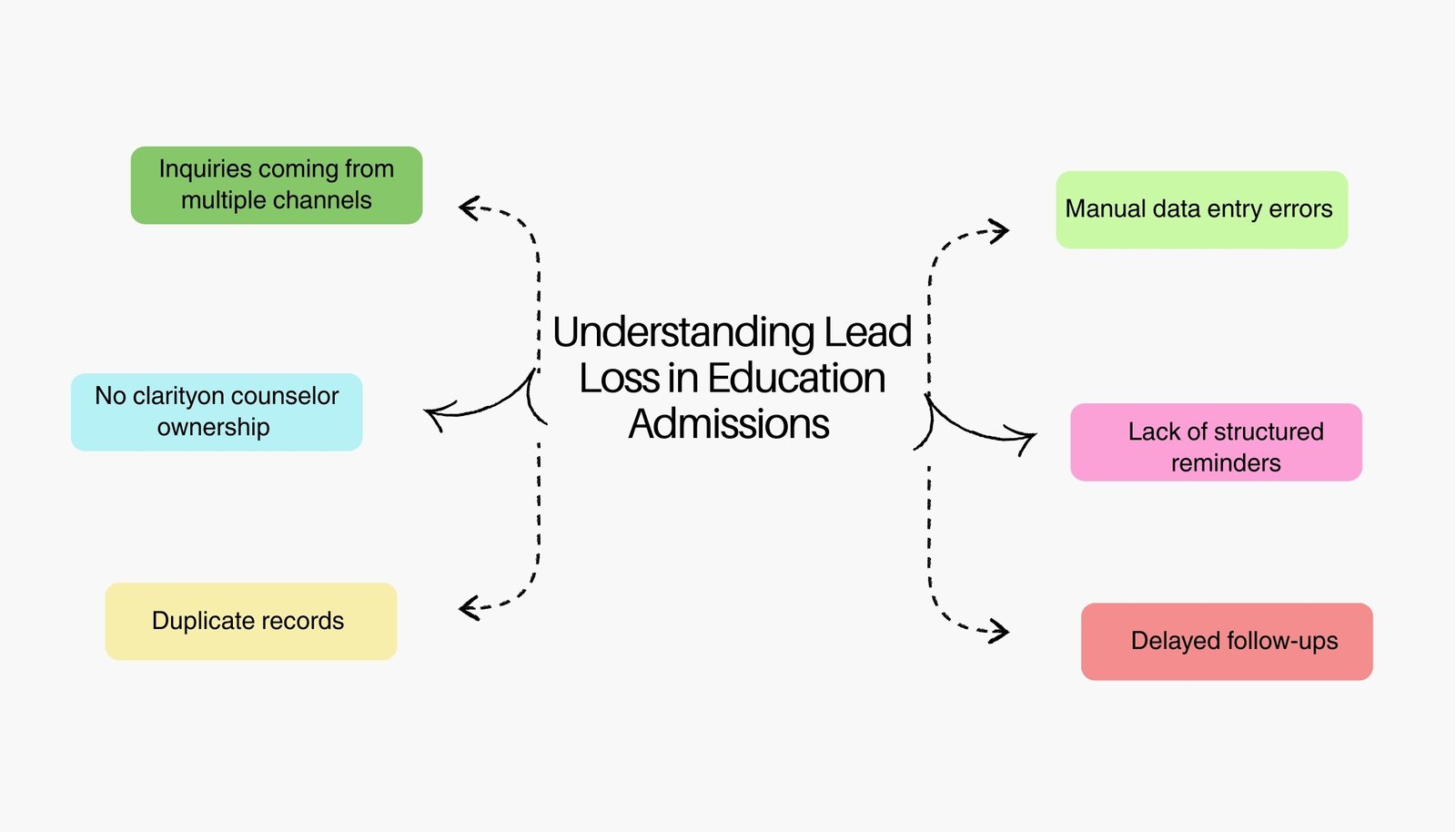
Lead loss is rarely dramatic. It happens in small, unnoticed ways.
Common Causes
- Inquiries coming from multiple channels with no central system
- Manual data entry errors
- Duplicate records
- Delayed follow-ups
- No clarity on counselor ownership
- Lack of structured reminders
For example, a counselor may intend to call a student back after checking course eligibility. Without a reminder system, that follow-up may never happen. During peak season, memory alone is unreliable.
Impact of Delayed Responses
Studies show that responding within the first hour significantly increases engagement probability. While education decisions are more complex, early response still builds trust.
When institutions delay communication:
- Student interest weakens
- Competing institutions step in
- Conversion probability decreases
Manual tracking systems simply cannot handle high volumes efficiently.
Challenges During Peak Admission Period
During admission rush:
-
Daily inquiries may increase by 30–50%
-
Counselors manage hundreds of active leads
-
Reporting becomes inconsistent
-
Funnel visibility reduces
Without CRM for educational institutions, teams work harder but not always effectively.
What Is an Education CRM?
An Education CRM is a platform designed to manage the complete student lifecycle, from first inquiry to enrollment. An Education CRM App makes this process more accessible by allowing teams to track and manage leads on the go.
Unlike generic CRM systems, CRM for higher education is built around admission workflows. Consider a student who submits an inquiry on a Friday evening and expects a response before the weekend. If the inquiry is overlooked or assigned late, the student may begin exploring alternatives. During admission season, these small delays can have a direct impact on enrollment numbers. This is why institutions increasingly rely on automated workflows and centralized communication systems.
Core functions include:
- Lead capture from multiple channels
- Automated lead assignment
- Follow-up scheduling
- Communication tracking
- Funnel stage monitoring
- Performance reporting
Its purpose is simple: ensure no inquiry is ignored.
Automation reduces dependency on memory. Structured workflows replace manual guesswork.
Key Ways an Education CRM Prevents Lead Loss
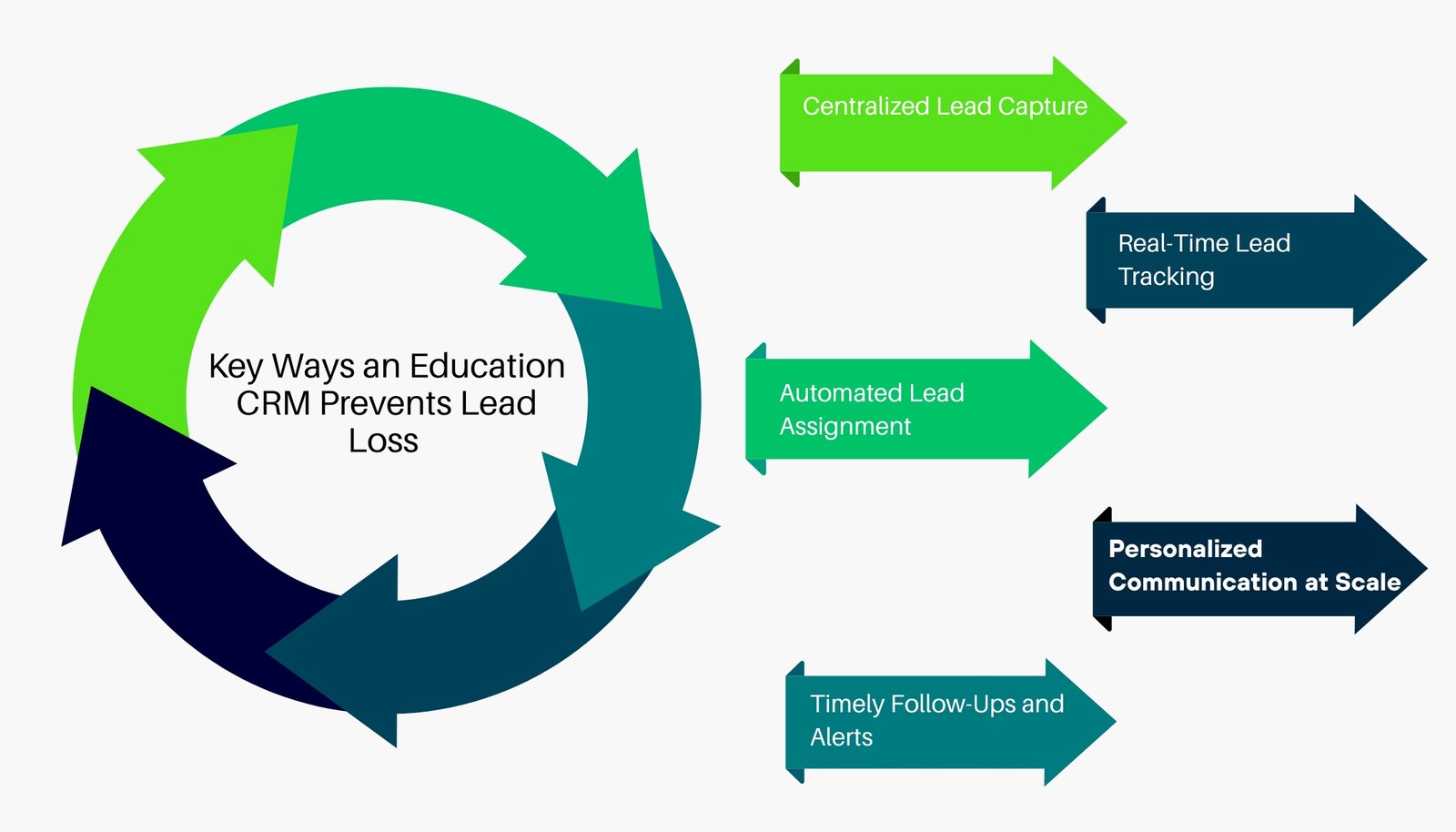
Centralized Lead Capture
Admission inquiries come from different platforms. Without integration, data remains fragmented. A CRM for education, especially a CRM for higher education, integrates:
- Website forms
- Landing pages
- Call logs
- Social media leads
- Event registrations
All inquiries feed into one centralized dashboard. This prevents duplication and ensures no source is overlooked. Institutions gain full visibility into inquiry volumes and sources.Centralization alone can significantly reduce leakage.
Automated Lead Assignment
One common issue during admission season is unclear ownership.If a lead sits unassigned for hours, response time increases.Education CRM systems assign leads automatically based on:
- Course preference
- Geographic location
- Counselor specialization
- Workload distribution
Timely Follow-Ups and Alerts
Admission decisions rarely happen after one conversation. It often takes 5–8 follow-ups before a student commits.
CRM Education systems provide:
- Automated call reminders
- Email scheduling
- Application deadline alerts
- Escalation notifications
Real-Time Lead Tracking
Visibility reduces risk.
CRM for higher education tracks each lead’s movement through the admission funnel:
- New Inquiry
- Contacted
- Interested
- Application Started
- Application Submitted
- Enrolled
- Conversion ratios
- Stage drop-offs
- Counselor performance
- Daily inquiry numbers
Personalized Communication at Scale
During peak seasons, communication often becomes generic due to workload pressure.But personalized engagement improves response rates by 20–30%, based on marketing benchmarks. CRM for educational institutions enables segmentation based on:
- Course interest
- Location
- Engagement behavior
- Academic background
Institutions can send targeted emails, SMS, or WhatsApp messages relevant to each student group. Personalization builds stronger connection.
Benefits of Using CRM during Admission Season
Reduced Lead Leakage: Structured workflows reduce untracked inquiries.Even improving conversion by 5% can significantly impact revenue for mid-sized institutions.
Faster Response Time: Instant lead routing shortens response cycles.Students feel acknowledged quickly.
Improved Counselor Productivity: Automation reduces repetitive tasks. Counselors focus more on meaningful conversations rather than manual tracking.
Higher Conversion Rates: Consistent follow-ups and structured nurturing improve overall enrollment ratios.CRM does not guarantee admission success. But it ensures that opportunity is not lost due to internal inefficiency.
Use Case: Managing High Inquiry Volume
Consider an institution receiving 3,000–4,000 inquiries in six weeks.
Imagine an institution receiving more than 4,000 inquiries within a six-week admission cycle. Without a centralized system, counselors may struggle to prioritize follow-ups, track interactions, and monitor application progress. As inquiry volumes increase, delays become more common and valuable opportunities may be missed. A CRM helps organize this process by automatically assigning leads, scheduling follow-ups, and providing real-time visibility into admission performance.
With CRM Education:
- Inquiry captured automatically
- Auto acknowledgment sent
- Lead assigned instantly
- Reminder scheduled
- Interaction logged
- Funnel stage updated
- Management monitors dashboard
Every inquiry has accountability.
Structure replaces chaos.
Essential Features to Look for in an Admission CRM
Institutions should prioritize:
- Multi-channel lead capture
- Automation workflows
- Lead scoring
- Segmentation
- Reporting dashboards
- Counselor performance tracking
Without reporting and automation, CRM becomes just another database.
Best Practices to Maximize Lead Retention
Technology alone is not enough.
Standardize Follow-Up Timelines
Define clear rules for response and follow-up intervals.
Train Admission Teams
Regular training ensures proper CRM usage.
Monitor Metrics Weekly
Track response time, conversion rates, and drop-offs.
Data-driven adjustments improve outcomes.
What happens without CRM
Admission season creates pressure. Inquiry volumes rise, expectations increase, and competition intensifies.
Without structured systems, institutions risk losing valuable prospects due to operational gaps. Sensation CRM for higher education brings centralization, automation, and visibility. It ensures every inquiry is captured, assigned, nurtured, and tracked. Contact US to streamline your admission workflows and prevent lead loss during peak seasons.
In today’s competitive education landscape, institutions need a structured admission process that combines speed, consistency, and personalized communication. Even small improvements in these areas can lead to better enrollment outcomes.