Introduction
Colleges and universities today operate under growing pressure. Student expectations are higher, competition between institutions is intense, and admission cycles are longer and more complex than ever. A single intake may involve thousands of inquiries, multiple decision-makers within families, entrance exams, interviews, financial discussions, and extended follow-up periods.
In many institutions, these processes are still managed through spreadsheets, emails, and disconnected software tools instead of a centralized CRM solution. While this approach may function at a small scale, it quickly breaks down as volume increases. Information gets lost, follow-ups are delayed, and leadership lacks a clear picture of overall enrollment health.
A CRM for higher education addresses these challenges by bringing structure, visibility, and consistency to admissions and enrollment processes. Rather than acting as a sales tool, it functions as an operational system that supports academic integrity while Improves Admissions, Follow-Ups & Conversions through better data management and coordinated communication.
This article explains how CRM systems are used in higher education, the specific admission and enrollment challenges they solve, and what colleges and universities should realistically expect from adopting a CRM.
What CRM Means in Higher Education
In a higher education environment, CRM stands for relationship continuity rather than customer management. Institutions are not selling impulse products; they are guiding students through one of the most important decisions of their lives.
A CRM for higher education is designed to manage prospective student interactions over long periods while maintaining accuracy, compliance, and institutional consistency.
Core functions typically include:
-
- Capturing and organizing student inquiries
-
- Managing multi-stage admission workflows
-
- Tracking communication across calls, emails, and messages
-
- Coordinating counselors, departments, and campuses
-
- Providing enrollment visibility and reporting
The emphasis is on process control and data clarity rather than aggressive automation.
Admission and Enrollment Challenges in Colleges & Universities
High Inquiry Volume With Long Decision Timelines
Universities often receive large volumes of inquiries early in the admission cycle, but final decisions may occur months later. During this time, students explore alternatives, wait for exam results, compare financial options, and seek reassurance.
Without a CRM, maintaining consistent engagement over this extended period becomes difficult. Follow-ups depend on individual discipline rather than system support contact us to learn how the right system can streamline and automate this process.
Multiple Programs, Criteria, and Deadlines
Higher education institutions offer diverse programs with different:
-
- Capturing and organizing student inquiries
-
- Managing multi-stage admission workflows
-
- Tracking communication across calls, emails, and messages
-
- Coordinating counselors, departments, and campuses
-
- Providing enrollment visibility and reporting
Managing this complexity manually increases the risk of errors, missed deadlines, and student frustration.
Siloed Departments and Information Gaps
Admissions teams, academic departments, finance offices, and marketing teams often operate on separate systems. When information is not shared effectively, students receive inconsistent answers and internal coordination suffers.
Limited Enrollment Predictability
Leadership teams often struggle to forecast enrollment accurately due to gaps in lead management. Questions such as how many applicants are likely to convert or which programs may fall short often remain unanswered until late in the cycle.
How CRM Supports the Higher Education Admission Process
Centralized Prospect and Applicant Data
A CRM captures inquiries from multiple sources, including:
-
- Institutional websites
-
- Education portals
-
- Campus events and fairs
-
- Walk-ins and referrals
Each prospect profile stores complete interaction history, program interest, eligibility notes, and current admission status. This centralized view eliminates duplication and ensures continuity across departments.
Structured Admission Pipelines
CRMs allow institutions to define clear admission stages aligned with their academic processes. Common stages include:
-
- New Inquiry
-
- Eligibility Assessment
-
- Counselling Completed
-
- Application Submitted
-
- Entrance Exam or Interview
-
- Offer Issued
-
- Fee Payment
-
- Enrollment Confirmed
This structure helps teams manage volume while maintaining clarity on progress and responsibilities.
Managing Follow-Ups Over Extended Admission Cycles
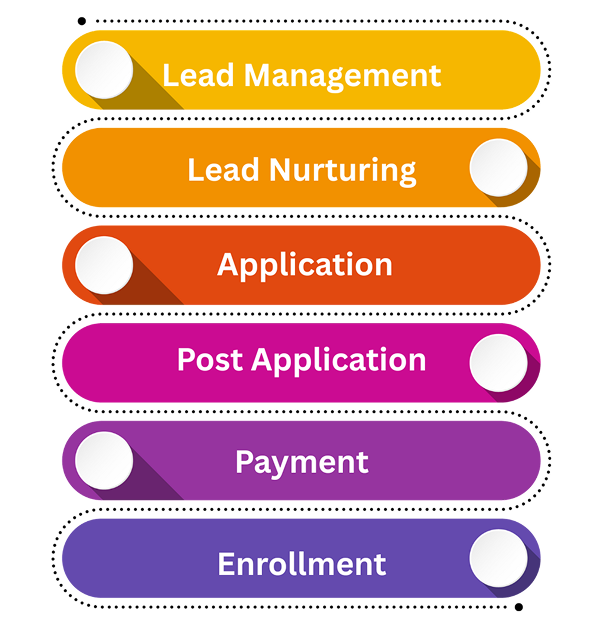
Follow-ups in higher education require patience, consistency, and relevance.
Automated Reminders and Task Management
CRMs generate reminders for scheduled calls, emails, document checks, and meetings. Counsellors no longer depend on memory or personal tracking methods.
Complete Communication Context
All interactions are logged within the CRM. If a student reconnects after weeks or months, staff can continue the conversation without repetition or confusion.
Program-Specific and Stage-Based Communication
CRMs enable targeted messaging based on:
-
- Program interest
-
- Admission stage
-
- Exam or interview outcomes
This ensures students receive relevant information at the right time.
Improving Enrollment Conversion Rates
Enrollment challenges often arise due to uncertainty rather than lack of interest.
Reduced Drop-Offs Through Process Clarity
When students clearly understand next steps, documentation requirements, and timelines, they are less likely to disengage.
Early Identification of At-Risk Applicants
CRMs highlight stalled applications and inactive prospects, allowing teams to intervene before students drop out of the process.
Source and Program-Level Insights
Institutions gain visibility into which inquiry sources and programs generate the most enrollments, enabling better planning and outreach.
Data Visibility for Academic and Administrative Leadership
Higher education leaders require timely and accurate information.
CRM dashboards provide insights into:
-
- Inquiry-to-application ratios
-
- Application-to-enrollment conversion rates
-
- Program-wise demand trends
-
- Counselor workload and productivity
These insights support informed decisions around capacity planning, staffing, and marketing investments.
Cross-Department Collaboration and Accountability
Admissions in colleges and universities involve multiple stakeholders.
A CRM supports collaboration by:
-
- Providing shared access to applicant information
-
- Defining ownership at each stage of the process
-
- Creating transparent handoffs between departments
This reduces miscommunication and improves the applicant experience.
CRM Use Cases Across Higher Education Segments
Undergraduate Admissions: Managing high volumes, entrance exams, counseling schedules, and parent communication.
Postgraduate and Research Programs: Tracking eligibility reviews, interviews, recommendations, and documentation across longer timelines.
Professional and Executive Education: Handling working professionals, flexible timelines, cohort-based enrollments, and batch planning.
Comparison Table: Higher Education Admissions With and Without CRM
| Area | Without CRM | With CRM |
| Prospect Tracking | Fragmented systems | Centralized database |
| Follow-Ups | Manual and inconsistent | System-driven and timely |
| Admission Visibility | Limited | Real-time pipeline |
| Department Coordination | Disconnected | Structured collaboration |
| Enrollment Forecasting | Assumption-based | Data-backed |
Common Misunderstandings About CRM in Higher Education
-
- CRM is only for private institutions. Public universities benefit equally from process visibility and accountability.
-
- CRM interferes with academic autonomy. CRM supports administration, not academic evaluation.
-
- CRM implementation is disruptive. Modern systems allow phased adoption without interrupting admission cycles.
Implementation Considerations for Universities
A CRM delivers value only when aligned with institutional workflows.
Key considerations include:
-
- Mapping current admission processes accurately
-
- Defining realistic pipeline stages
-
- Training staff with real scenarios
-
- Reviewing data regularly during the admission cycle
Simplicity and consistency matter more than feature depth.
CRM for Higher Education Brings Leads
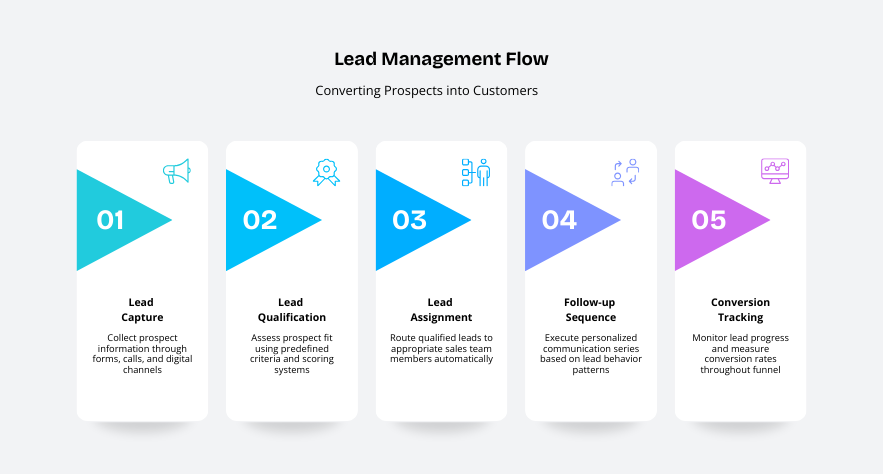
A CRM for higher education brings order to admissions and enrollment without compromising academic values. It allows colleges and universities to manage scale, complexity, and long decision cycles with clarity and consistency.
For institutions seeking a CRM aligned with higher education workflows, Sensation CRMs offers solutions built specifically for colleges and universities. The platform supports inquiry management, admission tracking, structured follow-ups, and enrollment visibility while remaining practical and easy to adopt.
When implemented thoughtfully, a CRM becomes a reliable operational foundation for modern higher education admissions.