
Categories
Education CRM

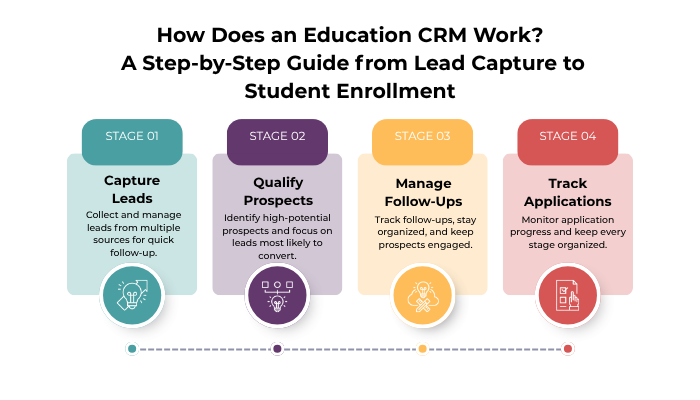
How Does an Education CRM Work? A Step-by-Step Guide from Lead Capture to Student Enrollment

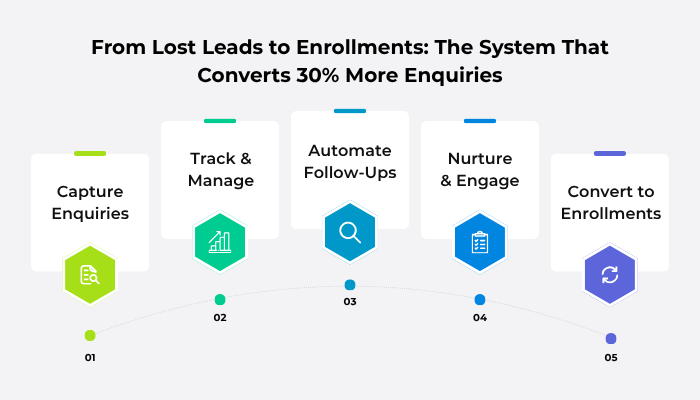
Every educational institution wants the same thing: turn more enquiries into enrolled students. But between the first enquiry and the final admission lies a journey with dozens of touchpoints, and without the right system, students slip through the cracks at every stage. That’s exactly where an Education CRM comes in. It captures every lead, automates follow-ups, tracks each student’s journey, and helps your admissions team convert more enquiries into enrolments. In this guide, we’ll walk through how an Education CRM works, step by step, from lead capture to student enrollment, and how the right software transforms your admissions process.

What Is an Education CRM?

An Education CRM (Customer Relationship Management) is software built specifically to help schools, colleges, universities, and coaching institutes manage their entire admissions journey, from the moment a student enquires to the day they enrol. Unlike a generic CRM software for business, an education CRM is designed around admissions: capturing leads from every source, nurturing prospective students, automating follow-ups, and giving your team clear visibility into what’s working.

In short, it replaces scattered spreadsheets, missed calls, and forgotten follow-ups with one organised, automated system that helps you convert more of the leads you already have.

Why Education CRMs Matter More Than Ever

The shift toward CRM software in education isn’t a passing trend, it’s a response to how students research and choose institutions today. A few realities make the case clear.

1. Admissions have gone digital and competitive: Prospective students now enquire across websites, social media, ad campaigns, and education portals, often comparing several institutions at once. Managing this volume of multi-channel enquiries manually is nearly impossible, which is why more institutions are adopting CRM software for education. The global education CRM market, valued at approximately $2.8 billion, is projected to reach $7.6 billion by 2034, growing at a CAGR of 11.7%. Driven by personalized engagement and digital admissions, CRM adoption in education is estimated to be around 85%.

2. Speed and follow-up decide who wins the student: Studies on lead response consistently show that faster, more consistent follow-up dramatically improves conversion, and that most conversions happen only after multiple touchpoints, not the first. Institutions that respond quickly and nurture leads systematically convert far more enquiries. Responding to a lead within 5 minutes makes a sales team 21 times more likely to qualify that lead compared to waiting 30 minutes, yet the average company response time sits at a slow 42 to 47 hours.

3. Most enquiries are lost, not lacking: For many institutions, the biggest opportunity isn’t generating more leads, it’s converting the ones they already have. A large share of enquiries go cold simply due to slow or inconsistent follow-up, revenue lost not to competition, but to disorganisation. Roughly 71% of leads are wasted due to poor or delayed follow-up.

4. Data-driven decisions are the new standard: Institutions increasingly want to know which channels, campaigns, and counsellors actually deliver admissions, so they can invest wisely. A CRM turns scattered activity into clear analytics, making the admissions process measurable and improvable.

The takeaway: as admissions grow more digital, competitive, and data-driven, an education CRM has shifted from a nice-to-have to an essential tool for growth.

Logo

Ready to See Why Education CRMs Matter More Than Ever?

Centralized Lead Management

Automated Follow-ups

Real-time Reports & Analytics

Secure & Reliable

How Does an Education CRM Work? Step by Step

Here’s how a CRM software works across the complete admissions journey, from first enquiry to enrolment.


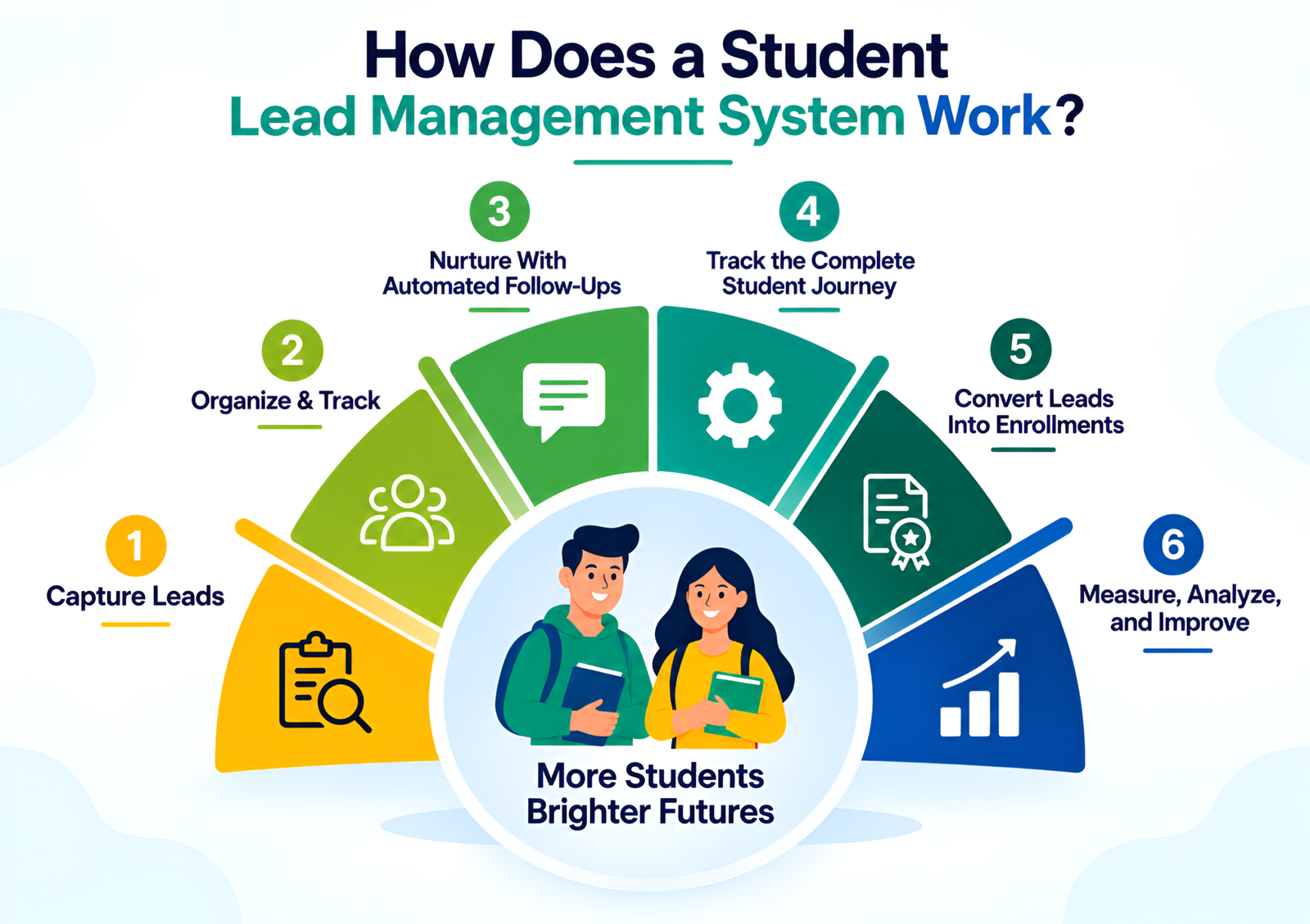
Step 1: Capture Every Lead, From Every Source

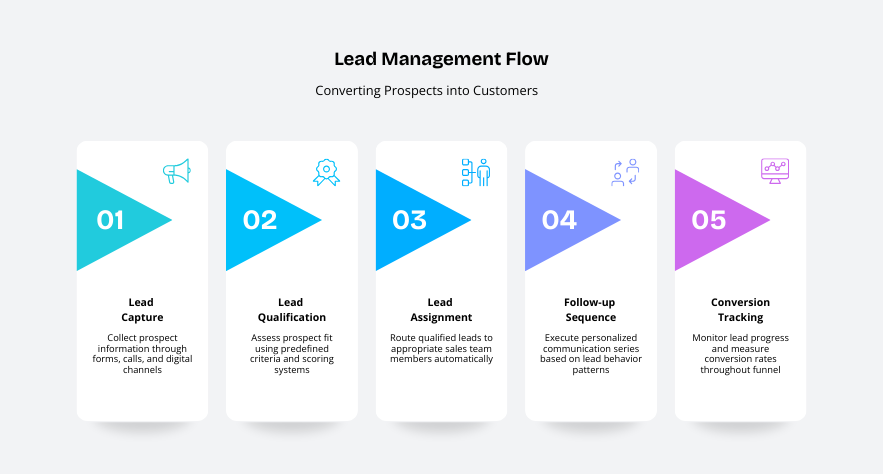
The journey begins with lead capture. Prospective students reach out through many channels, your website, Google and Meta ads, education portals, referrals, walk-ins, and phone calls. An education CRM automatically captures leads from all of these into one place, so no enquiry is ever lost. This is the foundation of effective CRM for lead management: every potential student is recorded the moment they show interest.


Step 2: Organise and Assign Leads Instantly

Once captured, leads need to reach the right counsellor quickly. The CRM automatically organises and assigns each lead based on your rules, by course, location, source, or team, so students are contacted fast. Speed matters: the quicker you respond, the more likely you are to convert. Automated lead assignment ensures no enquiry sits unattended.


Step 3: Nurture Leads With Automated Follow-Ups

Most students don’t enrol after the first conversation, they need several touch points. This is where CRM for lead nurturing proves its value. The CRM schedules and automates follow-ups across WhatsApp, email, SMS, and calls, with reminders so counsellors never forget. Consistent, timely follow-ups keep your institution top of mind and gently guide interested students toward a decision.


Step 4: Track the Complete Student Journey

At every stage, the CRM records the student’s status, enquired, contacted, counselled, application started, documents pending, admission confirmed. Your team always knows exactly where each student is in the journey, and what the next step should be. This visibility is what makes CRM for admissions so powerful: nothing gets forgotten, and every student receives a clear, consistent experience.


Step 5: Counsel and Convert

With all the student’s information and history in one place, counsellors can have better, more personalised conversations. They can see past interactions, answer questions confidently, and address concerns, turning interest into intent. The CRM supports the counselling process with reminders, follow-up scheduling, and complete context on every prospective student.


Step 6: Enrol the Student

As students move toward a decision, the CRM helps manage applications, document collection, and admission steps, right through to confirmed enrolment. What started as a simple enquiry is now an enrolled student, tracked and supported at every stage. The result: more admissions from the same volume of leads.


Step 7: Measure, Analyse, and Improve

The journey doesn’t end at enrolment. The CRM gives you analytics on everything: which sources bring the best students, which campaigns convert, how counsellors are performing, and where students drop off. These insights help you make smarter decisions, invest in what works, and keep improving your conversion rate over time.

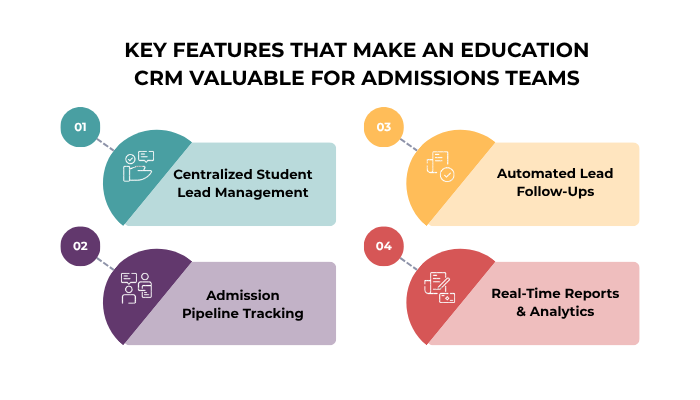
Key Features That Make an Education CRM Valuable for Admissions Team

Education CRM

Not all systems are equal. The features that make an education CRM genuinely valuable for admissions teams include:

  • Multi-source lead capture -collect every enquiry from ads, website, portals, and referrals automatically.
  • Automated lead assignment -route leads to the right counsellor instantly.
  • Follow-up automation -reminders and scheduled communication across WhatsApp, email, SMS, and calls.
  • Complete student tracking -see each student’s stage and history at a glance.
  • Counsellor performance tracking -measure leads handled, follow-ups completed, and admissions converted.
  • Admission analytics and reporting -understand which channels, campaigns, and courses drive results.
  • Communication tools -reach students where they are, without switching platforms like  whatsapp integration or  Admissions calling automation  

Together, these features turn a chaotic admissions process into a smooth, measurable system, which is exactly what a strong education CRM software should deliver.

How Does CRM Automation Improve Student Follow-Ups and Lead Nurturing?

CRM automation transforms follow-ups from a manual, easily-forgotten task into a reliable, consistent process. Instead of relying on counsellors’ memory, the CRM automatically schedules follow-ups, sends reminders, and triggers communication at the right time, so every interested student is nurtured without anything falling through the cracks.

For lead nurturing, automation means prospective students receive timely, relevant messages across their preferred channels, keeping your institution top of mind throughout their decision-making. Automated follow-ups also free your team from repetitive admin, giving counsellors more time for meaningful conversations that actually convert. The outcome is simple: more consistent nurturing, fewer lost leads, and a higher enrolment rate from the same enquiries.

Common Admission Challenges Solved by CRM Software

Admissions teams face the same recurring problems, and the right CRM software solves each one:

  • Leads getting lost -scattered enquiries across channels are captured in one place.
  • Slow response times -automated assignment gets students contacted faster.
  • Inconsistent follow-ups -automation ensures no student is forgotten.
  • No visibility -clear tracking shows exactly where each student is.
  • Wasted ad spend -analytics reveal which sources actually convert, so you invest wisely.
  • Underperforming teams -counsellor tracking highlights where to coach and improve.
  • Manual, repetitive work -automation frees your team to focus on students, not spreadsheets.

By solving these challenges, an education CRM directly increases the number of enquiries that turn into enrolments, growing revenue from your existing lead volume.

How to Choose the Best Education CRM Software for Your Organization

Choosing the best education CRM software comes down to a few key considerations:

  • Built for education -pick a CRM designed for admissions, not a generic business tool adapted to fit.
  • Ease of use -your counsellors should be able to use it without lengthy training.
  • Automation capabilities -strong follow-up, assignment, and communication automation.
  • Multi-channel communication -WhatsApp, email, SMS, and calls in one place.
  • Analytics and reporting -clear insights into leads, sources, and counsellor performance.
  • Scalability -a system that grows with your institution.
  • Support and onboarding -a partner who helps you get set up and succeed.

The best way to judge a CRM is to see it in action with your own admissions process. A quick demo shows you exactly how it will capture leads, automate follow-ups, and help you convert more students.

Book a free Sensation CRM demo →


Logo

Ready to Find the Right Education CRM for Your Team?

Streamline lead management, automate follow-ups,
and improve admissions with the right CRM

Why Sensation CRM Is Built for Education

Sensation CRM is an education CRM designed specifically to help schools, colleges, universities, and coaching institutes convert more enquiries into enrolments. From capturing every lead and automating follow-ups to tracking counsellor performance and admission analytics, Sensation CRM manages your complete admissions journey, from lead capture to student enrollment, in one simple, powerful platform.

With Sensation CRM, your team spends less time on manual work and more time engaging students, so you grow admissions and revenue from the leads you already have.

  • Capture, assign, and nurture every lead automatically
  • Automate follow-ups across WhatsApp, email, SMS, and calls
  • Track your complete admission funnel and counsellor performance
  • Make smarter decisions with admission analytics

Ready to Convert More Enquiries into Enrolments?

An education CRM isn’t just software; it’s the system that turns your enquiries into enrolled students, consistently and measurably. If you’re ready to capture more leads, follow up automatically, and grow your admissions, Sensation CRM is built to help. Contact us today to learn how Sensation CRM can support your admissions growth.

Frequently Asked Questions

Q: How does a CRM work in simple terms?

A CRM works by capturing every lead in one place, organising and assigning them to the right team member, automating follow-ups and reminders, tracking each contact’s journey, and providing analytics on what’s working. For education, this means capturing every enquiry and guiding it all the way to enrolment.

Q: What is the difference between an education CRM and a business CRM?

A business CRM is built for general sales and customer management, while an education CRM is designed specifically for admissions, capturing student enquiries, nurturing prospective students, managing the admission journey, and tracking enrolments. An education CRM fits the way institutions actually work.

Q: How does a CRM help with lead management and follow-ups?

A CRM helps with lead management by automatically capturing and assigning every enquiry, and it improves follow-ups by scheduling and automating communication across WhatsApp, email, SMS, and calls, with reminders so no lead is forgotten. This consistency is what turns more enquiries into enrolments.

Q: Can I see how an education CRM works before buying?

Yes. The best way to understand how a CRM will work for your institution is to book a demo. A demo shows you exactly how the software captures leads, automates follow-ups, and helps your team convert more students.
Categories
Education CRM

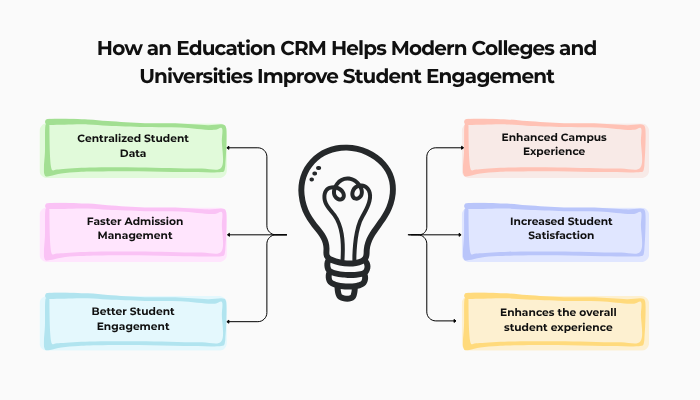
How an Education CRM Helps Modern Colleges and Universities Improve Student Engagement

Today’s students in India expect fast, personal, and consistent communication from the institutions they apply to and attend. Yet many colleges and universities still rely on scattered spreadsheets, disconnected email tools, and manual follow-ups that let prospects slip through the cracks. An Education CRM changes that.

By bringing every enquiry, interaction, and student record into one place, Education CRM software helps institutions engage students more effectively at every stage, from first enquiry to enrolment and beyond. Here’s how it works, the trends driving its adoption, and why it matters.

What Is an Education CRM?

An Education CRM (Customer Relationship Management) system is a platform built specifically for the way colleges and universities work. Instead of managing generic sales contacts, it manages prospective students, applicants, current students, and even alumni, tracking every touchpoint across the entire student lifecycle.

Where a general CRM focuses on deals and revenue, Education CRM software focuses on relationships and outcomes: responding to enquiries quickly, guiding applicants through admissions, and keeping students engaged throughout their journey. It becomes the single source of truth for every interaction your institution has with a student.

Logo

Still Wondering What an Education CRM Can Do?

Centralized Lead Management

Automated Follow-ups

Real-time Reports & Analytics

Secure & Reliable

Market Trends: Why Education CRM Adoption Is Accelerating in India

The move toward Education CRM software isn’t a passing fad, it reflects deep shifts in how students behave and how institutions compete. Several clear trends are driving adoption across the sector.

1. The CRM market is growing fast: CRM is already one of the largest software categories in the world, and both the overall CRM market and the education-specific segment are widely projected to keep expanding at strong double-digit annual rates over the coming years.

2. Students behave like consumers:Students in India increasingly behave like consumers, researching institutions online and often searching for colleges near me before making admission decisions.

3. Competition for enrolments is intensifying: With more institutions competing for a limited pool of applicants, the colleges that communicate best and respond fastest win more students. A CRM is increasingly seen as core infrastructure rather than a nice-to-have.

4. Personalisation is now expected: Generic mass emails no longer cut through. Institutions are turning to CRM-driven segmentation and tailored messaging to engage students meaningfully at every stage.

5. Data-driven decision-making is the new standard: Leadership teams increasingly demand measurable results from marketing and admissions spend. Enquiry-to-enrolment analytics and admissions analytics have moved from optional extras to essential tools for proving and improving performance.

The takeaway: as competition rises and student expectations climb, Education CRM software has shifted from a back-office convenience to a strategic advantage.

Why Student Engagement Is Harder Than Ever

Many prospective students begin their admission journey by searching for colleges, universities, or courses “near me”, making timely responses even more important.

Modern institutions face rising expectations and growing competition. Prospective students research dozens of options, apply to several, and gravitate toward the colleges that respond fastest and communicate best. Meanwhile, admissions and marketing teams are stretched thin, juggling high enquiry volumes across phone, email, social media, and web forms.


Without a unified system, enquiries get missed, follow-ups are inconsistent, and staff spend more time on admin than on building relationships. The result is lost prospects, frustrated applicants, and disengaged students.


A CRM for College and Universities, powered by an advanced Education CRM, tackles these challenges head-on by centralizing student enquiries, automating follow-ups, streamlining admissions, and improving engagement throughout the entire student lifecycle.

How an Education CRM Improves Student Engagement

1. Captures Every Enquiry Instantly

Whether a student reaches out through a web form, phone call, email, or social channel, an Education CRM captures the enquiry automatically and in one place. Nothing gets lost, and every prospect enters a clear, trackable pipeline from the moment they show interest.

2. Enables Fast, Personalised Follow-Up

Speed matters. The institutions that respond first often win the student. Education CRM software automates timely follow-ups and lets staff personalise communication based on a student’s interests, course preferences, and stage in the journey, so every message feels relevant rather than generic.

3. Automates Repetitive Communication

Reminders, application updates, event invitations, and nurture emails can all be automated. This keeps students consistently engaged without adding to your team’s workload, freeing staff to focus on the conversations that need a human touch.

4. Unifies the Entire Student Journey

From first enquiry to enrolment and student support, every interaction is logged in one profile. Any team member can pick up where another left off, delivering a seamless, joined-up experience that makes students feel known and valued.

5. Delivers Powerful Admissions Analytics

A strong Education CRM turns activity into insight. With enquiry-to-enrolment analytics, institutions can see exactly where students drop off, which channels deliver the best applicants, and how quickly teams respond. These admissions analytics help you refine your approach, allocate resources wisely, and continually improve conversion and engagement.

6. Strengthens Long-Term Relationships

Engagement doesn’t end at enrolment. An Education CRM helps institutions stay connected with current students and alumni through ongoing communication, support, and community-building, boosting satisfaction, retention, and advocacy over time.

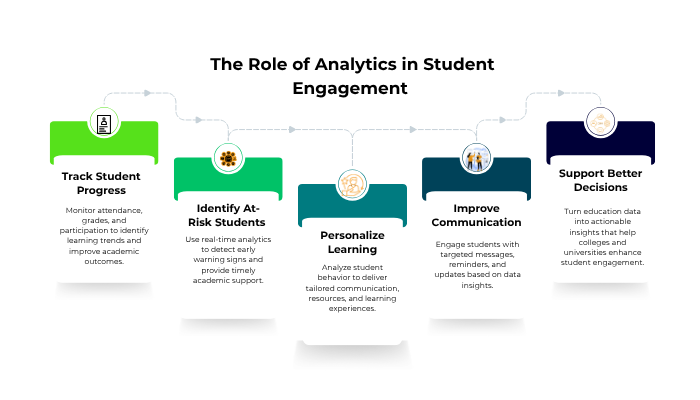
The Role of Analytics in Student Engagement

Education CRM

Data is where an Education CRM truly proves its value. Enquiry-to-enrolment analytics give admissions teams a clear view of the full funnel: how many enquiries arrive, how many convert to applications, and how many result in enrolments.

This visibility helps institutions spot bottlenecks, respond faster, and personalise outreach where it matters most. Admissions analytics also reveal which marketing channels and campaigns bring in the strongest prospects, so budgets go further.

Instead of guessing, decision-makers get evidence, turning student engagement from a hopeful effort into a measurable, improvable process. In an era where leadership expects a clear return on every rupee spent, that measurability is often what justifies the investment in Education CRM software in the first place.

For more insights, best practices, and expert guidance on student admissions, lead management, and CRM solutions, explore Our blogs to stay updated with the latest trends in education technology.

What to Look for in an Education CRM

Not all Education CRM software is created equal. When evaluating options, institutions should look for a platform that captures enquiries from every channel automatically, automates follow-ups and nurture communication, and unifies the full student journey in a single profile.

Strong reporting is essential too, so prioritise a system with genuine enquiry-to-enrolment analytics and admissions analytics rather than surface-level dashboards.

Just as important is ease of use. A CRM only delivers value if your teams actually adopt it, so intuitive design, smooth onboarding, and responsive support should weigh heavily in your decision.

Finally, choose a platform built for education specifically. Purpose-built Education CRM software will always fit admissions workflows better than a generic sales tool adapted after the fact.

Why Colleges and Universities Across India Choose Sensation CRM

Sensation CRM is Education CRM software built specifically for colleges and universities that want to engage students better and convert more enquiries into enrolments.

Rather than forcing your team to adapt to a generic sales tool, it’s designed around the realities of admissions and student engagement.

With Sensation CRM, your institution can:

  •     Capture every enquiry from web, phone, email, and social media in one unified platform.
  •     Automate follow-ups so no prospective student is ever forgotten.
  •     Track the full journey with enquiry-to-enrolment analytics and detailed admissions analytics.
  •     Personalise communication at scale across the entire student lifecycle.
  •     Empower your teams with intuitive tools that are quick to learn and easy to use.

By combining automation, unified records, and powerful analytics, Sensation CRM helps colleges and universities respond faster, engage students more meaningfully, and make smarter, data-driven decisions.


Logo

Empower Your Institution with Sensation CRM

Simplify admissions, automate communication, and
improve student engagement with one powerful Education CRM

Ready to Improve Student Engagement With Sensation CRM?

Students across India expect fast, personalized communication throughout the admission process. Many begin by searching for colleges near me or universities near me, making timely engagement essential.

Sensation CRM helps educational institutions capture every enquiry, automate follow-ups, and improve student engagement with powerful admissions analytics.

If you’re looking for the best Education CRM software in India, Sensation CRM simplifies admissions, increases enrolments, and supports long-term student success.

Common Questions About CRM

Q: What are the 4 types of CRM?

The four main types of CRM are operational CRM (which streamlines day-to-day tasks like enquiries, follow-ups, and admissions workflows), analytical CRM (which turns data into insights, such as enquiry-to-enrolment analytics), collaborative CRM (which shares information across teams for a unified student experience), and strategic CRM (which focuses on building long-term relationships).

A strong Education CRM combines all four to support the full student lifecycle.

Q: Which CRM is most used?

Globally, large general-purpose platforms like Salesforce, HubSpot, Microsoft Dynamics, and Zoho are among the most widely used CRMs across industries.

However, colleges and universities increasingly choose purpose-built Education CRM software, because it’s designed around admissions, enquiries, and student engagement rather than generic sales, making it a far better fit for institutional needs.

Q: Is CRM easy to learn and use?

Modern CRMs are built to be user-friendly, with intuitive dashboards, automation, and guided workflows that reduce manual effort.

A good Education CRM is designed for admissions and marketing teams rather than technical specialists, so most staff can learn the essentials quickly, especially when the provider offers onboarding, training, and support.

Frequently Asked Questions

Q: What is an Education CRM used for?

An Education CRM is used to manage every interaction between an institution and its students, from capturing enquiries and automating admissions follow-ups to tracking the student journey and analysing performance.

It centralises communication so colleges and universities can respond faster, personalise outreach, and improve student engagement at every stage.

Q: How does an Education CRM improve enrolment rates?

By capturing every enquiry instantly and automating timely, personalised follow-ups, an Education CRM ensures no prospective student is forgotten.

Faster responses and consistent nurturing keep applicants engaged through the funnel, while enquiry-to-enrolment analytics highlight where students drop off, so teams can fix bottlenecks and convert more enquiries into enrolments.

Q: What is enquiry-to-enrolment analytics?

Enquiry-to-enrolment analytics track a prospective student’s full journey, from the first enquiry through application to final enrolment.

It shows how many enquiries convert at each stage, which channels deliver the best applicants, and where prospects are lost, giving admissions teams the insight to improve conversion and allocate resources effectively.

Q: Can Education CRM software integrate with our existing systems?

Most modern Education CRM software is built to integrate with the tools institutions already use, such as student information systems, marketing platforms, email, and communication channels.

Integration keeps data consistent across systems and gives teams a single, unified view of each student. It’s always worth confirming specific integrations with your provider.

Q: Is student data secure in an Education CRM?

Reputable Education CRM platforms are designed with data security and privacy in mind, using access controls, secure storage, and compliance measures to protect sensitive student information.

When choosing a provider, ask about their security standards and data-handling practices to ensure they meet your institution’s requirements.

Q: Do smaller colleges really need an Education CRM?

Yes. An Education CRM isn’t just for large universities.

Smaller colleges often benefit even more, because automation lets lean teams handle high enquiry volumes, respond quickly, and compete with larger institutions, without adding headcount. Purpose-built Education CRM software scales to fit institutions of any size.

Q: How long does it take to implement an Education CRM?

Implementation timelines vary with the size of the institution and the complexity of the setup, but a good provider makes onboarding straightforward with guided setup, data migration support, and training.

Because modern Education CRM software is designed to be easy to learn, teams can typically get up and running without a lengthy or disruptive rollout.

Categories
CRM Automation

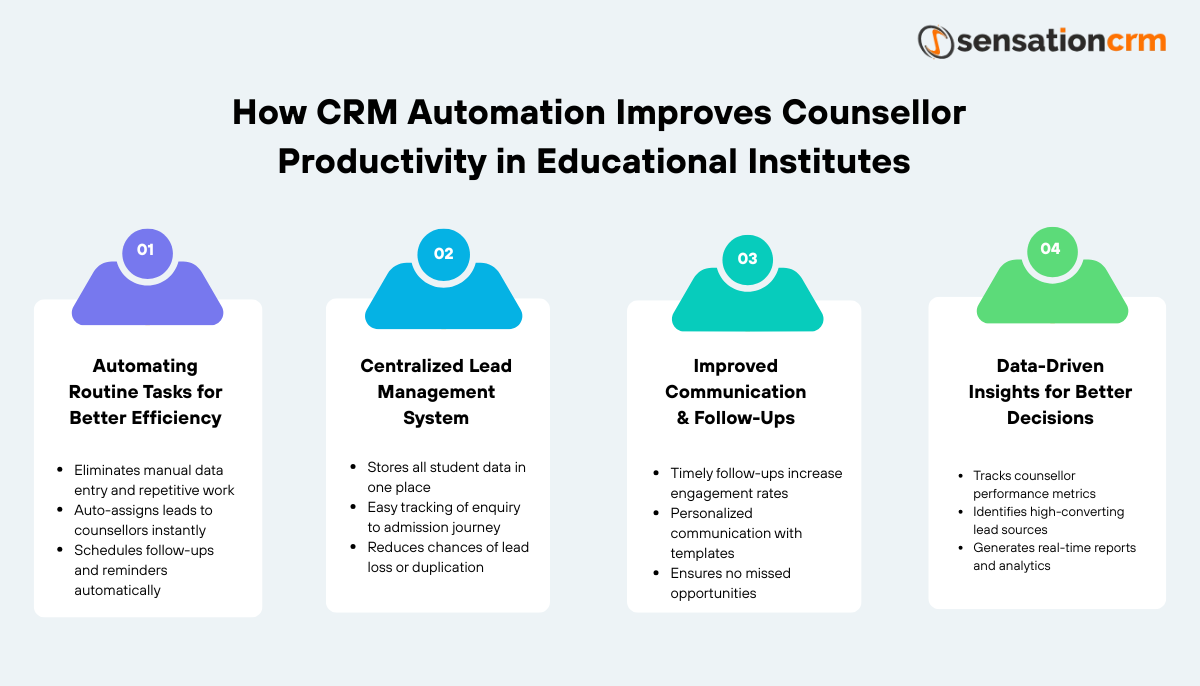
How CRM Automation Improves Counsellor Productivity in Educational Institutes

Admission season in educational institutes across India is honestly, quite hectic. Counsellors are handling hundreds (sometimes thousands) of inquiries, follow-ups, applications, and student queries all at the same time.

And this is exactly where CRM Automation becomes not just useful, but necessary. 

With the help of tools like CRM WhatsApp automationstudent managementadmissions workflow automation, and automated status tracking, institutes can reduce manual work and help counsellors focus on what actually matters converting and guiding students.

What is CRM Automation in Education? 

CRM Automation refers to using technology to automate repetitive and time-consuming tasks involved in managing student leads and admissions. 

Instead of manually tracking everything, a CRM system handles: 

  • Lead capture 
  • Follow-ups 
  • Application tracking 
  • Communication 

As discussed in our blog, Sensation CRM is specifically designed for educational institutes across India, making it easier to manage the entire admission lifecycle from student inquiry to enrollment in one centralized platform.

Why Counsellor Productivity is a Challenge? 

Before understanding automation, it’s important to see where time actually goes. 

Counsellors usually spend a lot of time on: 

  • Repetitive follow-ups 
  • Managing data across Excel, WhatsApp, and emails 
  • Tracking application status manually 
  • Responding to common queries 

The result? 

  • Delayed responses 
  • Missed follow-ups 
  • Lead leakage 
  • Burnout among counsellors 

Automation helps fix these problems at the root level. 


Logo

Ready to Boost Counsellor Productivity?

Automate repetitive tasks, streamline student follow-ups, and help your counsellors focus on more admissions.

CRM WhatsApp Automation for Faster Communication 

Students across India expect quick responses and increasingly prefer communicating through WhatsApp during the admission process.

With CRM WhatsApp automation, institutes can: 

  • Send instant replies to inquiries 
  • Automate follow-up messages 
  • Share course details and updates 
  • Send reminders for deadlines 

How it improves productivity? 

  • Counsellors don’t have to reply manually every time 
  • Faster response = higher chances of conversion 
  • Consistent communication across all leads 

Instead of typing the same answers again and again, counsellors can focus on meaningful conversations. 

Admissions Workflow Automation 

Admissions involve multiple steps, and managing them manually can get messy. 

Admissions workflow automation helps streamline the entire process. 

What gets automated? 

  • Lead assignment to counsellors 
  • Follow-up scheduling 
  • Application movement through stages 
  • Notification triggers 

Example Workflow: 

StageAction
InquiryAuto-assign to counsellor
Follow-upAutomated reminders
ApplicationStatus update
EnrollmentFinal confirmation

Benefits: 

  • Clear process flow 
  • No confusion or overlap 
  • Faster progression of leads 

Application Automation Simplifies the Process 

Handling applications manually is time-consuming and error-prone. 

With application automation, institutes can: 

  • Collect applications digitally 
  • Auto-fill data from lead profiles 
  • Track document submissions 
  • Send alerts for incomplete applications 

Key advantages: 

  • Reduced paperwork 
  • Faster processing 
  • Fewer errors 

This allows counsellors to handle more applications without increasing workload. 

Automated Status Tracking for Better Visibility 

One of the biggest challenges is knowing where each lead stands. 

With automated status tracking, every lead is updated in real-time. 

What it tracks: 

  • Inquiry stage 
  • Application progress 
  • Payment status 
  • Enrollment confirmation 

Why it matters 

  • Counsellors don’t need to check manually 
  • Managers get full visibility 
  • No lead is forgotten 

It creates a “single source of truth” for the entire team. 

Role of Automation Tools in Daily Operations 

Modern automation tools are not just about saving time they improve overall efficiency. 

Key areas where automation tools help: 

  • Communication (emails, WhatsApp, SMS) 
  • Task management 
  • Reporting and analytics 
  • Lead tracking 

This reduces dependency on manual processes and improves team coordination. 

How CRM Automation Directly Improves Counsellor Productivity? 

When all these automation features work together, the impact is very clear. 

Productivity Improvements: 

  • Less manual work: Repetitive tasks are automated 
  • Faster responses: Leads are handled instantly 
  • Better focus: Counsellors spend more time on conversions 
  • Higher efficiency: More leads managed in less time
     

Before vs. After Automation:

TaskBefore CRMAfter CRM Automation
Follow-upsManualAutomated
Lead trackingExcel sheetsReal-time dashboard
CommunicationScatteredCentralized
ProductivityLowHigh

Why Institutes Are Adopting CRM Automation? 

Educational institutes across India are adopting CRM automation because:

  • Admissions are becoming more competitive 
  • Lead volumes are increasing 
  • Students expect quick responses 

Using solutions like Sensation CRM, institutes can: 

  • Manage leads efficiently
  • Improve counsellor performance
  • Increase conversion rates

Best Practices to Maximize CRM Automation

To get the best results, automation needs to be used correctly. 

Recommended practices: 

  • Set clear workflows 
  • Train counsellors properly 
  • Keep data updated 
  • Monitor performance regularly 
  • Use automation smartly (not blindly) 

Automation works best when combined with human judgment. 

Logo

Empower Your Counsellors with CRM Automation

Reduce manual work, improve response times, and manage every student inquiry from one intelligent CRM.

Capture Inquiries

From all sources in one place

Automate Follow-ups

Timely reminders & communication

Monitor Performance

Track counselors & team activity

Increase Enrollments

Convert more inquiries into admissions

Final Thoughts 

CRM Automation is not just about saving time it’s about working smarter. 

By using tools like: 

  • CRM WhatsApp automation 
  • Admissions workflow automation 
  • Application automation 
  • Automated status tracking 

Institutes can significantly improve counsellor productivity and overall admission performance. 

Platforms like Sensation CRM help educational institutions across India implement CRM automation without complexity. When counsellors spend less time managing data and more time engaging with students, conversions naturally improve while creating a better admission experience.

Frequently Asked Questions

Q: What is CRM automation in education?

CRM automation helps automate tasks like lead management, follow-ups, and application tracking in educational institutes. 

Q: How does CRM WhatsApp automation help counsellors?

It automates communication, reduces manual replies, and ensures faster responses to student inquiries. 

Q: What is admissions workflow automation?

It is the automation of the entire admission process, from lead capture to enrollment. 

Q: How does automated status tracking work?

It updates the status of each lead in real-time, giving full visibility to counsellors and management. 

Q: Can CRM automation improve conversion rates?

Yes, faster responses and better follow-ups significantly improve conversion rates. 

Q: Why should institutes use CRM automation tools?

To reduce manual work, improve efficiency, and manage large volumes of leads effectively.

Categories
Education Consultancy

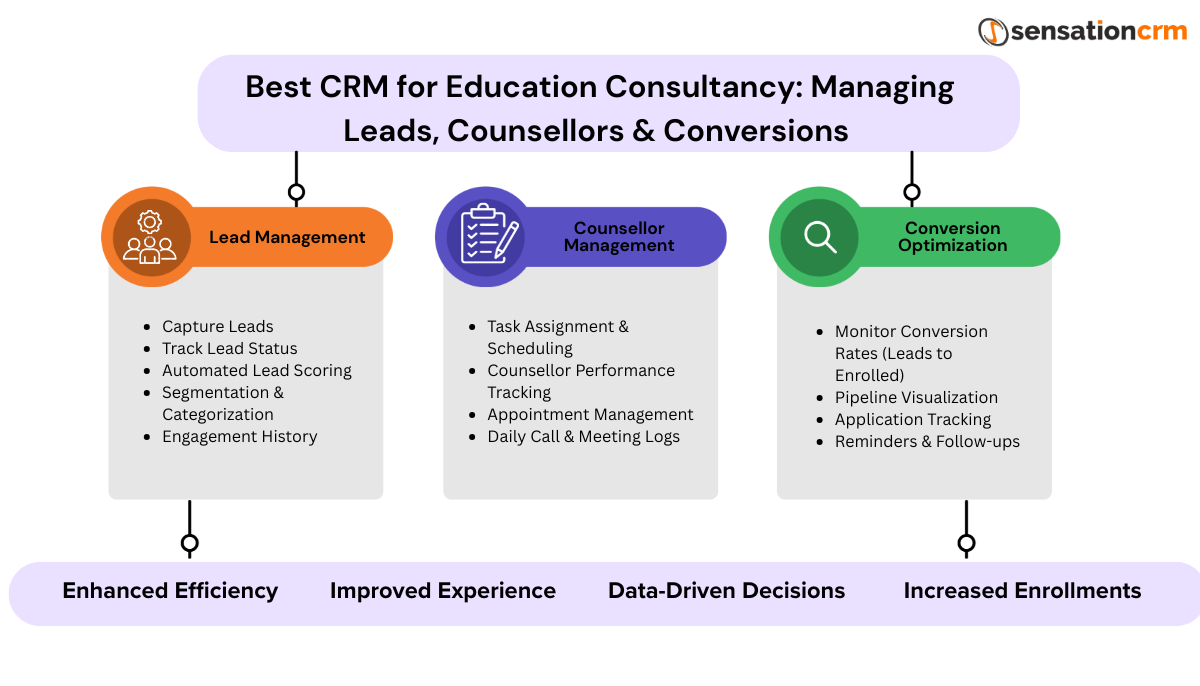
Best CRM for Education Consultancy: Managing Leads, Counsellors & Conversions 

In today’s competitive education sector, education consultancies across India are generating more student enquiries than ever through websites, WhatsApp, Google Search, education portals, social media, and referrals. The real challenge is no longer generating leads—it’s managing them efficiently, responding faster, and converting enquiries into successful admissions.

Leads come from: 

  • Website forms 
  • WhatsApp 
  • Calls
  • Social media 
  • Walk-ins 

And without a structured system, things quickly become messy–missed follow-ups, confused counsellors, and lost admissions. 

That’s exactly where an Education CRM becomes essential. As student expectations continue to grow across India, consultancies need a centralized platform that automates follow-ups, improves counsellor productivity, and manages every student enquiry from first contact to enrollment.

Sensation CRM, an Education CRM built specifically for education consultancies, colleges, universities, coaching institutes, and educational organizations in India, helps streamline admissions, student communication, and enrollment management from one centralized platform.

Why Education Consultancies in India Need a CRM (Not Optional Anymore) 

Let’s be real. 

Most consultancies still use: 

  • Excel sheets 
  • WhatsApp chats 
  • Manual tracking 

This leads to: 

  • Scattered data 
  • Delayed responses 
  • Zero visibility into lead status 

According to industry insights, managing inquiries across multiple channels without a system leads to missed follow-ups and poor conversion rates  

And in admission season, even a small delay can cost you a student. 


Logo

Ready to Grow Your Education Consultancy?

Manage leads, empower counsellors, and increase student conversions with Sensation CRM

What Makes an Education CRM Different? 

A normal CRM is built for sales pipelines. 

But CRM in higher education works differently. 

  • Longer decision cycles 
  • Multiple stakeholders (student + parents) 
  • Complex admission stages 


Education CRM systems are designed around the complete student lifecycle from inquiry to enrollment. This is where Sensation CRM is specifically built to perform. 

Why Sensation CRM is the Best CRM for Education Consultancy 

1. Centralized Lead Management (No More Lost Leads) 

With Sensation CRM: 

  • Leads from website, calls, WhatsApp, and forms are captured automatically 
  • Everything is stored in one dashboard 
  • No duplication, no missing data 


This creates a true lead management CRM system where every inquiry is tracked properly. 

2. Smart Lead Distribution to Counsellors 

One of the biggest problems in consultancies:

Some counsellors get overloaded, others idle 

Sensation CRM solves this by: 

  • Auto-assigning leads 
  • Balancing workload 
  • Tracking ownership 


This improves accountability and ensures faster response time. 

3. Complete Student Profile & Timeline 

Each lead has: 

  • Call logs
  • WhatsApp chats 
  • Email history 
  • Notes and documents 


Everything is visible in one place. 

This helps counsellors have better, more personalized conversations. 


4. Automation That Actually Works 

Manual follow-ups are unreliable. 

With Sensation CRM: 

  • Auto WhatsApp replies
  • Email drip campaigns 
  • Call reminders 
  • Follow-up scheduling 


Automation ensures: 

  • Faster responses 
  • Consistent communication 
  • Higher conversions 


In fact, automation removes dependency on memory–which is a major cause of lead loss. 

5. Full Admission Funnel Tracking 

You can track every stage: 

StageMeaning
New LeadFresh inquiry
ContactedFirst interaction
InterestedConsidering options
AppliedApplication submitted
EnrolledFinal conversion

This structured funnel removes guesswork and improves decision-making. 

 6. Real-Time Dashboard & Analytics 

Sensation CRM provides: 

  • Lead source tracking 
  • Conversion rates 
  • Counsellor performance 
  • ROI insights 


This helps consultancies: 

  • Identify what’s working 
  • Fix what’s not 


And make data-driven decisions, not assumptions. 

7. Built for Education (Not Generic Sales) 

Unlike generic CRMs: 

  • It supports admission workflows 
  • Handles parent-student communication 


Tracks counsellor performance 

This reduces the need for heavy customization and improves adoption rates 

8. Scalable for Growth 

As your consultancy grows: 

  • More leads 
  • More counsellors 
  • More programs 


Sensation CRM scales without complexity and keeps everything structured  

Logo

The CRM Built for Education Consultants

Capture Inquiries

From all sources in one place

Automate Follow-ups

Timely reminders & communication

Monitor Performance

Track counselors & team activity

Increase Enrollments

Convert more inquiries into admissions

Key Benefits of Using Sensation CRM 

For Education Consultancies: 

  • No lead leakage 
  • Faster response time 
  • Better team coordination 
  • Higher conversion rates 


For Counsellors: 

  • Clear lead ownership 
  • Easy follow-up tracking 
  • Less manual work 


For Management: 

  • Full visibility
  • Data-driven decisions 
  • Better ROI tracking 


Before vs. After Using Sensation CRM

Without CRMWith Sensation CRM
Excel + WhatsApp chaosCentralized system
Missed follow-upsAutomated tracking
No visibilityReal-time dashboards
Low conversionsHigher conversions

Why it’s perfect for Education Consultancies 

Education consultancies deal with: 

  • High lead volume 
  • Multi-channel communication 
  • Long decision cycles 

Sensation CRM is designed exactly for this. 

It: 

  • Captures every lead 
  • Tracks every interaction 
  • Converts more students 

That’s what actually matters. 

Choosing the Right Education CRM 

Choosing the right Education CRM is not just about managing leads–it about improving your entire admission process. Most consultancies lose students not because of lack of leads… but because of poor management. Contact us today to streamline your admission process and start converting more leads into students.

Sensation CRM solves this by bringing: 

  • Structure 
  • Automation 
  • Visibility 

Key Note: 

If you want to scale your education consultancy, you don’t just need more leads you need an intelligent Education CRM that converts enquiries into enrollments. Sensation CRM helps education consultancies across India automate student engagement, streamline admissions, and deliver a better admission experience while driving sustainable business growth.

Frequently Asked Question’s

Q: What is an Education CRM?

An Education CRM is a system designed to manage student inquiries, track admissions, and improve conversions across the entire student journey. 

Q: How does Sensation CRM help in lead management?

It captures leads from multiple sources, tracks them in one system, and ensures timely follow-ups through automation. 

Q: Is Sensation CRM suitable for small consultancies?

Yes, it offers scalable plans, making it suitable for both small and large education businesses. 

Q: How does it improve counsellor performance?

By assigning leads, tracking follow-ups, and monitoring response time, it increases accountability. 

Q: Can it handle WhatsApp and call leads?

Yes, it integrates communication channels and stores all interactions in one place. 

Q: What makes it better than generic CRM tools?

It is built specifically for education workflows, unlike generic CRMs that require heavy customization. 

Q: Does it improve conversion rates?

Yes, through automation, faster response time, and structured tracking, it significantly improves conversions. 

Categories
Education CRM

Education CRM for Admissions: Eliminate Lead Loss & Improve Conversions

Admission season can be one of the busiest periods for educational institutions. With inquiries arriving from websites, social media, phone calls, and email campaigns, admission teams often struggle to keep up with growing volumes of student interest.

When follow-ups are delayed or student information is scattered across different platforms, valuable opportunities can be lost. Prospective students expect quick responses and personalized communication, making efficient lead management more important than ever.

This is where an admissions CRM plays a vital role. By centralizing data, automating routine tasks, and improving visibility across the admission funnel, institutions can reduce lead loss and improve enrollment outcomes.

This is where an Education CRM becomes essential. A well-implemented CRM in higher education centralizes processes, automates communication, and ensures no lead is ignored-helping institutions manage high volumes efficiently and convert more inquiries into admissions.

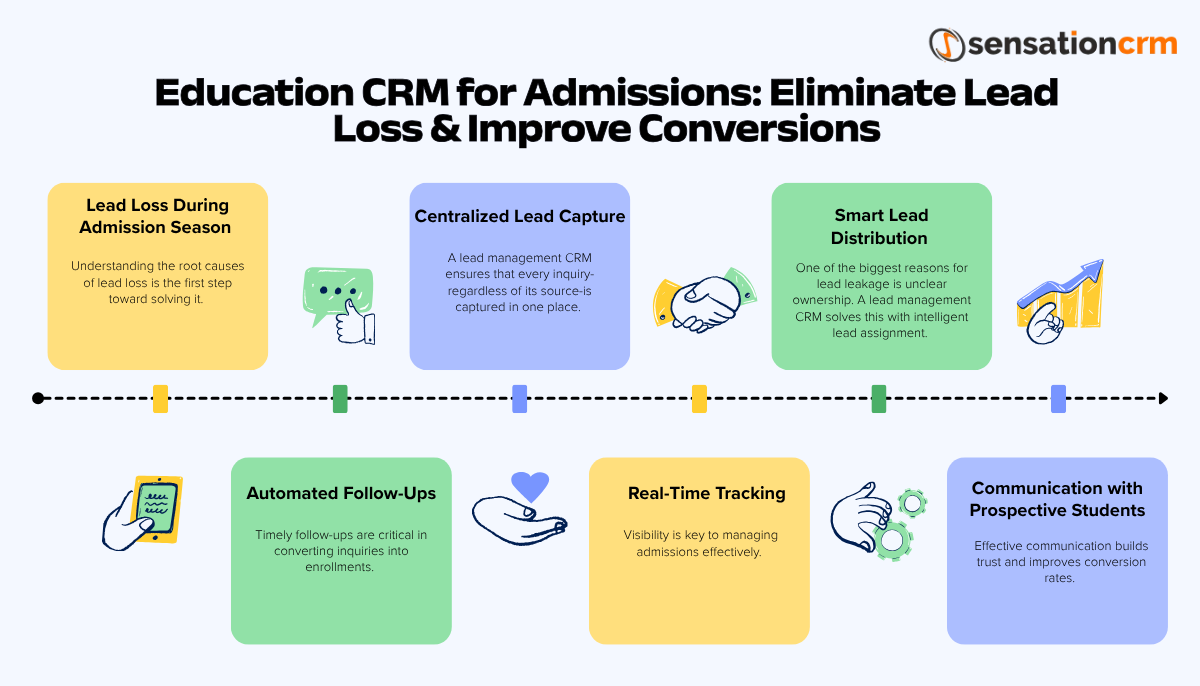
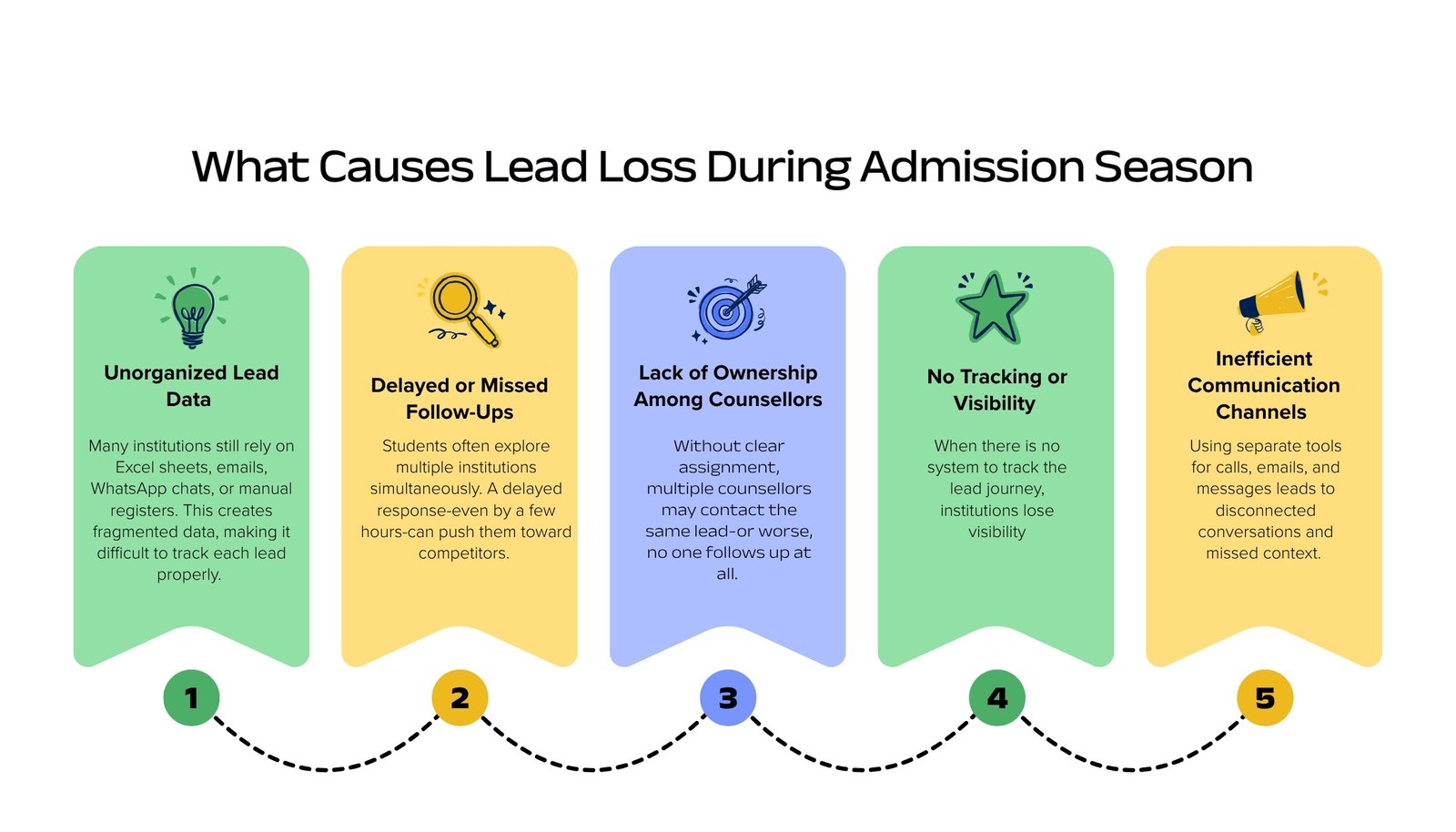
What Causes Student Lead Loss During Admission Season in India?

Lead Loss During Admission Season

Understanding the root causes of lead loss is the first step toward solving it. 

1. Unorganized Lead Data 

Many schools, colleges, universities, and educational institutions in India still rely on Excel sheets, emails, WhatsApp chats, or manual registers to manage admissions. This fragmented approach makes it difficult to track student inquiries, resulting in delayed follow-ups and missed admission opportunities.

2. Delayed or Missed Follow-Ups 

Students often explore multiple institutions simultaneously. A delayed response-even by a few hours-can push them toward competitors. 

3. Lack of Ownership Among Counsellors 

Without clear assignment, multiple counsellors may contact the same lead-or worse, no one follows up at all. 

4. No Tracking or Visibility 

When there is no system to track the lead journey, institutions lose visibility into: 

  • Which stage the student is in 

  • What actions have been taken 

  • What needs to happen next 

5. Inefficient Communication Channels 

Using separate tools for calls, emails, and messages leads to disconnected conversations and missed context. 

All these challenges create friction in the admission process, resulting in lost opportunities. 

Logo

Stop Losing Student Leads Today

Centralized Lead Management

Automated Follow-ups

Real-time Reports & Analytics

Secure & Reliable

What is an Education CRM?

An Education CRM in India is specialized admission management software that helps educational institutions manage the complete student lifecycle from the first inquiry to enrollment and beyond.

Unlike generic CRM tools, an Education CRM is tailored specifically for academic institutions, and an Education CRM App further enhances accessibility by allowing teams to manage admissions on the go. It understands the admission funnel and includes features such as:

  • Lead capture and tracking 

  • Admission workflow management 

  • Counsellor assignment 

  • Communication automation 

  • Reporting and analytics 

In the context of CRM in higher education, it acts as a centralized system that brings together marketing, admissions, and communication processes into one platform. 

The key advantage is automation combined with centralization, ensuring efficiency and accuracy during high-pressure admission cycles. 

Centralized Lead Capture with Lead Management CRM

A Lead Management CRM for Educational Institutions in India ensures every student inquiry is captured automatically, regardless of whether it comes from your website, Google Ads, Meta Ads, WhatsApp, phone calls, education portals, walk-ins, or referral campaigns.

Lead Sources Integrated: 

  • Website forms 

  • Phone calls 

  • Social media platforms 

  • Email inquiries 

  • Walk-ins 

Instead of scattered data, all leads flow into a single dashboard, creating a single source of truth

Key Benefits: 

  • No duplication of leads 

  • No missing data 

  • Easy access for the entire team 

  • Better tracking from day one 

With centralized lead capture, institutions eliminate the risk of losing leads due to manual errors or system gaps. 

Smart Lead Distribution and Ownership

One of the biggest reasons educational institutions in India lose student inquiries is the absence of a structured lead assignment process. An AI-powered Education CRM in India automatically assigns leads to counselors based on predefined rules such as course preference, city, department, workload, or campus.

How It Works: 

  • Leads are automatically assigned to counsellors 

  • Distribution can be based on rules (location, course, workload) 

  • Role-based access ensures accountability 

Impact: 

  • Faster response times 

  • Clear responsibility for each lead 

  • No overlap or confusion 

When every lead has a defined owner, follow-ups become consistent, and the chances of conversion increase significantly. 

Automated Follow-Ups and Reminders

Timely follow-ups are essential for improving student admissions in India’s highly competitive education sector.

An Education CRM automates this process through: 

Automation Features: 

  • Scheduled email campaigns 

  • SMS reminders 

  • Call follow-up alerts 

  • Task notifications for counsellors 

Why It Matters: 

  • Ensures no lead is forgotten 

  • Maintains consistent communication 

  • Keeps prospects engaged throughout the decision-making process 

Automation reduces dependency on manual effort and ensures every lead is nurtured at the right time. 

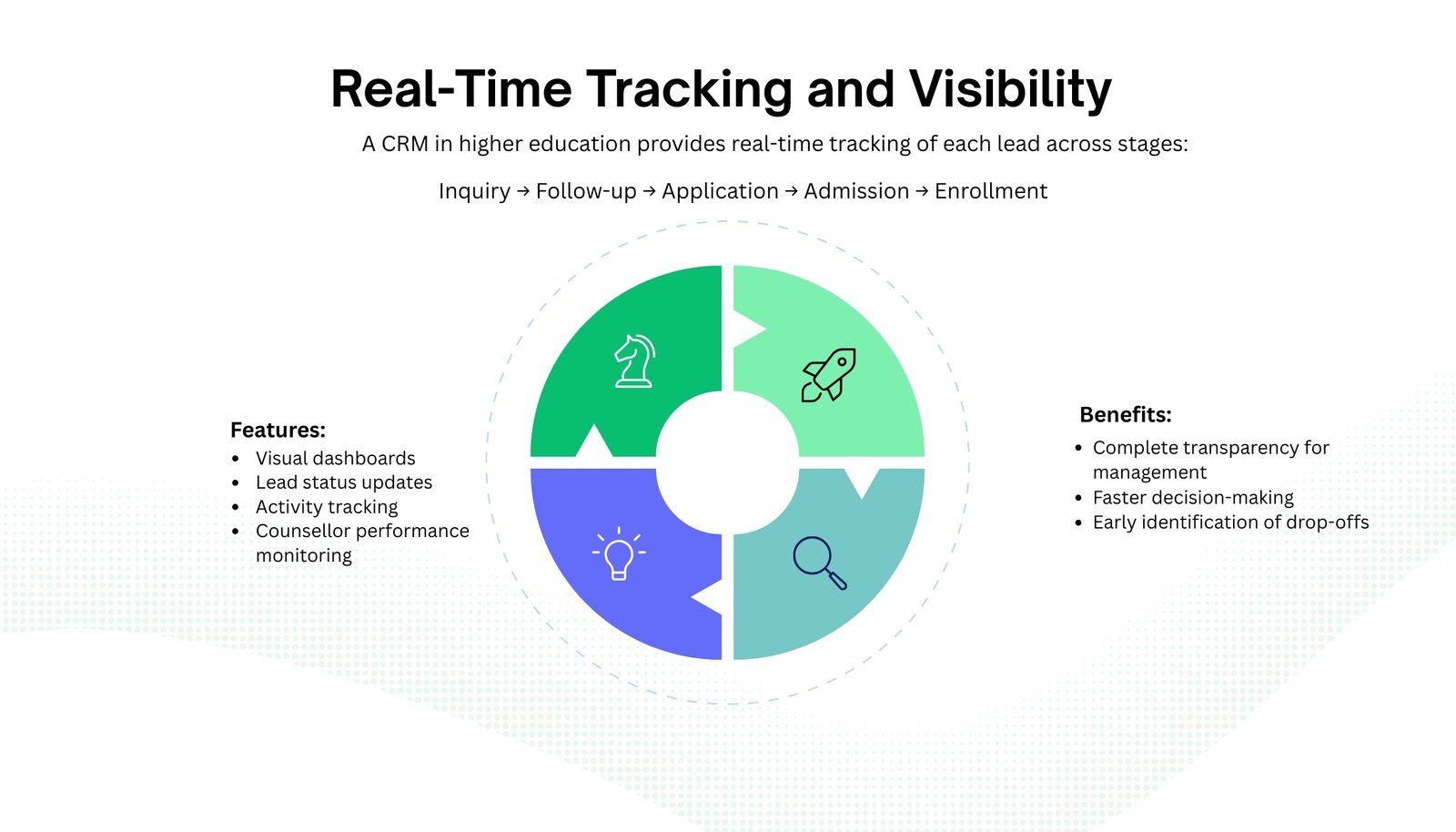
Real-Time Tracking and Visibility

Real-Time Tracking and Visibility

Visibility is key to managing admissions effectively. 

A CRM for Colleges and Universities in India provides complete visibility into every stage of the admission process:

Student Inquiry → Follow-up → Application → Document Verification → Admission → Enrollment

This enables admission managers to identify bottlenecks quickly and improve conversion rates.

Features: 

  • Visual dashboards 

  • Lead status updates 

  • Activity tracking 

  • Counsellor performance monitoring 

Benefits: 

  • Complete transparency for management 

  • Faster decision-making 

  • Early identification of drop-offs 

Institutions can instantly see where leads are getting stuck and take corrective actions. 

Improved Communication with Prospective Students

An Education CRM in India centralizes every interaction with prospective students, including calls, emails, WhatsApp conversations, SMS messages, and counselor notes, allowing admission teams to deliver personalized communication and a better student experience.

Unified Communication Includes: 

  • Call logs 

  • Email history 

  • WhatsApp messages 

  • Notes from counsellors 

Advantages: 

  • Personalized interactions 

  • Context-aware conversations 

  • Consistent messaging across channels 

Students receive timely, relevant information, which enhances their experience and increases the likelihood of enrollment. 

Data-Driven Insights to Reduce Lead Loss

A Lead Management CRM in India provides actionable insights that help educational institutions make smarter admission decisions.

Key Reports: 

  • Lead source performance 

  • Conversion rates 

  • Campaign effectiveness 

  • Counsellor productivity 

How It Helps: 

  • Identify which channels bring high-quality leads 

  • Detect bottlenecks in the admission funnel 

  • Optimize strategies in real time 

Instead of guessing, institutions can make informed decisions based on actual data. 

Benefits of Using a CRM in Higher Education in India

Implementing a CRM in higher education delivers measurable improvements: 

1. Reduced Lead Leakage : Centralized tracking ensures no inquiry is missed. 

2. Faster Response Time : Automation and smart assignment enable quick responses. 

3. Higher Conversion Rates : Consistent follow-ups and personalized communication improve outcomes. 

4. Better Team Coordination : All departments work on the same system with shared visibility. 

5. Scalable Admission Process : Institutions can handle increased lead volume without operational breakdown. 

6. Better Admission Planning Across Multiple Campuses: Educational institutions operating across multiple campuses in India can manage admissions from a single centralized platform, ensuring standardized workflows, better reporting, and improved collaboration between teams.

Overall, a CRM transforms admission management from reactive to proactive. 


Logo

Turn More Student Inquiries into Enrollments

Streamline admissions, eliminate lead loss, and convert more prospects with an AI-powered Education CRM

Best Practices to Maximize CRM Effectiveness

Simply implementing an Education CRM is not enough. To get maximum value, institutions must follow best practices:

1. Train Your Admission Team: Ensure counsellors understand how to use the CRM effectively.

2. Set Clear Workflows: Define processes for lead handling, follow-ups, and status updates.

3. Monitor Dashboards Regularly: Track performance metrics and take action when needed.

4. Use Automation Smartly: Automate repetitive tasks but maintain a human touch in communication.

5. Keep Data Updated: Accurate and updated data ensures reliable insights and smooth operations.

When used correctly, a CRM becomes a powerful growth tool rather than just a management system.

Admission Season is more Chaotic

Admission success is not just about generating more inquiries—it is about managing every opportunity effectively. Across India, educational institutions are competing to attract and enroll quality students. Even the most successful marketing campaigns can underperform if student inquiries are not tracked, nurtured, and followed up consistently.

A modern admissions CRM helps institutions create a more organized and student-focused enrollment process. By combining automation, visibility, and personalized communication, colleges and universities can reduce lead loss, improve team productivity, and convert more prospective students into enrolled learners.

As competition in India’s education sector continues to grow, institutions that invest in a modern CRM for Colleges and Universities in India will be better positioned to improve student experiences, reduce lead loss, and achieve sustainable enrollment growth.

The key takeaway:

Educational institutions that implement the right Education CRM in India don’t just manage student inquiries they build a scalable admission process that consistently converts prospects into enrolled students. For more information, contact us to explore how the right solution can transform your admissions process.

Frequently Asked Questions

Q: How does CRM improve admissions?

An Education CRM is a specialized system designed to manage student inquiries, track interactions, and streamline the admission process. During admission season, it helps institutions handle high volumes of leads efficiently, ensuring no inquiry is missed or delayed.

Q: How does a lead management CRM prevent lead loss?

A lead management CRM prevents lead loss by:

  • Capturing all leads in one system
  • Assigning them to the right counsellors
  • Automating follow-ups
  • Tracking every interaction

This ensures that every lead is consistently nurtured until conversion.

Q: How is CRM in higher education different from a regular CRM?

A CRM in higher education is tailored specifically for admission workflows. Unlike generic CRMs, it includes:

  • Student lifecycle tracking
  • Course/program-based segmentation
  • Admission funnel management
  • Education-specific automation

This makes it more effective for managing student inquiries and enrollments.

Q: Can an Education CRM integrate with multiple lead sources?

Yes, an Education CRM can integrate with various lead sources such as:

  • Website forms
  • Social media platforms
  • Phone calls
  • Email campaigns
  • Walk-ins

This ensures all leads are captured in a single system without duplication.

Q: Does a CRM help improve response time to student inquiries? ?

Absolutely. A lead management CRM enables:

  • Instant lead assignment
  • Automated responses
  • Real-time notifications

This significantly reduces response time, which is critical for improving conversion rates.


Categories
Education CRM

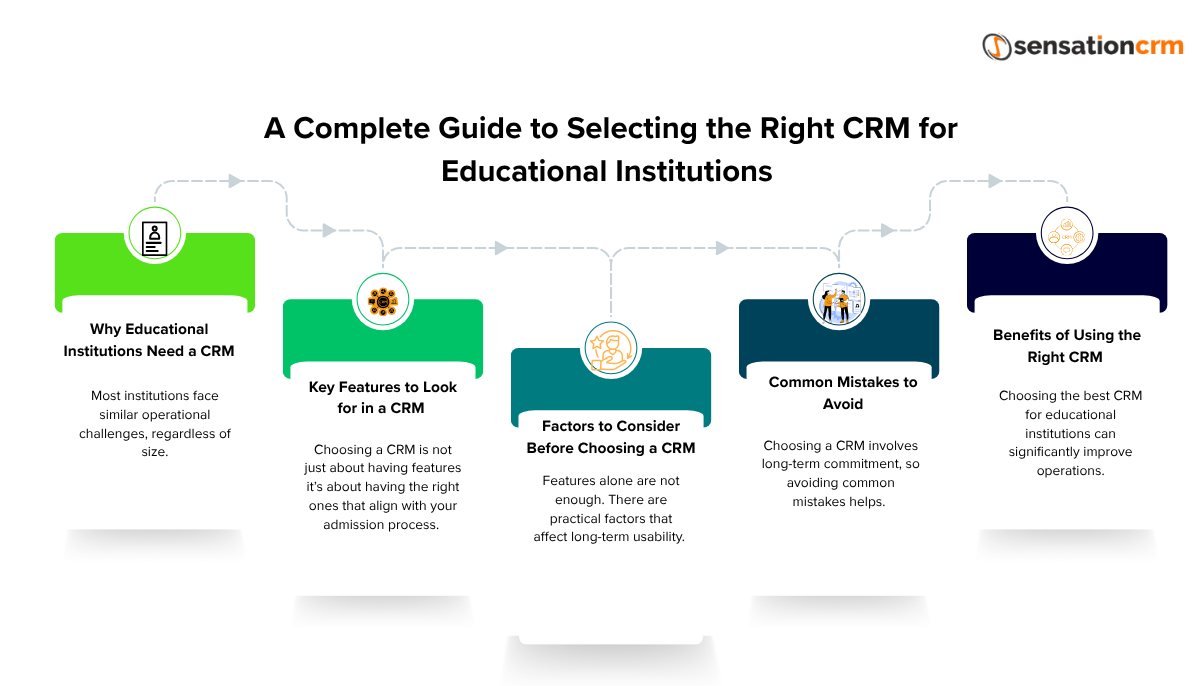
A Complete Guide to Selecting the Right CRM for Educational Institutions

Educational institutions today are handling more inquiries than ever before. Students reach out through websites, WhatsApp, calls, social media, and email, often across multiple touchpoints before making a decision.  Managing this volume manually is difficult. Leads get missed, follow-ups are delayed, and communication becomes inconsistent. In many cases, institutions don’t even have a clear view of how many inquiries actually convert into admissions.

This is where a CRM for educational institutions becomes important. A well-implemented CRM helps centralize data, track every interaction, and streamline the admission process. It doesn’t solve everything instantly, but it brings structure, and that alone improves outcomes over time.

Why Educational Institutions in India Need a CRM

Most institutions face similar operational challenges, regardless of size. 

1. Managing High Volumes of Inquiries

Admission teams across colleges, universities, schools, coaching institutes, and higher education institutions in India often receive hundreds or even thousands of student inquiries during every admission cycle. Without a centralized Education CRM in India, tracking each inquiry becomes difficult, resulting in missed follow-ups and lower conversion rates.

A CRM helps store and organize all leads in one place, making it easier to manage volume without losing visibility. 

2. Streamlining Communication Across Teams
A CRM for Colleges and Universities in India enables admission counselors, marketing teams, and administrators to work from a single platform.

Without a shared system: 

  • Communication gets fragmented 

  • Leads are duplicated 

  • Follow-ups overlap or get missed 

A CRM for colleges or a CRM for private schools ensures everyone works on the same data, reducing confusion. 

3. Improving Conversion Rates
Response time plays a big role in admissions. Studies across sales processes show that responding within the first 5–10 minutes can increase conversion chances significantly sometimes by 2–3x. 

A modern Admission CRM in India helps institutions improve conversion rates by:

  • Assigning leads instantly 

  • Triggering reminders 

  • Tracking follow-ups 

This improves consistency, even if teams are handling large volumes. 

4. Centralized Data Management
Instead of scattered spreadsheets or disconnected tools, a CRM provides a single source of truth. 

This includes: 

  • Student details 

  • Communication history 

  • Lead status 

  • Source of inquiry 

Having everything in one place makes reporting and decision-making more reliable. 

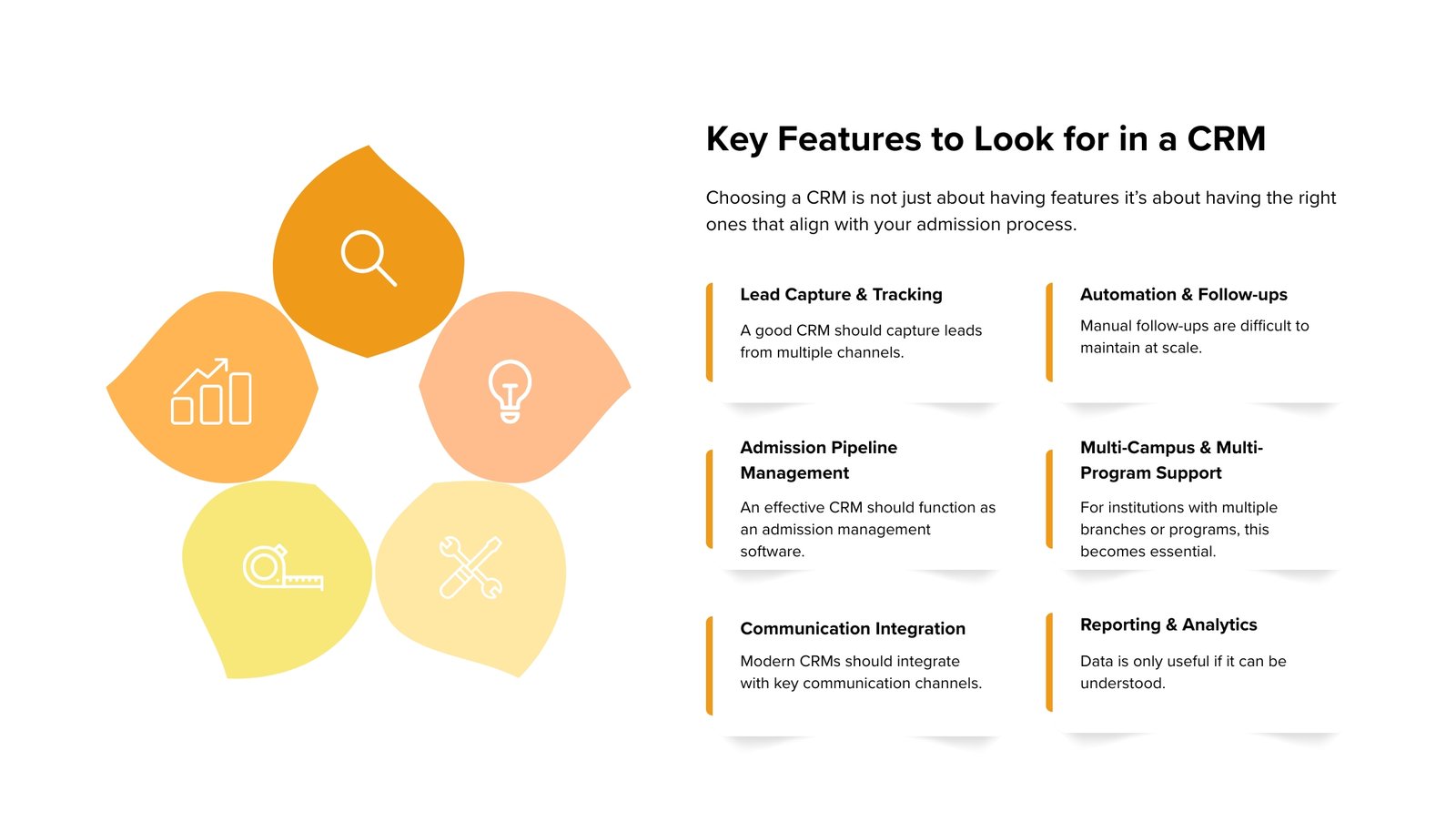
Key Features to Look for in a CRM for Educational Institutions in India

Key Features to Look for in a CRM

Choosing a CRM is not just about having features it’s about having the right ones that align with your admission process. 

 1. Lead Capture & Tracking 

A good CRM should capture leads from multiple channels: 

  • Website forms 

  • WhatsApp 

  • Calls 

  • Email campaigns 

Centralized CRM Lead Management helps institutions assign leads quickly, monitor inquiry sources, and improve admission conversions.

  • Track lead sources 

  • Assign leads quickly 

  • Monitor status changes 

Without proper tracking, even a high number of inquiries doesn’t translate into admissions. 

 2. Automation & Follow-ups 

Manual follow-ups are difficult to maintain at scale. 

Automation helps by: 

  • Sending instant responses to new inquiries 

  • Scheduling reminders for counselors 

  • Triggering email or WhatsApp sequences 

This reduces manual effort and ensures no lead is forgotten, though some level of manual oversight is still needed. 

3. Admission Pipeline Management

An effective Admission CRM in India should function as a complete admission management system.

This means tracking the student journey across stages such as: 

Inquiry → Contacted → Interested → Applied → Document Verification → Admitted → Enrolled

This pipeline view helps teams understand where leads are dropping off and where improvements are needed. 

4. Multi-Campus & Multi-Program Support 

Educational institutions operating across multiple campuses in India require centralized admission management.

The CRM should allow: 

  • Managing multiple campuses in one system 

  • Tracking leads by course or program 

  • Assigning counselors based on specialization 

Without this, scaling operations becomes complicated. 

5. Communication Integration 

A modern Education CRM App in India should integrate seamlessly with:

  • WhatsApp 

  • Email systems 

  • Telephony or call tracking tools 

This ensures all interactions are recorded and accessible from one platform. 

Switching between tools slows things down, and sometimes leads to missed context. 

6. Reporting & Analytics 

A modern CRM for Educational Institutions in India should provide AI-powered dashboards and reports, including:

  • Performance dashboards 

  • Lead source analysis 

  • Conversion tracking 

  • Counselor performance metrics 

For example: 

  • Which channel brings the most leads? 

  • Which counselor converts the most students? 

Institutions using CRM analytics often report 10–20% improvement in process efficiency, though it depends on how actively the data is used. 


Logo

Ready to Find the Best CRM for Your Institution?

Simplify admissions, automate workflows, and improve student engagement with Sensation CRM

Factors to Consider Before Choosing an Education CRM in India

Features alone are not enough. There are practical factors that affect long-term usability. 

1. Ease of Use and Interface 

If the CRM is difficult to use, adoption becomes a problem. 

Teams may: 

  • Avoid using it fully 

  • Enter incomplete data 

  • Revert to manual methods 

A clean and simple interface improves usage, even if the system is not feature-heavy. 

 2. Customization Options 

Every institution has slightly different workflows. 

A CRM should allow: 

  • Custom lead stages 

  • Flexible workflows 

  • Configurable fields 

Too much rigidity can limit usefulness. 

3.  Scalability for Future Growth 

Educational institutions in India continue to expand by adding new campuses, programs, online courses, and student intake.

The CRM should be able to handle: 

  • Increased data volume 

  • Additional users 

  • Expanded workflows 

Switching systems later is possible, but not easy. 

 4. Integration Capabilities 

The CRM should work well with existing tools such as: 

  • Marketing platforms 

  • Payment systems 

  • Learning management systems 

Lack of integration often creates extra manual work. 

 5. Customer Support and Training 

Implementation doesn’t end after purchase. 

Good CRM providers offer: 

  • Onboarding support 

  • Training sessions 

  • Ongoing assistance 

Without proper support, teams may not use the system effectively. 

Common Mistakes to Avoid

Choosing the right Education CRM in India is a long-term investment. Avoiding common mistakes helps institutions improve operational efficiency, student engagement, and long-term enrollment growth.

 1. Choosing Based Only on Price 

Lower-cost options may lack important features or scalability. 

Initial savings can lead to higher costs later due to inefficiencies. 

 2. Ignoring Scalability 

A system that works for 500 leads may not work for 5,000. 

Planning ahead avoids the need for migration later. 

3. Not Checking Integration Options 

If the CRM cannot integrate with your existing tools, manual work increases. 

This reduces overall efficiency. 

 4. Overlooking User Adoption and Training 

Even a good CRM fails if the team doesn’t use it properly. 

Training and ease of use matter more than expected. 

Benefits of Using the Best CRM for Educational Institutions in India

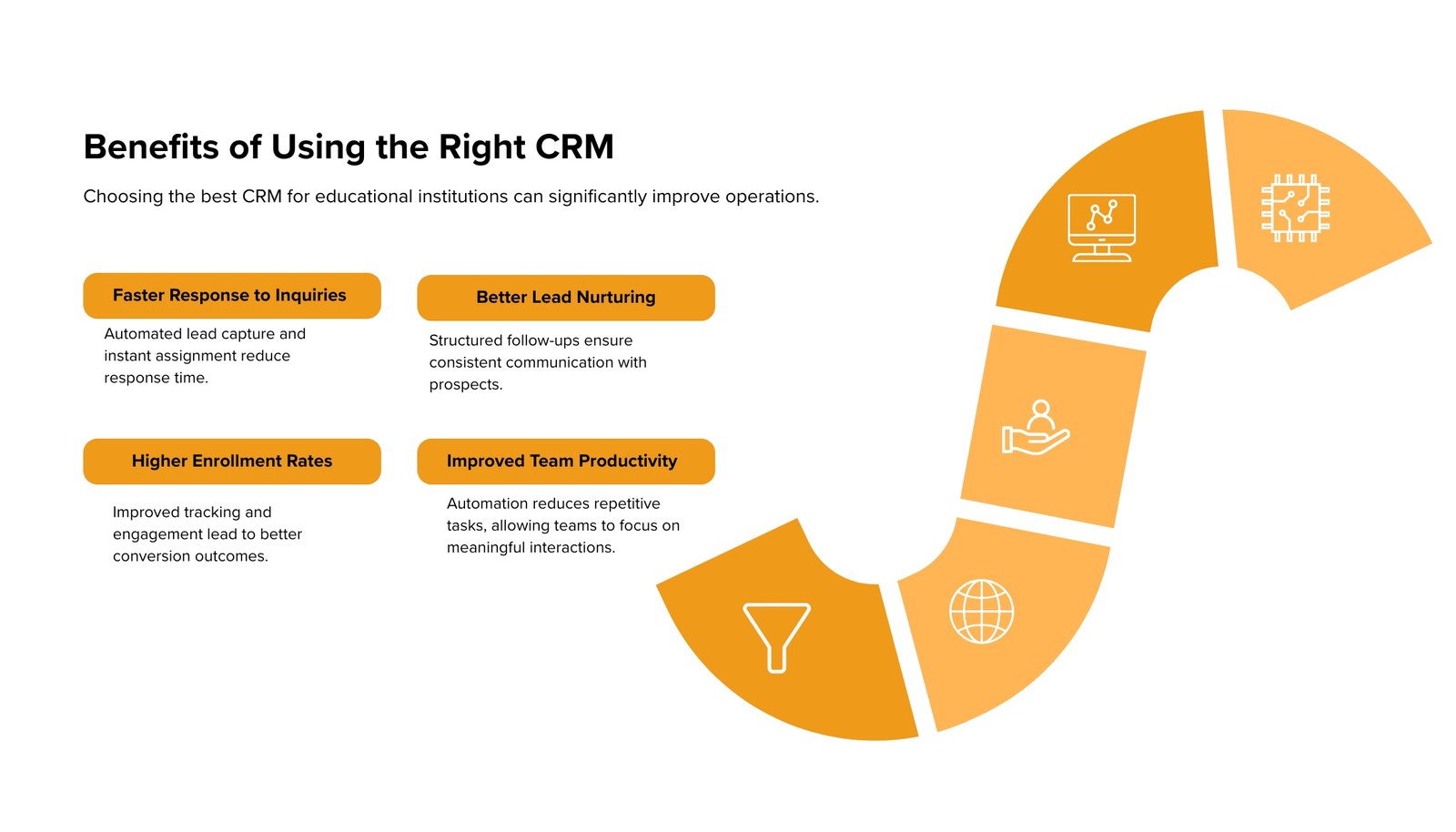
Benefits of Using the Right CRM

Educational institutions in India can provide faster responses, personalized updates, automated reminders, and consistent communication to both students and parents throughout the admission journey.

 1. Faster Response to Inquiries 

Automated lead capture and instant assignment reduce response time. 

 2. Better Lead Nurturing 

Structured follow-ups ensure consistent communication with prospects. 

 3. Higher Enrollment Rates 

Improved tracking and engagement lead to better conversion outcomes. 

Some institutions report 15–25% increase in enrollments after implementing CRM systems properly. 

 4. Improved Team Productivity 

Automation reduces repetitive tasks, allowing teams to focus on meaningful interactions. 

How CRM Improves Admission Process

An AI-powered Education CRM in India brings structure and automation to every stage of the admission process.

 1. Organized Lead Funnel 

Leads are categorized clearly, making it easier to track progress. 

2.  Automated Follow-ups 

No need to rely on memory or manual tracking. 

 3. Better Counselor Performance Tracking 

Managers can monitor: 

  • Response times 

  • Conversion rates 

  • Engagement levels 

4. Data-Driven Decisions 

Instead of assumptions, decisions are based on actual data. 

This improves planning and resource allocation over time. 

Who Should Use a CRM

A CRM for Educational Institutions in India is suitable for:

  • Colleges and Universities : Large volumes of inquiries and multiple departments make CRM essential. 
  • Coaching Institutes : High competition and frequent intake cycles require efficient lead management. 
  • Private Schools : Managing parent inquiries and follow-ups becomes easier with structured systems.
  • EdTech and Training Institutes : Digital-first operations benefit from automation and centralized data. 

Final Checklist Before You Decide

Before selecting a CRM, it helps to evaluate a few key points: 

  • Does it support your admission workflow? 

  • Can it scale with your institution? 

  • Does it offer strong CRM lead management

  • Is it easy for your team to adopt? 

If the answer to most of these is yes, the system is likely a good fit. 

Choosing The right Education CRM

Choosing the right CRM for Educational Institutions in India requires balancing usability, automation, scalability, and long-term value.

An AI-powered Education CRM helps colleges, universities, schools, coaching institutes, and EdTech organizations centralize admissions, automate follow-ups, improve communication, and increase student enrollments.

As competition in India’s education sector continues to grow, institutions that adopt modern admission management technology will be better positioned to deliver better student experiences and achieve sustainable enrollment growth.

Whether you’re managing admissions for a single campus or multiple institutions across India, investing in the right Education CRM in India can help your team reduce lead loss, improve counselor productivity, and convert more student inquiries into successful admissions.

Book a demo or get in touch to explore how a structured CRM system can support your institution’s growth. 

Logo

Choose the Right Education CRM with Confidence

Capture Inquiries

From all sources in one place

Automate Follow-ups

Timely reminders & communication

Monitor Performance

Track counselors & team activity

Increase Enrollments

Convert more inquiries into admissions

Frequently Asked Questions

Q: What is a CRM for educational institutions?

It is a software system designed to manage student inquiries, track leads, and streamline admissions processes.

Q: How does CRM improve admissions?

It organizes leads, automates follow-ups, and provides insights that help improve conversion rates.

Q: Is CRM useful for small institutions?

Yes, even smaller institutions benefit from better organization and faster response times.

Q: What features should I prioritize?

Lead management, automation, communication integration, and reporting are key features.

Q: How long does it take to implement a CRM?

Implementation can take a few days to a few weeks, depending on complexity and customization.


Categories
Education CRM

Best CRM for Education in India: Features, Use Cases & Selection Checklist

Education in India has changed fast. Schools, colleges, coaching institutes, edtech startups, and training centers now operate more like service businesses than traditional institutions. Leads come from websites, WhatsApp, ads, walk-ins, referrals, and counsellors handle dozens of conversations every day. Without a system, things fall apart quickly. That’s where an education-focused CRM comes in.

But not every CRM fits Indian education workflows. Some are built for generic sales teams. Others look good in demos but break when real admissions pressure starts. This guide breaks down what the best CRM for education in India actually needs to do, how different institutions use it, and how to choose one without overthinking. No buzzwords. Just how it works in real life.

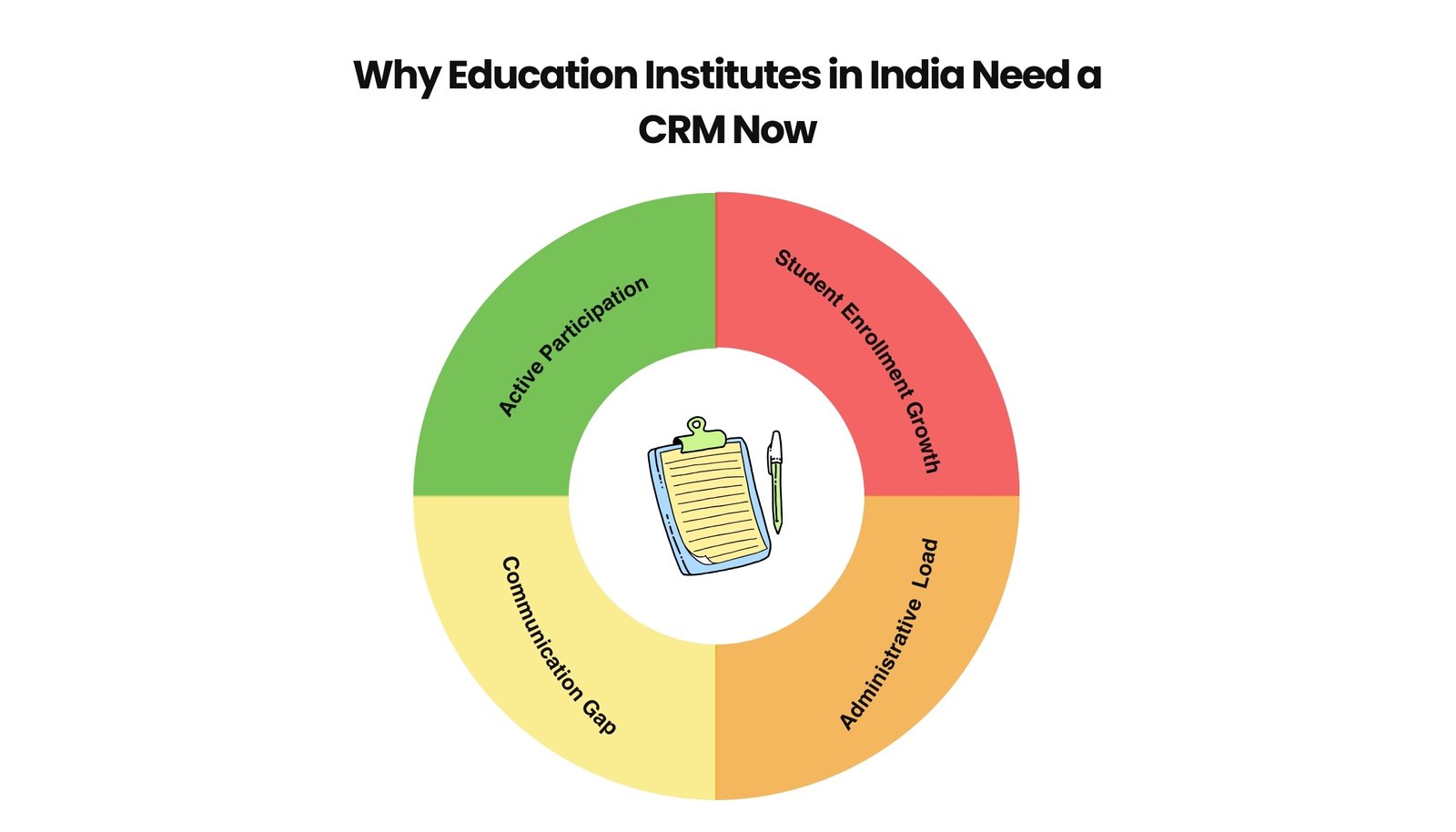
Why Education Institutes in India Need a CRM Now

Ten years ago, Excel sheets and phone registers were enough. Today, they’re not.

Here’s what most education teams deal with daily:

  • Hundreds of leads from multiple sources
  • Parents calling during working hours, students messaging late nights
  • Counselors juggling follow-ups, walk-ins, and fee discussions
  • Admission heads needing daily performance clarity
  • Marketing teams wanting ROI answers


Without a CRM, lead leakage becomes normal. Follow-ups are missed. Enquiries go cold. Teams blame marketing. Marketing blames counselors. It becomes messy.

A CRM doesn’t solve everything. But it gives structure. And structure matters when volumes increase.

Why Education Institutes in India Need a CRM Now

What Makes The Best CRM for Education Different From Regular CRMs

Education is not standard sales. The buying cycle is emotional, slow, and involves multiple decision-makers. A parent might enquire today and decide after two months. Or never reply again. Or suddenly show up at the center.

A good education CRM understands this behavior.

Key differences:

  • Lead stages are admission-focused, not sales-focused
  • Follow-ups are time-sensitive and repetitive
  • Communication is multi-channel (calls, WhatsApp, SMS, email)
  • Data needs to be simple for counselors, not complex dashboards


Generic CRMs often feel heavy. Education teams need speed, not complexity.


Logo

Choose the Best Education CRM for Your Institution

Compare essential features, streamline admissions, and improve student engagement with Sensation CRM

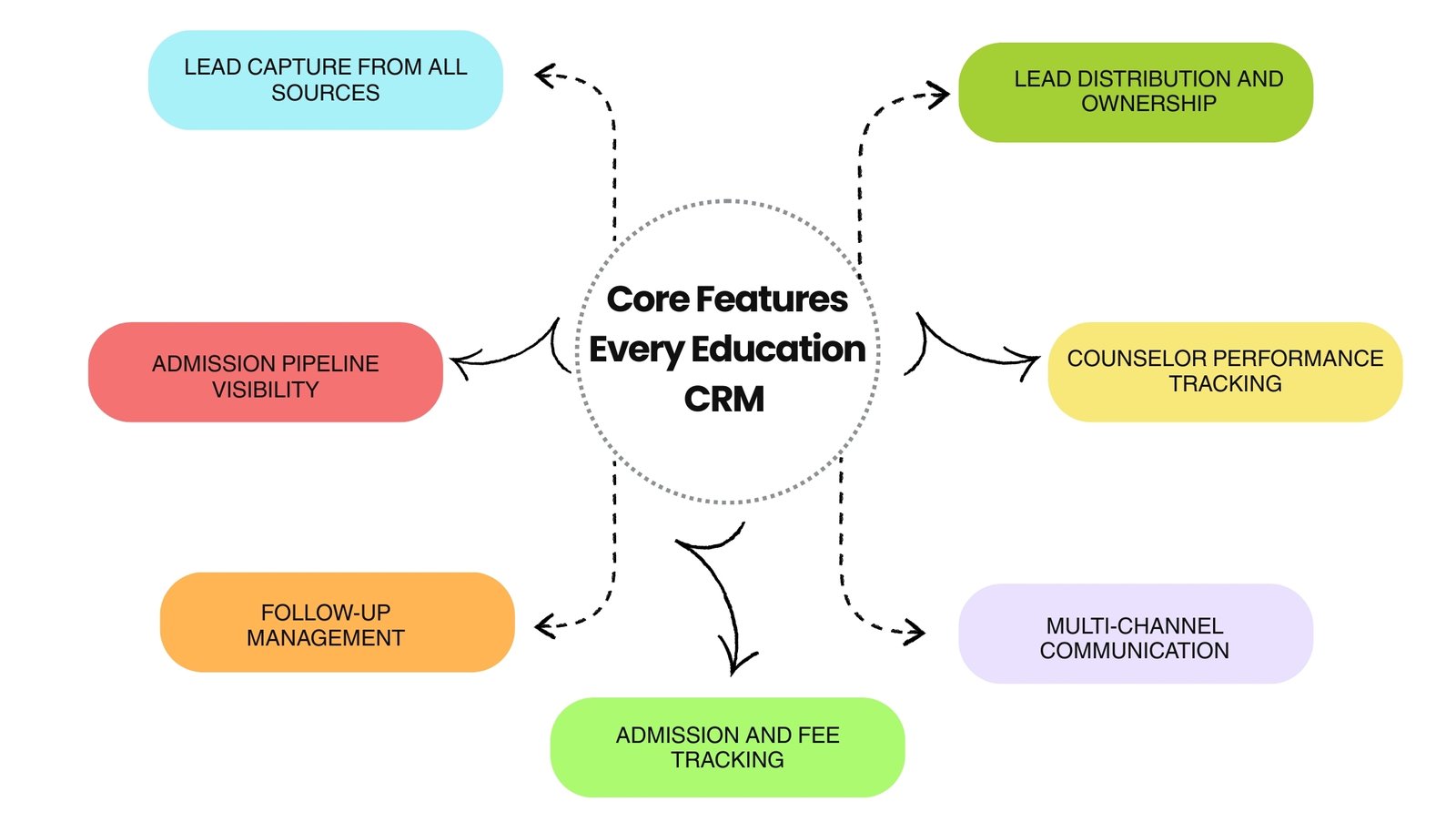
Core Features Every Education CRM Must Have

Let’s break this down properly. Not feature lists for marketing pages, but features that actually get used.

1. Lead Capture From All Sources

The best CRM for education in India must pull leads from:

  • Website forms
  • Facebook and Google Ads
  • WhatsApp enquiries
  • Walk-ins (manual entry)
  • Referral leads

If counselors still manually copy leads from emails, that’s already a red flag.

Platforms like Sensation CRM focus heavily on centralized lead capture because that’s where most education teams struggle first.

2. Lead Distribution and Ownership

Once a lead enters the system, someone must own it.

The CRM should:

  • Auto-assign leads to counselors
  • Balance lead load fairly
  • Track who contacted the lead and when

Without ownership, follow-ups become optional. That’s when conversion drops.

3. Follow-Up Management That Actually Works

This is where most CRMs fail in real use.

A good education CRM should:

  • Allow quick follow-up creation
  • Show overdue follow-ups clearly
  • Support daily calling workflows
  • Send reminders that don’t get ignored

Counselors don’t want fancy calendars. They want to know who to call next. CRM for Educational Institutions proves that simple follow-up systems consistently outperform complex ones.

4. Multi-Channel Communication

In India, admissions don’t happen only on email.

The CRM must support:

  • Click-to-call
  • WhatsApp messaging (official or integrated)
  • SMS alerts
  • Email (secondary, but still useful)

Conversation history matters. When a parent calls after two weeks, the counselor should see past notes instantly.

5. Admission Pipeline Visibility

Education CRMs need custom stages like:

  • New enquiry
  • Contacted
  • Interested
  • Visit scheduled
  • Admission confirmed
  • Not interested / Lost

The ability to customize stages is critical. Each institute works slightly differently. The best CRM adapts to the institute, not the other way around.

6. Counselor Performance Tracking

This part is uncomfortable but necessary.

CRM should show:

  • Calls made per counselor
  • Follow-ups completed
  • Conversions achieved
  • Drop-off points

Not for micromanagement, but for clarity. Without data, performance discussions become emotional. Sensation CRM handles this well by keeping reports readable, not overwhelming.

7. Admission and Fee Tracking (Basic Level)

Not every CRM needs full ERP-level finance features. But basic tracking helps:

  • Admission status
  • Course selected
  • Fee committed vs paid
  • Admission date

This avoids confusion later and helps lead management forecast revenue accurately.

Core Features Every Education CRM

Common Use Cases of CRM in Indian Education

Let’s look at how different education segments use CRM daily.

1. Coaching Institutes (NEET, JEE, UPSC, CAT)

High enquiry volume, seasonal spikes, intense follow-ups.

CRM helps with:

  • Managing campaign leads during peak months
  • Assigning leads quickly
  • Tracking conversion per counselor
  • Re-engaging cold leads

Without CRM, most coaching institutes lose leads simply due to delay.

2. Schools (Private, CBSE, ICSE, International)

Decision cycles are longer. Parents ask more questions.

CRM is used for:

  • Enquiry tracking across academic years
  • Visit and demo scheduling
  • Parent communication history
  • Admission funnel reporting

Schools benefit most from structured follow-ups and visit tracking.

3. Colleges and Universities

Larger teams, more layers.

CRM supports:

  • Department-wise lead handling
  • Course-based segmentation
  • Central admission visibility
  • Long-term enquiry nurturing

Here, scalability and role-based access matters.

4. EdTech and Online Training Platforms

Speed is everything.

CRM is used to:

  • Instantly contact leads
  • Automate reminders
  • Track ad ROI
  • Convert trials to paid users

Fast response equals higher conversion.

Mistakes Institutes Make While Choosing a CRM

This is important. Many teams choose wrong and regret later.

1. Choosing Based on Brand Name Alone

Big CRM brands don’t always mean better education workflows.

2. Overbuying Features

If your team won’t use automation rules, don’t pay for them.

3. Ignoring Counselor Feedback

If counselors hate using it, CRM adoption fails. Simple.

4. Not Checking Support Quality

Indian institutes need quick support, not ticket delays.

Sensation CRM gained popularity largely because it focused on education-specific needs instead of generic sales logic.

Selection Checklist: How to Choose The Best CRM for Education in India

Use this checklist before finalizing.

1. Lead Management

  • Does it capture leads automatically?
  • Can it handle high lead volume?
  • Can leads be reassigned easily?

2. Follow-Ups

  • Are reminders simple and visible?
  • Can counselors update follow-ups quickly?

3. Communication

  • Call, WhatsApp, SMS integration?
  • Can history be seen instantly?

4. Reporting

  • Daily counselor activity reports?
  • Source-wise lead performance?
  • Conversion tracking?

5. Ease of Use

  • Can a new counselor learn it in 1–2 days?
  • Is mobile usage smooth?

6. Support

  • Indian support team?
  • Fast response?
  • Training provided?

If a CRM checks most of these boxes, you’re on the right track.

Why Many Institutes Prefer Sensation CRM

Sensation CRM is built specifically for Indian education workflows. Not adapted later. Built with them in mind.

Institutes choose it because:

  • Lead handling is fast
  • Follow-ups don’t get lost
  • Counselors find it easy
  • Reporting is practical

It doesn’t try to be everything. It focuses on what admissions teams actually need day to day. That focus matters more than feature count. Contact us to see how the right CRM can simplify admissions, improve follow-ups, and support your team with clarity and consistency.

Logo

Ready to Upgrade Your Admissions Process?

Capture Inquiries

From all sources in one place

Automate Follow-ups

Timely reminders & communication

Monitor Performance

Track counselors & team activity

Increase Enrollments

Convert more inquiries into admissions

CRM Implementation: What to Expect in The First 30 Days

Let’s be honest. CRM adoption takes time.

Week 1:

  • Data setup
  • Lead source integration
  • Basic training


Week 2:

  • Counselor usage begins
  • Initial resistance (normal)


Week 3:

  • Follow-ups improve
  • Missed leads reduce


Week 4:

  • Clearer reporting
  • Better team coordination


If implementation feels perfect from day one, something is probably being ignored.

CRM Is a Tool, Not a Magic Fix

This needs saying.

A CRM won’t:

  • Fix bad counselors
  • Improve weak marketing
  • Replace training


But it will:

  • Reduce chaos
  • Improve visibility
  • Increase consistency


And consistency is what improves admissions numbers over time.

Choosing The best CRM for education

Choosing the best CRM for education isn’t about buying the most expensive software. It’s about choosing a system your team will actually use.

Indian education institutes work under pressure. Admissions are time-sensitive. Follow-ups matter. Data clarity matters.

A CRM like Sensation CRM, built with education workflows in mind, helps bring order to that pressure. Not by promising miracles, but by making daily work manageable.

And that, honestly, is what most teams need.

Frequently Asked Question

Q: Which is the best CRM for education in India?

The best CRM depends on your institute size and workflow. Education-focused platforms like Sensation CRM are designed specifically for Indian admissions teams.

Q: Is CRM useful for small coaching institutes?

Yes. Even small teams benefit from lead tracking and follow-up reminders.

Q: How long does CRM implementation take?

Basic setup usually takes 1-2 weeks. Full adoption may take a month.

Q: Can CRM integrate with WhatsApp?

Most modern education CRMs support WhatsApp integration directly or via approved APIs.

Q: Is training required for counselors?

Yes, but if the CRM is simple, counselors adapt quickly.

Q: Does CRM help improve conversions?

Indirectly, yes. Faster follow-ups and better tracking improve conversion rates.

Categories
CRM Automation CRM for Higher Education

CRM for Higher Education: Solving Admission & Enrollment Challenges in Colleges & Universities

Colleges and universities across India are facing increasing pressure to modernize their admission and enrollment processes. Student expectations continue to evolve, competition among higher education institutions is growing, and admission cycles are becoming longer and more complex.

A single admission cycle may involve thousands of student inquiries from websites, Google Ads, education portals, WhatsApp, phone calls, campus events, and referrals. Admission teams must also manage entrance exams, counseling sessions, document verification, financial discussions, interviews, and extended follow-ups before a student finally enrolls.

Many colleges and universities in India still rely on spreadsheets, emails, and disconnected software to manage these processes. While this may work for smaller institutions, it quickly becomes inefficient as inquiry volumes increase. Student information gets scattered, follow-ups are delayed, and institutional leaders struggle to gain accurate visibility into enrollment performance.

A modern CRM for Higher Education in India helps institutions centralize admission management, automate follow-ups, improve collaboration across departments, and make data-driven enrollment decisions. Rather than functioning as a sales tool, it serves as a strategic admission management platform designed specifically for colleges and universities.

What Does CRM Mean in Higher Education in India?

Within India’s higher education sector, CRM is less about customer management and more about building long-term relationships with prospective students and their families throughout the admission journey.

A modern Higher Education CRM in India helps institutions manage student inquiries, automate admission workflows, improve communication, and provide a seamless enrollment experience.

Core functions typically include: 

  • Capturing and organizing student inquiries
  • Managing multi-stage admission workflows
  • Tracking communication across calls, emails, and messages
  • Coordinating counselors, departments, and campuses
  • Providing enrollment visibility and reporting

The emphasis is on process control and data clarity rather than aggressive automation.

Admission and Enrollment Challenges for Colleges and Universities in India

Colleges and universities across India experience several operational challenges during admission season. As inquiry volumes increase and student decision-making becomes more complex, managing admissions manually often leads to inefficiencies, delayed responses, and reduced enrollment conversions.

1. High Inquiry Volume With Long Decision Timelines

Universities in India often receive thousands of student inquiries months before admissions close.

Students typically compare multiple colleges, entrance exam scores, scholarships, fee structures, campus facilities, and placement opportunities before making a final decision.

A modern Education CRM in India helps institutions maintain continuous engagement throughout this extended admission journey.

2. Multiple Programs, Criteria, and Deadlines

Higher education institutions offer diverse programs with different:

  • Capturing and organizing student inquiries
  • Managing multi-stage admission workflows
  • Tracking communication across calls, emails, and messages
  • Coordinating counselors, departments, and campuses
  • Providing enrollment visibility and reporting

Managing this complexity manually increases the risk of errors, missed deadlines, and student frustration.

3. Siloed Departments and Information Gaps

Admissions teams, academic departments, finance offices, and marketing teams often operate on separate systems. When information is not shared effectively, students receive inconsistent answers and internal coordination suffers.

4. Limited Enrollment Predictability

Leadership teams often struggle to forecast enrollment accurately due to gaps in lead management. Questions such as how many applicants are likely to convert or which programs may fall short often remain unanswered until late in the cycle.

Logo

Simplify Admissions for Colleges & Universities

Capture Inquiries

From all sources in one place

Automate Follow-ups

Timely reminders & communication

Monitor Performance

Track counselors & team activity

Increase Enrollments

Convert more inquiries into admissions

How CRM Supports the Higher Education Admission Process

1. Centralized Prospect and Applicant Data

A modern CRM for Universities in India captures student inquiries from every admission channel into one centralized platform.

  • Institutional websites
  • Education portals
  • Campus events and fairs
  • Walk-ins and referrals

Each prospect profile stores complete interaction history, program interest, eligibility notes, and current admission status. This centralized view eliminates duplication and ensures continuity across departments.

2. Structured Admission Pipelines

An Admission CRM in India enables colleges and universities to create structured admission workflows that align with institutional processes.

Typical admission stages include:

Inquiry → Counseling → Eligibility Review → Application Submitted → Entrance Exam → Interview → Offer Letter → Fee Payment → Enrollment

This structured pipeline helps admission teams monitor student progress and improve enrollment efficiency.

Managing Follow-Ups Over Extended Admission Cycles

Managing Follow ups

Follow-ups in higher education require patience, consistency, and relevance.

1. Automated Reminders and Task Management

CRMs generate reminders for scheduled calls, emails, document checks, and meetings. Counsellors no longer depend on memory or personal tracking methods.

2. Complete Communication Context

All interactions are logged within the CRM. If a student reconnects after weeks or months, staff can continue the conversation without repetition or confusion.

3. Program-Specific and Stage-Based Communication

CRMs enable targeted messaging based on:

  • Program interest
  • Admission stage
  • Exam or interview outcomes

This ensures students receive relevant information at the right time.

Improving Enrollment Conversion Rates

Enrollment challenges often arise due to uncertainty rather than lack of interest.

1. Reduced Drop-Offs Through Process Clarity

When students clearly understand next steps, documentation requirements, and timelines, they are less likely to disengage.

2. Early Identification of At-Risk Applicants

CRMs highlight stalled applications and inactive prospects, allowing teams to intervene before students drop out of the process.

3. Source and Program-Level Insights

Institutions gain visibility into which inquiry sources and programs generate the most enrollments, enabling better planning and outreach.


Logo

Ready to Improve Student Enrollment?

Streamline admission workflows, empower your admissions team, and convert more applicants with an AI-powered Education CRM

Data Visibility for Academic and Administrative Leadership

A modern CRM for Higher Education in India provides real-time dashboards that help institutional leaders monitor:

CRM dashboards provide insights into:

  • Inquiry-to-application ratios
  • Application-to-enrollment conversion rates
  • Program-wise demand trends
  • Counselor workload and productivity

These insights support informed decisions around capacity planning, staffing, and marketing investments.

Cross-Department Collaboration and Accountability

Admissions in Indian colleges and universities require collaboration between admission counselors, academic departments, finance teams, scholarship offices, and marketing teams.

A centralized Education CRM enables every department to work from the same student record, improving coordination and reducing communication gaps.

A CRM supports collaboration by:

  • Providing shared access to applicant information
  • Defining ownership at each stage of the process
  • Creating transparent handoffs between departments

This reduces miscommunication and improves the applicant experience.

CRM Use Cases Across Higher Education Institutions in India

1. Undergraduate Admissions: Managing high volumes, entrance exams, counseling schedules, and parent communication.

2. Postgraduate and Research Programs: Tracking eligibility reviews, interviews, recommendations, and documentation across longer timelines.

3. Professional and Executive Education: Handling working professionals, flexible timelines, cohort-based enrollments, and batch planning.

Comparison Table: Higher Education Admissions With and Without CRM


Area Without CRM With CRM
Prospect Tracking Fragmented systems Centralized database
Follow-Ups Manual and inconsistent System-driven and timely
Admission Visibility Limited Real-time pipeline
Department Coordination Disconnected Structured collaboration
Enrollment Forecasting Assumption-based Data-backed

Why Indian Colleges and Universities Are Adopting AI-Powered Education CRMs

As competition for student enrollments increases across India, educational institutions are adopting AI-powered CRM platforms to automate repetitive tasks, improve counselor productivity, personalize communication, and provide a better admission experience.

AI-powered Education CRMs help institutions reduce manual work while improving enrollment forecasting and operational efficiency.

Common Misconceptions About CRM for Higher Education in India

  • CRM is only for private institutions. Public universities benefit equally from process visibility and accountability.
  • CRM interferes with academic autonomy. CRM supports administration, not academic evaluation.
  • CRM implementation is disruptive. Modern systems allow phased adoption without interrupting admission cycles.

Best Practices for Implementing a Higher Education CRM in India

A CRM delivers value only when aligned with institutional workflows.

Key considerations include:

  • Mapping current admission processes accurately
  • Defining realistic pipeline stages
  • Training staff with real scenarios
  • Reviewing data regularly during the admission cycle

Simplicity and consistency matter more than feature depth.

CRM for Higher Education Brings Leads

Lead Management Flow

A CRM for higher education brings order to admissions and enrollment without compromising academic values. It allows colleges and universities to manage scale, complexity, and long decision cycles with clarity and consistency.

For institutions seeking a CRM aligned with higher education workflows, Sensation CRMs offers solutions built specifically for colleges and universities. The platform supports inquiry management, admission tracking, structured follow-ups, and enrollment visibility while remaining practical and easy to adopt.

When implemented thoughtfully, a CRM becomes a reliable operational foundation for modern higher education admissions.

Frequently Asked Questions

Q: What challenges do colleges face in admissions?

Higher education institutions often struggle with managing large inquiry volumes, long decision timelines, complex program options, and consistent follow-ups.

Q: How does a CRM help colleges improve admissions?

A CRM centralizes student interactions, tracks admissions stages, automates follow-ups, and provides visibility into conversion trends to improve enrollment performance.

Q: Does CRM improve communication with prospective students?

Yes. It logs all interactions email, calls, messages and ensures counselors always have context for each conversation. 

Q: Is CRM only useful during admissions?

No. A CRM supports engagement from inquiry through enrollment and can also assist with retention, communication, and alumni tracking.

Q: How does CRM reduce manual workload for admissions staff?

CRMs automate reminders, track tasks, and reduce repetitive data entry, freeing staff to focus on higher-value student engagement.

Categories
Education CRM Educational Institutions

How to Choose the Right CRM for Educational Institutions (Without Overpaying)

Choosing the right CRM for Educational Institutions in India has become one of the most important technology decisions for schools, colleges, universities, coaching institutes, and EdTech organizations. As student inquiries increase across websites, WhatsApp, Google Ads, social media, education portals, and phone calls, institutions need a centralized system to manage admissions efficiently.

With so many CRM platforms available, it’s easy to choose software that looks impressive but doesn’t actually solve day-to-day admission challenges. Many institutions in India end up paying for features they rarely use because the CRM is designed for business sales instead of education workflows.

This guide explains how to choose an Education CRM in India that aligns with your admission process, supports long-term growth, improves student engagement, and helps you avoid unnecessary software costs.

Why Educational Institutions in India Often Overpay for CRM Software

Many educational institutions across India invest in CRM software expecting better admissions, improved communication, and higher enrollments.

However, overpaying rarely happens because of poor budgeting. It usually happens because institutions purchase generic CRM systems that require expensive customization before they can support student admissions effectively.

Admission processes in India are very different from traditional business sales. Student decisions often involve parents, counselors, entrance examinations, scholarship discussions, fee planning, and multiple follow-ups over several weeks or months.

A generic sales CRM rarely supports these workflows without significant customization, increasing implementation costs over time.

Logo

Choose the Right Education CRM Without Overpaying

Capture Inquiries

From all sources in one place

Automate Follow-ups

Timely reminders & communication

Monitor Performance

Track counselors & team activity

Increase Enrollments

Convert more inquiries into admissions

Why Education Requires a Specialized CRM in India

A CRM designed for education needs to understand how students move through the system. This includes inquiry, counseling, documentation, fee discussion, enrollment, and post-admission communication.

In many institutions, the same student interacts with multiple staff members over weeks or months. A proper CRM for educational institutions keeps that entire history visible and accessible. Generic CRMs usually don’t do this well without heavy modification.

If a system treats students like short-term sales leads, it’s not a good match.

Start With Your Actual Admission Process

Before comparing CRM software, educational institutions should carefully evaluate how admissions currently work.

Questions to consider include:

  • How do inquiries arrive?
  • Through website forms, phone calls, walk-ins, or social media?
  • Who responds first?
  • How are follow-ups tracked?
  • Where do delays happen?

The best Education CRM should improve your existing workflow rather than forcing your admission team to change how they work.

Don’t Pay for Features Your Institution Doesn’t Need

Many CRM vendors bundle features like:

  • Advanced sales forecasting
  • Revenue pipelines
  • AI deal scoring
  • Complex automation chains

Most schools, colleges, universities, and coaching institutes in India benefit far more from reliable admission tracking, automated follow-ups, counselor management, and student communication.

Ease of Use Is More Important Than Feature Volume

Even the most advanced CRM fails if staff don’t use it properly. Admissions teams are busy. If a CRM requires too many steps to log a call or update a status, people will avoid it. Data becomes incomplete. Reports become unreliable.

The best CRM for Higher education feels intuitive. Staff should be able to learn it quickly, without long training sessions. When the system feels simple, consistency follows.

Customization Should Support, Not Complicate

The best CRM for Colleges and Schools in India should already include admission-specific workflows.

Excessive customization often indicates the CRM wasn’t originally built for education.

Institutions should prioritize platforms that work effectively with minimal configuration.

  • Extra setup costs
  • Consultants
  • Long implementation timelines
  • Ongoing dependency

If a CRM needs constant changes to function properly, it’s probably not designed for education in the first place.

Admission Reports Should Help Decision-Making

Reports should answer real questions, not just display numbers. Institutions typically want to know how many inquiries are active, where students drop off, which programs perform well, and how counselors are managing follow-ups.

A good CRM for educational institutions presents this information in simple language. If reports require interpretation or technical knowledge, they won’t be used consistently.

Integration Should Feel Natural

Educational institutions in India already use multiple platforms such as websites, WhatsApp Business, email, SMS, payment gateways, and Learning Management Systems.

A modern Education CRM in India should integrate seamlessly with these tools instead of replacing them.

Data Security Is Non-Negotiable

Student and parent data must be protected. Any CRM solution should include secure hosting, strong access controls, detailed activity logs, and regular backups to ensure data privacy and compliance.

Security shouldn’t be treated as an optional feature. It should be standard. Institutions that ignore this risk not just operational issues, but trust as well.

Pricing Transparency Prevents Long-Term Cost Surprises

The lowest-priced CRM isn’t always the most affordable in the long run.

When comparing Education CRM software in India, evaluate:

  • User limits
  • Storage caps
  • Feature upgrades
  • Support fees

Clear, predictable pricing is safer than aggressive discounts. Over time, transparency saves more money than cheap entry plans.

Support and Onboarding Matter More Than Demos

CRM success depends on implementation. Strong onboarding, workflow setup, and ongoing support are essential.

Vendors who disappear after the sale leave institutions struggling to adapt. Education institutions should value long-term partnership over flashy demos. Support quality often determines whether a CRM succeeds or fails.

Choosing a CRM That Grows With You

Institutions grow gradually. New programs. More counselors. Higher inquiry volume.

A CRM should scale smoothly without forcing system changes every year. Scalability doesn’t mean complexity. It means stability under growth.

Why Education-Focused CRM Platforms Make Sense

Education CRMs are built with real institutional workflows in mind.

They understand:

  • Admission seasons
  • Multiple stakeholders
  • Long decision cycles
  • Counselor accountability
  • Parent communication

This reduces friction. Less friction means better outcomes.

Why AI-Powered Education CRMs Are Becoming Popular in India

Educational institutions are increasingly adopting AI-powered CRM platforms to improve operational efficiency.

Modern AI-enabled Education CRMs help institutions:

  • Automate repetitive tasks
  • Prioritize student inquiries
  • Personalize communication
  • Improve counselor productivity
  • Generate admission insights
  • Increase enrollment forecasting accuracy

This allows admission teams to focus more on student engagement and less on administrative work.

Sensation CRM: Designed for Education, Not Sales Pipelines

For institutions seeking a practical and education-focused solution, Sensation CRM is built around actual academic workflows. It supports inquiry management, admissions tracking, counselor coordination, and reporting without unnecessary complexity.

Instead of adapting sales tools for education, Sensation CRM provides structure that fits schools, colleges, and coaching institutes helping teams stay organized, accountable, and scalable without overpaying for features they don’t need.


Logo

Looking for a Cost-Effective Education CRM?

From inquiry capture to enrollment, manage everything
in one place and never miss a potential student.

Choosing The Right CRM

Choosing the right CRM for educational institutions isn’t about buying the most advanced software. It’s about selecting a system that matches how education actually operates.

Institutions that prioritize usability, clarity, and education-specific design avoid wasted spending and operational stress. A good CRM supports people, processes, and growth without getting in the way, while making it easy for prospects to contact us and receive timely responses.

Conclusion

Choosing the right CRM for Educational Institutions in India isn’t about selecting the platform with the longest feature list. It’s about investing in a solution that supports the way educational institutions actually manage admissions.

A modern Education CRM in India helps schools, colleges, universities, coaching institutes, and EdTech organizations centralize student inquiries, automate admission workflows, improve counselor collaboration, and deliver a better enrollment experience.

By focusing on usability, transparency, security, scalability, and education-specific functionality, institutions can reduce unnecessary software costs while improving operational efficiency and student engagement.

As competition in India’s education sector continues to grow, adopting an AI-powered Education CRM will help institutions manage admissions more effectively and achieve sustainable enrollment growth.

Frequently Asked Questions

Q: What is a CRM for educational institutions?

A CRM for educational institutions is software designed to manage student inquiries, communication history, admissions workflows, and engagement across the student lifecycle.

Q: How is education CRM different from sales CRM?

Education CRMs focus on inquiries, counselingenrollment, and student communication, whereas sales CRMs are built around short sales cycles and revenue pipelines.

Q: Why shouldn’t schools use generic CRM systems?

Generic CRMs require heavy customization, don’t follow education workflows out of the box, and often force institutions to overpay for features they will not use.

Q: What should schools look for when choosing a CRM?

Schools should look for ease of use, built-in education workflows, simple reporting, secure data handling, predictable pricing, and support tailored to admissions teams.

Q: Can a CRM integrate with existing systems like Whatsapp or Facebook?

Yes. Many education-focused CRMs can integrate with these platforms, inquiry forms, and communication tools to streamline information flow.

Categories
CRM Implementation Timeline

What Is an Education CRM? A Complete Guide for Schools, Colleges & Coaching Institutes

Educational institutions across India are managing more student inquiries, admission applications, and communication channels than ever before. Schools, colleges, universities, coaching institutes, and EdTech organizations receive inquiries through websites, Google Ads, WhatsApp, social media, education portals, phone calls, and walk-in visits every day.

Managing these interactions through spreadsheets, notebooks, emails, or disconnected software often results in delayed follow-ups, duplicate records, inconsistent communication, and missed enrollment opportunities.

A modern Education CRM Software in India is designed specifically to solve these challenges. It centralizes student inquiries, automates admission workflows, streamlines counselor communication, and helps institutions manage every stage of the student journey from the first inquiry to enrollment and beyond.

Unlike traditional CRM platforms built for business sales, an Education CRM reflects how educational institutions in India actually manage admissions, student relationships, and long-term engagement.

Why Educational Institutions in India Need a Specialized Education CRM

The admission process in India’s education sector is fundamentally different from traditional sales.

Students and parents often compare multiple institutions, entrance examinations, scholarships, placement opportunities, fee structures, and academic programs before making a final decision.

A modern Education CRM in India supports these longer decision journeys by helping institutions maintain organized communication and structured follow-ups.

Generic CRM platforms are not designed for this reality. They assume quick conversions, uniform pipelines, and simple buyer behavior. As a result, institutions using traditional CRMs for CRM lead management often end up forcing education workflows into systems that were never built to support them. This leads to workarounds, manual tracking, and eventually, system abandonment.

Education CRM software is different because it reflects how institutions actually function. It accounts for counseling cycles, eligibility verification, document collection, multiple follow-ups, and long enrollment timelines. Instead of treating students as sales leads, it treats them as individuals moving through an academic lifecycle.

Logo

Ready to Simplify Student Admissions?

Capture Inquiries

From all sources in one place

Automate Follow-ups

Timely reminders & communication

Monitor Performance

Track counselors & team activity

Increase Enrollments

Convert more inquiries into admissions

How Education CRM Software Supports Daily Admission Operations

Educational institutions across India often use multiple systems simultaneously including websites, WhatsApp Business, Google Forms, Excel spreadsheets, phone calls, emails, and education portals.

An Education CRM connects all these touchpoints into one centralized platform, eliminating fragmented data and creating a single source of truth for every student inquiry.

Understanding The Student Lifecycle Inside an Education CRM

CRM Workflow Foundation

An education CRM is designed to follow a student through every meaningful stage of interaction with the institution. It begins at the moment of inquiry, whether that inquiry comes from a website form, a phone call, a walk-in visit, or a marketing campaign.

From there, the system tracks counseling conversations, program discussions, eligibility checks, document submissions, and fee-related communication. Each step is clearly recorded, time-stamped, and visible. If a student pauses or delays, the reason is documented. If follow-ups are required, reminders are generated.

Once enrollment is confirmed, the CRM continues to serve as a communication and coordination tool, supporting post-enrollment interactions and ongoing relationship management. This end-to-end visibility ensures that no student becomes “inactive” simply because someone forgot to follow up.

Student Inquiry Management and Lead Capture

Lead Management Flow

Inquiry management is one of the most critical functions of an education CRM. Institutions receive inquiries from multiple channels, and without structure, these inquiries often overlap, duplicate, or disappear entirely.

Education CRM software captures each inquiry with its source, time, and associated details. Whether a student fills out a website form, calls the admissions office, or visits in person, the inquiry becomes a structured record. Duplicate entries are avoided, and the system ensures that each inquiry is acknowledged and assigned.

Over time, this data helps institutions understand which channels perform best and where prospective students are coming from. Instead of guessing what works, decisions can be made based on real inquiry patterns.

Counselor Management and Admission Follow-Ups

Admission counselors are central to every successful enrollment process.

A modern Education CRM in India helps institutions:

  • Automatically assign student inquiries
  • Balance counselor workloads
  • Schedule follow-ups
  • Track response times
  • Measure counselor productivity

This improves accountability while ensuring that every prospective student receives timely attention.

Centralized Student and Parent Communication

Admission decisions in India often involve students, parents, guardians, and sometimes sponsors.

An Education CRM stores every interaction  including WhatsApp conversations, emails, phone calls, counseling notes, and meeting history within a single student profile.

This enables consistent communication throughout the admission journey.

Admissions Pipeline Visibility and Management Insights

Customer Onboarding Process

Admissions leaders need more than anecdotal updates. They need real-time visibility into how the admissions process is functioning.

Education CRM software provides dashboards and pipeline views that show how many inquiries are active, how many are in counseling, how many have submitted documents, and how many have enrolled. Bottlenecks become visible, and delays can be addressed proactively.

Instead of reacting to missed targets after the fact, institutions can monitor performance continuously and adjust strategies in real time.

Reporting and Analytics for Data-Driven Decision Making

Sales Pipeline Management

One of the long-term benefits of education CRM software is structured reporting. Institutions can generate reports on inquiry sources, conversion rates, enrollment timelines, counselor productivity, and program demand.

These insights replace assumptions with evidence. For example, an institution may discover that a particular program attracts many inquiries but has low conversion due to eligibility confusion. With this knowledge, messaging and counseling can be improved.

Over time, CRM data supports strategic planning, budgeting, and growth decisions.

Education CRM vs Traditional CRM: Why The Difference Matters

This distinction is best understood through CRM Software vs Generic CRM – Key Differences Explained. Traditional CRM systems are optimized for sales pipelines, not academic journeys. They focus on closing deals quickly, often with minimal emphasis on long-term relationships or compliance requirements.

Education CRM software, by contrast, is built around student lifecycles, parent communication, and institutional reporting needs. Admissions workflows, academic documentation, and regulatory considerations are part of the system’s core design, not add-ons.

This distinction affects daily usability. Staff members can work within familiar academic processes rather than adapting to sales-oriented frameworks.

Who Uses Education CRM Software and Why

Schools use education CRM systems to manage admission seasons, parent inquiries, and yearly enrollment cycles with consistency. The system ensures that each inquiry receives attention and that admission processes remain standardized year after year.

Colleges and universities face greater complexity due to multiple programs, longer decision timelines, and higher inquiry volumes. Education CRM software helps manage this scale without overwhelming staff.

Coaching institutes benefit from CRM systems by enforcing discipline in follow-ups and reducing inquiry leakage. Speed and consistency are essential in competitive environments, and CRM education platforms support both.

Skill training centers use CRM software to manage batch enrollments, coordinate counseling, and track student engagement across different programs.

Logo

See How an Education CRM Can Transform Your Institution

Centralized Lead Management

Automated Follow-ups

Real-time Reports & Analytics

Secure & Reliable

Benefits of Education CRM Software for Educational Institutions

Institutions that adopt education CRM software experience operational clarity. Admissions processes become organized, communication improves, and staff coordination strengthens.

Students and parents benefit from timely responses and consistent information. Counselors benefit from structured workflows and reduced manual tracking. Management benefits from visibility and reporting.

As institutions grow, CRM systems allow scaling without operational breakdowns. Processes remain stable even as inquiry volumes increase.

Data Security, Privacy, and Compliance Considerations

Education institutions handle sensitive personal and academic data. Modern education CRM software includes role-based access controls, secure hosting, audit logs, and backup systems to protect this information.

These safeguards are essential not only for compliance but also for trust. Parents and students need confidence that their data is handled responsibly.

Common Challenges Institutions Face Without an Education CRM

Without a centralized CRM system, institutions often rely on fragmented tracking methods. This leads to duplicate inquiries, missed follow-ups, manual reporting errors, and limited visibility into admissions performance.

Over time, these operational inefficiencies directly impact enrollment outcomes. What begins as a process issue becomes a growth constraint.

Selecting The Right Education CRM Software

CRM Workflow Types

Choosing an education CRM requires evaluating usability, customization options, integration capabilities, reporting depth, and support quality. The system should adapt to institutional workflows rather than forcing unnecessary changes.

Successful implementations focus on long-term adoption rather than quick fixes.

Implementation, Training, and Adoption Realities

Technology alone does not solve problems. Effective CRM adoption requires onboarding, training, and gradual optimization. Institutions that invest in change management see stronger long-term results.

CRM systems are most effective when treated as core infrastructure rather than optional tools.

The Future of CRM in Education

Education is becoming increasingly data-driven. CRM systems will continue to evolve, supporting predictive enrollment insights, tracking student engagement, and managing long-term relationships beyond enrollment.

The focus will remain on clarity, structure, and informed decision-making rather than complexity.

To learn how your institution can benefit, contact us today.

Why AI-Powered Education CRM Software Is the Future of Admissions in India

Educational institutions are increasingly adopting AI-powered CRM platforms to improve efficiency and deliver better admission experiences.

Modern AI-enabled Education CRM Software helps institutions:

  • Automate repetitive admission tasks
  • Prioritize high-quality inquiries
  • Personalize student communication
  • Improve counselor productivity
  • Predict enrollment trends
  • Generate admission insights

AI allows institutions to focus more on student success while reducing administrative work.

Final Perspective

Educational institutions across India need more than disconnected admission tools—they need a centralized system that supports every stage of the student journey.

A modern Education CRM Software in India helps schools, colleges, universities, coaching institutes, and EdTech organizations manage admissions more efficiently through automated workflows, centralized student data, personalized communication, and real-time reporting.

By improving operational efficiency, strengthening counselor collaboration, and delivering better experiences for students and parents, an Education CRM becomes a long-term investment in institutional growth.

Solutions like Sensation CRM are purpose-built for educational institutions, helping admission teams simplify inquiry management, improve follow-ups, and increase enrollment conversions while remaining scalable for future growth.

Frequently Asked Questions

Q: What exactly is an education CRM?

An education CRM is a software that organizes student inquiries, tracks admissions workflows, and manages communication in schools, colleges, or coaching institutes.

Q: How does an education CRM differ from a generic CRM?

Education CRMs are built around student lifecycles and academic processes, while generic CRMs are mainly designed for sales cycles and revenue tracking.

Q: Who uses education CRM software?

Schools, colleges, universities, coaching classes, and training centers use education CRMs to manage inquiries and admissions.

Q: What stages of the student journey can a CRM handle?

CRMs can handle inquiry capture, follow-ups, document tracking, enrollment and sometimes post-enrollment communication.

Q: Does an education CRM replace counselors?

No. It helps counselors stay organized and consistent, but the human role in counseling and engagement remains essential.

Q: Can education CRMs integrate with admission forms and email?

Yes. Most modern education CRMs integrate with email, web forms, and communication tools for seamless data flow.