
Are Your Facebook Leads Turning into Enrollments?
Centralized Lead Management
Automated Follow-ups
Real-time Reports & Analytics
Secure & Reliable
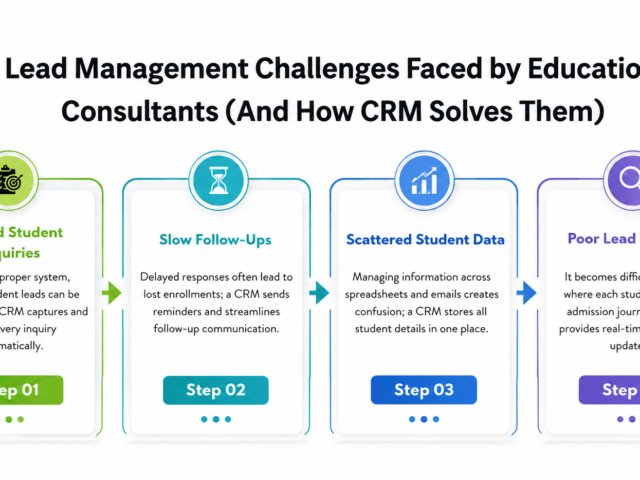
The Real Cost of a Slow Response
This isn’t a minor operational detail -it’s the single biggest reason institutions lose admissions leads they already paid for.
- Research widely cited from Harvard Business Review found that contacting a lead within 5 minutes makes you roughly 100 times more likely to connect than waiting 30 minutes.
- Most businesses take longer than 5 minutes to respond to a lead, and as a result lose an estimated 71% of those leads.
- A common admissions scenario: an inquiry comes in, nobody follows up for four days, and by then the prospective student has already requested information from three other schools -all of which replied within the hour.
- Industry data puts the average inquiry-to-enrollment conversion rate at just 4.2%, with response time identified as the single biggest predictor of whether an inquiry converts.
Speed isn’t optional -it’s the whole game. With Sensation CRM, every Facebook inquiry is captured in real time and stored securely inside the CRM, so counselors are working the lead within minutes instead of days.
How Do I Route Student Enquiries From Facebook and Google Ads Into a Single CRM for My Admissions Team?
This is the exact question most marketing and admissions leads are searching for -and the answer has three moving parts:
- Connect each ad source to your CRM automatically, not manually.
Facebook/Instagram Lead Ads and Google Lead Form Extensions both support direct integrations with modern CRMs, pushing new leads in real time instead of requiring CSV downloads from two separate ad managers. - Normalize the data on the way in.
Facebook and Google forms rarely use identical field names. A proper integration maps “Full Name,” “Phone,” “Program of Interest,” and campaign data into consistent CRM fields -one clean lead record, regardless of source. - Route by rule, not by hand.
Once leads from both sources land in the same CRM, the same assignment logic should apply to all of them -by program, territory, or round-robin across counselors -so no channel is neglected.
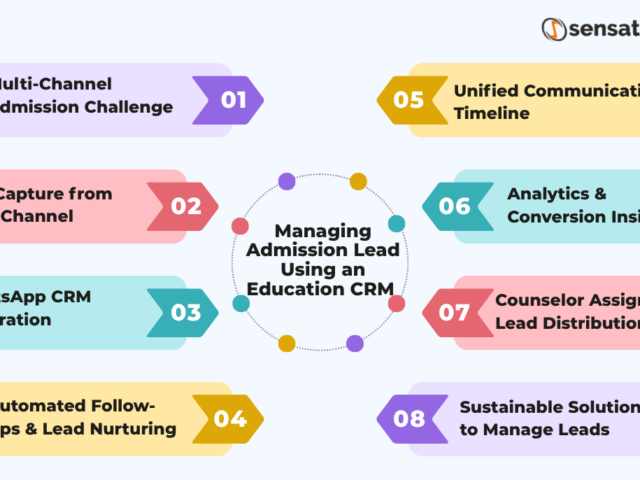
This is where Sensation CRM is purpose-built for admissions teams. Rather than juggling exports from Facebook and Google Ads separately, Sensation CRM’s education CRM solutions bring every inquiry -Facebook, Google, WhatsApp, website -into one admissions pipeline, with leads automatically assigned to counselors based on your predefined rules so no inquiry goes unattended.
How to Integrate Facebook Leads to CRM
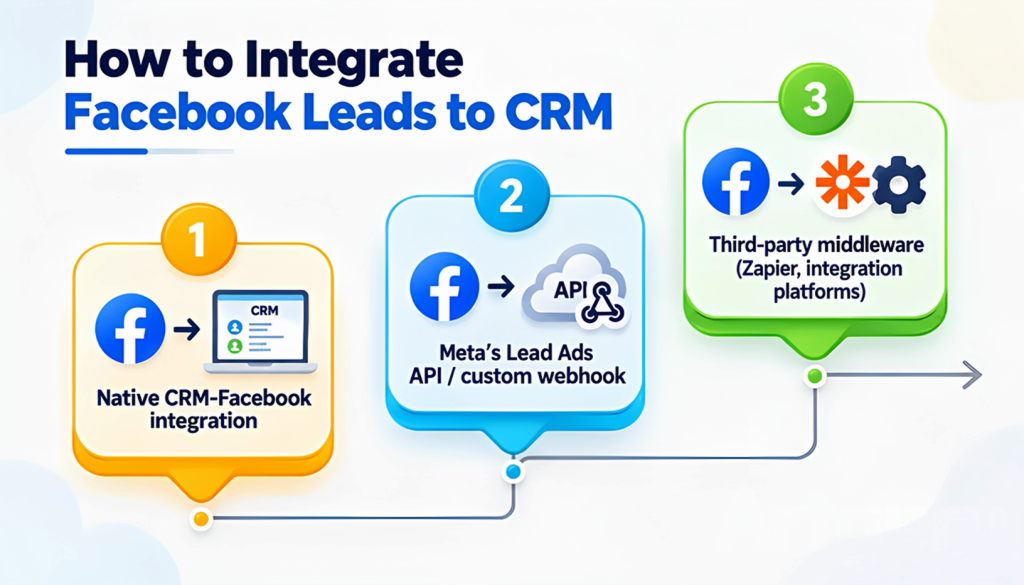
There are three common ways institutions connect Facebook Lead Ads to a CRM:
Option 1: Native CRM-Facebook integration (recommended for most institutions)
A purpose-built education CRM offers a direct Facebook integration that syncs leads automatically, with no middleware to maintain. This is exactly how Sensation CRM’s Facebook CRM integration works: leads are captured instantly, assigned automatically, and followed up without delay -and because it’s built specifically for educational institutions, the integration is aligned with admissions workflows, not a generic sales pipeline.
Option 2: Meta’s Lead Ads API / custom webhook
Technically resourced teams can build a direct webhook using Meta’s API. This gives full control but requires ongoing engineering maintenance -token refreshes, error handling, and field-mapping updates whenever a form changes.
Option 3: Third-party middleware (Zapier, integration platforms)
Useful for institutions without in-house developers, though these typically add sync delay and an extra monthly cost layer on top of your CRM.
For most colleges, universities, and edtech teams, Option 1 is the fastest path to a working setup -no developer required, no third-party subscription, and the integration already understands admissions-specific fields like intake, program interest, and counselor assignment.
How to Plug Facebook and Google Leads Directly Into an Admissions CRM
A genuinely unified setup does three things beyond the initial sync:
- Source and campaign tagging: every lead retains which ad, campaign, and platform it came from, so marketing can see cost-per-inquiry and cost-per-enrollment by channel.
- Multi-channel instant follow-up: with Sensation CRM, counselors can instantly respond to a newly captured lead via WhatsApp, email, or a call -all from within the same platform -which directly improves lead engagement and conversion.
- Duplicate and quality control: verification at intake filters out fake or low-intent submissions before they consume a counselor’s time.
What Sensation CRM Does That a Generic CRM Doesn’t
Capability | Generic CRM | Sensation CRM |
Real-time Facebook lead sync | Often needs middleware | Native, built-in |
Admissions-specific fields (intake, program) | Rarely | Yes, by design |
Automatic counselor assignment by rule | Sometimes, manual setup | Built-in, rule-based |
WhatsApp + email + call follow-up in one place | Rarely unified | Yes |
Built for education workflows | No -generic sales pipeline | Yes -education-first CRM |
Unlike generic sales CRMs that treat every lead the same way, Sensation CRM understands that a “student inquiry” isn’t a sales opportunity in the traditional sense it needs intake tracking, program-level segmentation, and counsellor workload balancing built in from day one. When you compare the benefits of a higher education CRM vs a generic marketing CRM, the key difference is how well the system supports education-specific admissions workflows rather than treating student inquiries like standard sales leads.
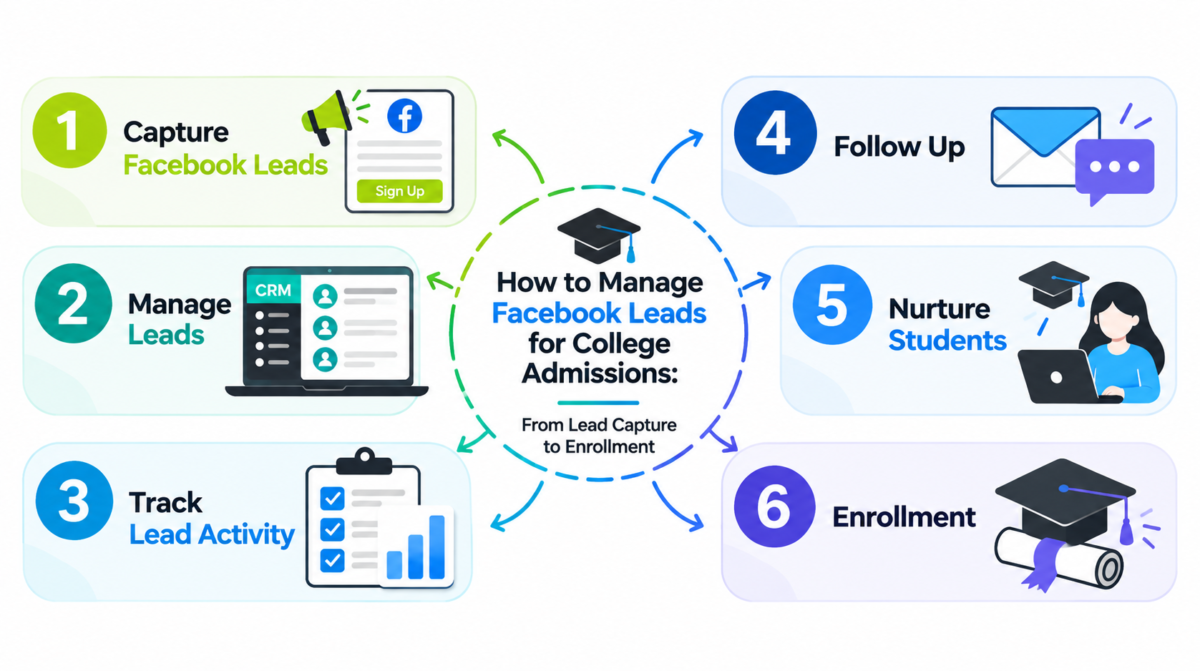
From Lead Capture to Enrollment: How Sensation CRM Maps the Full Funnel
- Capture: Facebook lead submits the in-app form; Sensation CRM ingests it instantly with full source/campaign data.
- Qualify: Counsellor confirms intent, program interest, and intake timeline directly inside the CRM.
- Nurture: Automated and personal follow-up (WhatsApp, email, call) keeps the student engaged, since most inquiries won’t enroll in the same intake and need nurturing over months, not days.
- Apply: Student moves from inquiry to formal application, tracked as a distinct pipeline stage so drop-off is visible to your team.
- Enroll: Final conversion, with full visibility into which channel -Facebook, Google, or otherwise -actually produced the enrolled student.
Want to Map Your Student Journey from Lead Capture to Enrollment?
See how Sensation CRM can connect every stage of the admissions funnel,
from capturing inquiries to nurturing leads and converting them into enrollments
This staged view matters because institutions frequently discover mismatches between what marketing reports and what admissions actually sees for example, a marketing manager reporting over 220 leads from Facebook Ads in a week that admissions counselors only partially find, because website enquiries, WhatsApp messages, and Instagram DMs are all tracked in separate places. Sensation CRM eliminates that gap through seamless CRM Integration, keeping every channel connected in one workspace so marketing and admissions teams can access the same lead data, track interactions, and manage follow-ups more efficiently.
Common Mistakes Institutions Make With Facebook Admissions Leads
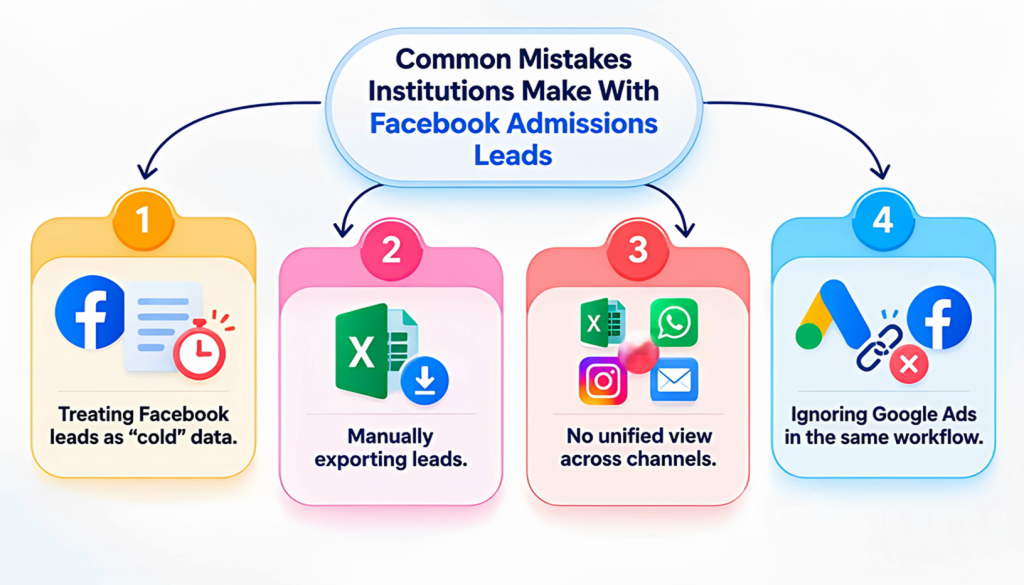
- Treating Facebook leads as “cold” data A form-fill on Facebook is often a same-session comparison against 2–3 other institutions -speed matters more here than almost any other channel.
- Manually exporting leads, which guarantees delay and directly causes the response-time losses cited above.
- No unified view across channels, leading to leads getting lost between Excel sheets, WhatsApp, Instagram DMs, and email inboxes.
- Ignoring Google Ads in the same workflow paid search alone accounts for roughly 22% of student inquiries, with education carrying one of the highest CPCs on Google Ads at $4.12, so treating it separately from Facebook wastes both budget clarity and reporting accuracy.
Sensation CRM addresses all four directly by centralizing Facebook, Google, WhatsApp, and website inquiries into a single, real-time admissions pipeline with automatic assignment and instant response tools.
Why Institutions Are Moving to Sensation CRM
The broader CRM market is expanding fast, and education is one of its biggest growth segments: the admission management software market alone is projected to reach USD 4.01 billion by 2034, growing at a 10.2% CAGR from 2025. Marketing automation adoption among universities has grown to 67%, up from 41% just a couple of years earlier institutions are actively moving away from manual, spreadsheet-based lead tracking.
If your team is still exporting Facebook leads manually, juggling WhatsApp on someone’s personal phone, and reconciling numbers between marketing and admissions every week, that’s the exact problem Sensation CRM was built to solve. It’s an education-first CRM where Facebook integration is aligned with your admissions workflow from day one not bolted on as an afterthought. Book a Demo today to see how Sensation CRM can streamline your admissions and lead management workflow.
Frequently Asked Questions
Q: What is CRM Facebook integration?
CRM Facebook integration is a connection that automatically pulls leads submitted through Facebook (and Instagram) Lead Ads directly into your CRM in real time, instead of requiring manual CSV downloads from Meta’s Ads Manager.
Q: How does Sensation CRM integrate with Facebook?
Sensation CRM automatically syncs lead data from Facebook Lead Ads and Page inquiries directly into the CRM in real time, without manual effort -leads are captured, automatically assigned to counsellors, and ready for instant follow-up via WhatsApp, email, or call.
Q: Can Sensation CRM route both Facebook and Google Ads leads into one place?
Yes -Sensation CRM is designed to bring inquiries from multiple channels, including Facebook, Google Ads, WhatsApp, and your website, into a single admissions pipeline with consistent assignment rules.
Q: Is Sensation CRM built specifically for education institutions?
Yes. Unlike generic sales CRMs, Sensation CRM’s Facebook integration is aligned with admissions workflows specifically -intake tracking, program-level segmentation, and counsellor assignment -making it suited for colleges, universities, and EdTech platforms rather than general sales teams.
Q: How fast should an admissions team respond to a Facebook lead?
As close to instantly as possible. A 5-minute response window dramatically outperforms delayed follow-up, and institutions that wait longer typically lose the majority of those leads to competing schools that respond faster.
Q: How do I get started with Sensation CRM’s Facebook integration?
You can request a demo directly through Sensation CRM to see how Facebook leads flow into the CRM, how counselor assignment rules work, and how WhatsApp/email/call follow-up operates in one place.