
Categories
Lead management

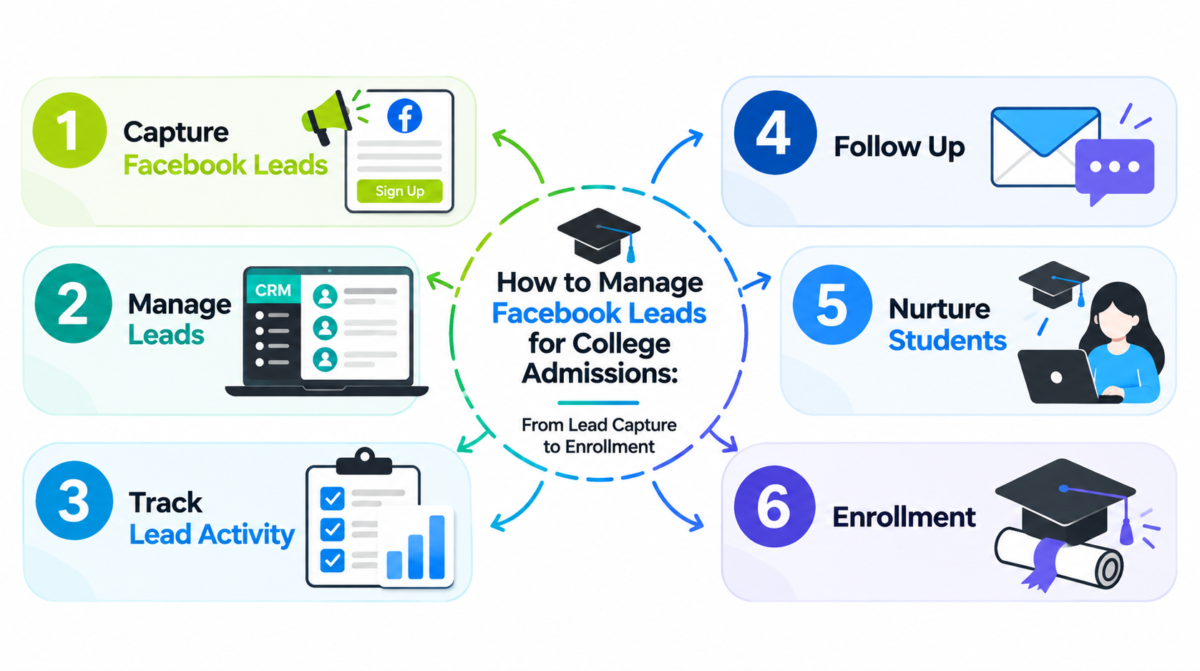
How to Manage Facebook Leads for College Admissions: From Lead Capture to Enrollment

Facebook remains one of the highest-volume inquiry sources for colleges, universities, and edtech platforms worldwide but it’s also where the most admissions leads quietly disappear. A prospective student fills out an in-app form, gets excited about your program for thirty seconds, and then nothing happens for days because the lead sat inside Meta’s Ads Manager instead of landing on a counselor’s desk.

This guide covers exactly how to capture, route, and convert Facebook leads for admissions including how to integrate Facebook leads into a CRM, how Education CRM Solutions can streamline lead management, and how Sensation CRM solves this specifically for education teams.

Why Facebook Leads Need Different Handling Than Website Inquiries

Facebook (and Instagram) Lead Ads work differently from a standard “Apply Now” website form. Instead of clicking off the platform, a prospective student sees an in-app form that auto-fills with their profile data name, email, phone and simply reviews and submits. This lower-friction format produces dramatically lower drop-off rates and a significantly higher volume of completed submissions compared to traditional click-to-website campaigns. Lead ads convert 2–3 times better than traditional landing pages precisely because the forms are pre-filled inside the app.

That’s the good news. The problem is what happens after submission. When someone fills out a Facebook Lead Ad form, Meta simply stores that lead in Ads Manager no alert, no CRM entry. Unless you’ve built a bridge from Facebook into your admissions system, that lead sits untouched until someone remembers to export a spreadsheet.

This is the exact gap Sensation CRM closes. Its Facebook integration automatically syncs lead data from Facebook Lead Ads directly into the CRM without manual effort. As part of CRM enrollment management, every student inquiry can move directly into your admissions pipeline the moment a student submits a form, the lead is already inside your CRM, ready for follow-up and enrollment tracking.

Logo

Are Your Facebook Leads Turning into Enrollments?

Centralized Lead Management

Automated Follow-ups

Real-time Reports & Analytics

Secure & Reliable

The Real Cost of a Slow Response

This isn’t a minor operational detail -it’s the single biggest reason institutions lose admissions leads they already paid for.

  • Research widely cited from Harvard Business Review found that contacting a lead within 5 minutes makes you roughly 100 times more likely to connect than waiting 30 minutes.
  • Most businesses take longer than 5 minutes to respond to a lead, and as a result lose an estimated 71% of those leads.
  • A common admissions scenario: an inquiry comes in, nobody follows up for four days, and by then the prospective student has already requested information from three other schools -all of which replied within the hour.
  • Industry data puts the average inquiry-to-enrollment conversion rate at just 4.2%, with response time identified as the single biggest predictor of whether an inquiry converts.

Speed isn’t optional -it’s the whole game. With Sensation CRM, every Facebook inquiry is captured in real time and stored securely inside the CRM, so counselors are working the lead within minutes instead of days.

How Do I Route Student Enquiries From Facebook and Google Ads Into a Single CRM for My Admissions Team?

This is the exact question most marketing and admissions leads are searching for -and the answer has three moving parts:

  1. Connect each ad source to your CRM automatically, not manually.
    Facebook/Instagram Lead Ads and Google Lead Form Extensions both support direct integrations with modern CRMs, pushing new leads in real time instead of requiring CSV downloads from two separate ad managers.
  2. Normalize the data on the way in.
    Facebook and Google forms rarely use identical field names. A proper integration maps “Full Name,” “Phone,” “Program of Interest,” and campaign data into consistent CRM fields -one clean lead record, regardless of source.
  3. Route by rule, not by hand.
    Once leads from both sources land in the same CRM, the same assignment logic should apply to all of them -by program, territory, or round-robin across counselors -so no channel is neglected.

This is where Sensation CRM is purpose-built for admissions teams. Rather than juggling exports from Facebook and Google Ads separately, Sensation CRM’s education CRM solutions bring every inquiry -Facebook, Google, WhatsApp, website -into one admissions pipeline, with leads automatically assigned to counselors based on your predefined rules so no inquiry goes unattended.

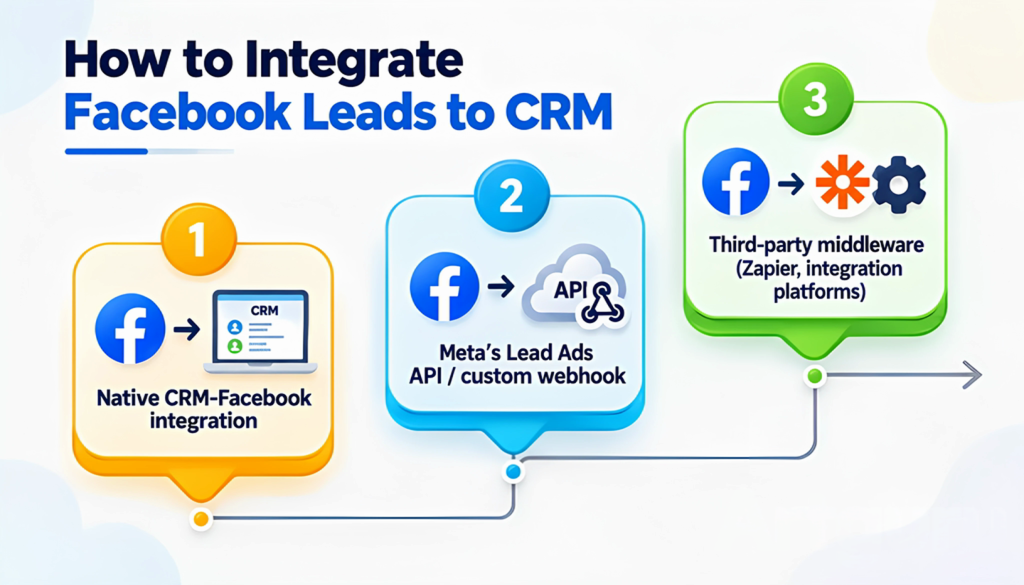
How to Integrate Facebook Leads to CRM
How to Integrate Facebook Leads to CRM

There are three common ways institutions connect Facebook Lead Ads to a CRM:

Option 1: Native CRM-Facebook integration (recommended for most institutions)
A purpose-built education CRM offers a direct Facebook integration that syncs leads automatically, with no middleware to maintain. This is exactly how Sensation CRM’s Facebook CRM integration works: leads are captured instantly, assigned automatically, and followed up without delay -and because it’s built specifically for educational institutions, the integration is aligned with admissions workflows, not a generic sales pipeline.

Option 2: Meta’s Lead Ads API / custom webhook
Technically resourced teams can build a direct webhook using Meta’s API. This gives full control but requires ongoing engineering maintenance -token refreshes, error handling, and field-mapping updates whenever a form changes.

Option 3: Third-party middleware (Zapier, integration platforms)
Useful for institutions without in-house developers, though these typically add sync delay and an extra monthly cost layer on top of your CRM.

For most colleges, universities, and edtech teams, Option 1 is the fastest path to a working setup -no developer required, no third-party subscription, and the integration already understands admissions-specific fields like intake, program interest, and counselor assignment.

How to Plug Facebook and Google Leads Directly Into an Admissions CRM

A genuinely unified setup does three things beyond the initial sync:

  • Source and campaign tagging: every lead retains which ad, campaign, and platform it came from, so marketing can see cost-per-inquiry and cost-per-enrollment by channel.
  • Multi-channel instant follow-up: with Sensation CRM, counselors can instantly respond to a newly captured lead via WhatsApp, email, or a call -all from within the same platform -which directly improves lead engagement and conversion.
  • Duplicate and quality control: verification at intake filters out fake or low-intent submissions before they consume a counselor’s time.

What Sensation CRM Does That a Generic CRM Doesn’t

Capability

Generic CRM

Sensation CRM

Real-time Facebook lead sync

Often needs middleware

Native, built-in

Admissions-specific fields (intake, program)

Rarely

Yes, by design

Automatic counselor assignment by rule

Sometimes, manual setup

Built-in, rule-based

WhatsApp + email + call follow-up in one place

Rarely unified

Yes

Built for education workflows

No -generic sales pipeline

Yes -education-first CRM

Unlike generic sales CRMs that treat every lead the same way, Sensation CRM understands that a “student inquiry” isn’t a sales opportunity in the traditional sense it needs intake tracking, program-level segmentation, and counsellor workload balancing built in from day one. When you compare the benefits of a higher education CRM vs a generic marketing CRM, the key difference is how well the system supports education-specific admissions workflows rather than treating student inquiries like standard sales leads.

From Lead Capture to Enrollment: How Sensation CRM Maps the Full Funnel

  1. Capture: Facebook lead submits the in-app form; Sensation CRM ingests it instantly with full source/campaign data.
  2. Qualify: Counsellor confirms intent, program interest, and intake timeline directly inside the CRM.
  3. Nurture: Automated and personal follow-up (WhatsApp, email, call) keeps the student engaged, since most inquiries won’t enroll in the same intake and need nurturing over months, not days.
  4. Apply: Student moves from inquiry to formal application, tracked as a distinct pipeline stage so drop-off is visible to your team.
  5. Enroll: Final conversion, with full visibility into which channel -Facebook, Google, or otherwise -actually produced the enrolled student.


Logo

Want to Map Your Student Journey from Lead Capture to Enrollment?

See how Sensation CRM can connect every stage of the admissions funnel,
from capturing inquiries to nurturing leads and converting them into enrollments

This staged view matters because institutions frequently discover mismatches between what marketing reports and what admissions actually sees for example, a marketing manager reporting over 220 leads from Facebook Ads in a week that admissions counselors only partially find, because website enquiries, WhatsApp messages, and Instagram DMs are all tracked in separate places. Sensation CRM eliminates that gap through seamless CRM Integration, keeping every channel connected in one workspace so marketing and admissions teams can access the same lead data, track interactions, and manage follow-ups more efficiently.

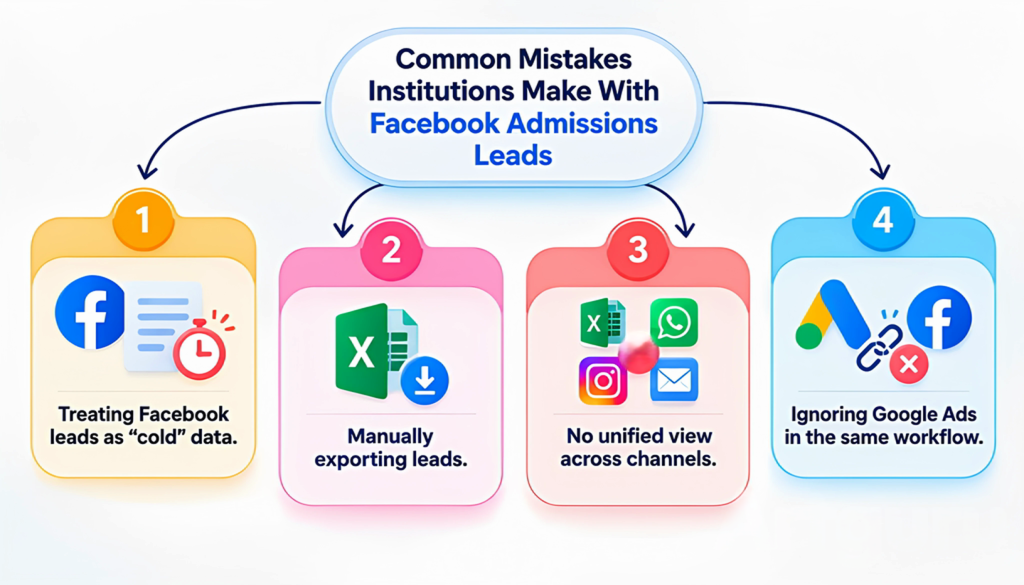
Common Mistakes Institutions Make With Facebook Admissions Leads
Common Mistakes Institutions Make With Facebook Admissions Leads

  • Treating Facebook leads as “cold” data A form-fill on Facebook is often a same-session comparison against 2–3 other institutions -speed matters more here than almost any other channel.
  • Manually exporting leads, which guarantees delay and directly causes the response-time losses cited above.
  • No unified view across channels, leading to leads getting lost between Excel sheets, WhatsApp, Instagram DMs, and email inboxes.
  • Ignoring Google Ads in the same workflow paid search alone accounts for roughly 22% of student inquiries, with education carrying one of the highest CPCs on Google Ads at $4.12, so treating it separately from Facebook wastes both budget clarity and reporting accuracy.

Sensation CRM addresses all four directly by centralizing Facebook, Google, WhatsApp, and website inquiries into a single, real-time admissions pipeline with automatic assignment and instant response tools.

Why Institutions Are Moving to Sensation CRM

The broader CRM market is expanding fast, and education is one of its biggest growth segments: the admission management software market alone is projected to reach USD 4.01 billion by 2034, growing at a 10.2% CAGR from 2025. Marketing automation adoption among universities has grown to 67%, up from 41% just a couple of years earlier institutions are actively moving away from manual, spreadsheet-based lead tracking.

If your team is still exporting Facebook leads manually, juggling WhatsApp on someone’s personal phone, and reconciling numbers between marketing and admissions every week, that’s the exact problem Sensation CRM was built to solve. It’s an education-first CRM where Facebook integration is aligned with your admissions workflow from day one not bolted on as an afterthought. Book a Demo today to see how Sensation CRM can streamline your admissions and lead management workflow.

Frequently Asked Questions

Q: What is CRM Facebook integration?
CRM Facebook integration is a connection that automatically pulls leads submitted through Facebook (and Instagram) Lead Ads directly into your CRM in real time, instead of requiring manual CSV downloads from Meta’s Ads Manager.

Q: How does Sensation CRM integrate with Facebook?
Sensation CRM automatically syncs lead data from Facebook Lead Ads and Page inquiries directly into the CRM in real time, without manual effort -leads are captured, automatically assigned to counsellors, and ready for instant follow-up via WhatsApp, email, or call.

Q: Can Sensation CRM route both Facebook and Google Ads leads into one place?
Yes -Sensation CRM is designed to bring inquiries from multiple channels, including Facebook, Google Ads, WhatsApp, and your website, into a single admissions pipeline with consistent assignment rules.

Q: Is Sensation CRM built specifically for education institutions?
Yes. Unlike generic sales CRMs, Sensation CRM’s Facebook integration is aligned with admissions workflows specifically -intake tracking, program-level segmentation, and counsellor assignment -making it suited for colleges, universities, and EdTech platforms rather than general sales teams.

Q: How fast should an admissions team respond to a Facebook lead?
As close to instantly as possible. A 5-minute response window dramatically outperforms delayed follow-up, and institutions that wait longer typically lose the majority of those leads to competing schools that respond faster.

Q: How do I get started with Sensation CRM’s Facebook integration?
You can request a demo directly through Sensation CRM to see how Facebook leads flow into the CRM, how counselor assignment rules work, and how WhatsApp/email/call follow-up operates in one place.
Categories
Student Lead Management

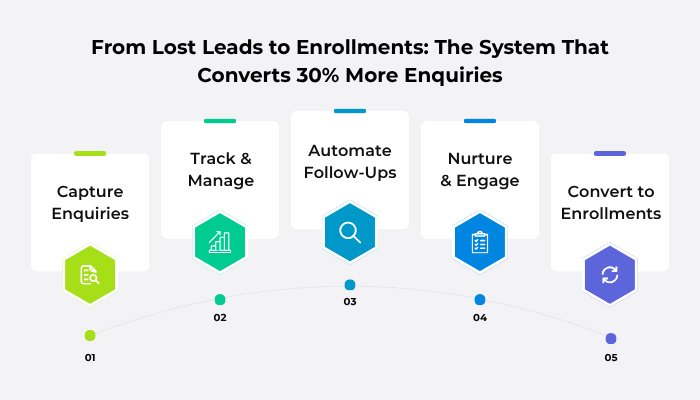
From Lost Leads to Enrollments: The System That Converts 30% More Enquiries

Every educational institution faces the same quiet problem: enquiries come in, but not enough of them turn into enrolled students. A parent fills out a form at 11 PM. A student messages on WhatsApp during class. A lead arrives from a Google ad you paid for. And then, somewhere between the first enquiry and the final admission, they slip away forgotten in a spreadsheet, contacted too late, or never followed up at all. The result is lost revenue, not from a lack of interest, but from a lack of system.

The opportunity is bigger than most institutions realize. Because so many enquiries are lost to slow, inconsistent follow-up rather than genuine disinterest, simply managing leads better can lift conversions dramatically, often by a double-digit percentage, without spending a rupee more on generating new leads.

This is where a crm for educational institutions can make a meaningful difference. The opportunity is bigger than most institutions realize because many enquiries are lost due to slow, inconsistent follow-up rather than genuine disinterest. Better lead management can meaningfully lift conversions, while industry research on lead response and nurturing consistently shows that faster, structured follow-up can recover a significant share of leads that would otherwise go cold. A student lead management system is what unlocks that gain. In this guide, we’ll explain what it is, how it works, and how it turns lost leads into enrollments, so your institution grows from the enquiries you already have.

What Is a Student Lead Management System?

A student lead management system is software that captures, organizes, tracks, and nurtures every student enquiry from first contact to final enrollment. It brings all your leads, from your website, ads, education portals, referrals, WhatsApp, and phone calls, into one place, then helps your admissions team follow up consistently, track each student’s journey, and convert more enquiries into admissions.

Think of it as the engine room of your admissions process. Instead of scattered spreadsheets, sticky notes, and missed calls, you get one organized, automated system that ensures no potential student is ever lost. Purpose-built platforms like Sensation CRM are designed around this exact journey, capturing every lead, automating follow-ups, and giving admissions teams the visibility they need to enroll more students, which is why more institutions are adopting a dedicated system rather than managing admissions manually.

Logo

Ready to Convert More Student Enquiries into Enrolments?

Centralized Lead Management

Automated Follow-ups

Real-time Reports & Analytics

Secure & Reliable

Why Do Institutions Lose Leads in the First Place?

Understanding the problem is the first step to fixing it. Most institutions don’t lose students to better competitors, they lose them to broken processes. The most common reasons enquiries go cold include:

  • Slow response times: Leads contacted hours or days later have often already chosen elsewhere.
  • Inconsistent follow-ups: Counsellors rely on memory, and busy periods mean students get forgotten.
  • Scattered data: Enquiries spread across spreadsheets, inboxes, and phones with no single view.
  • No lead tracking: Nobody knows which stage a student is at, or what the next step should be.
  • No accountability: Without tracking, it’s impossible to see which leads were followed up and which were dropped.

Each of these leaks quietly drains revenue. A student lead management system plugs every leak by making the entire process organized, automated, and visible.

How Does a Student Lead Management System Work?

student management

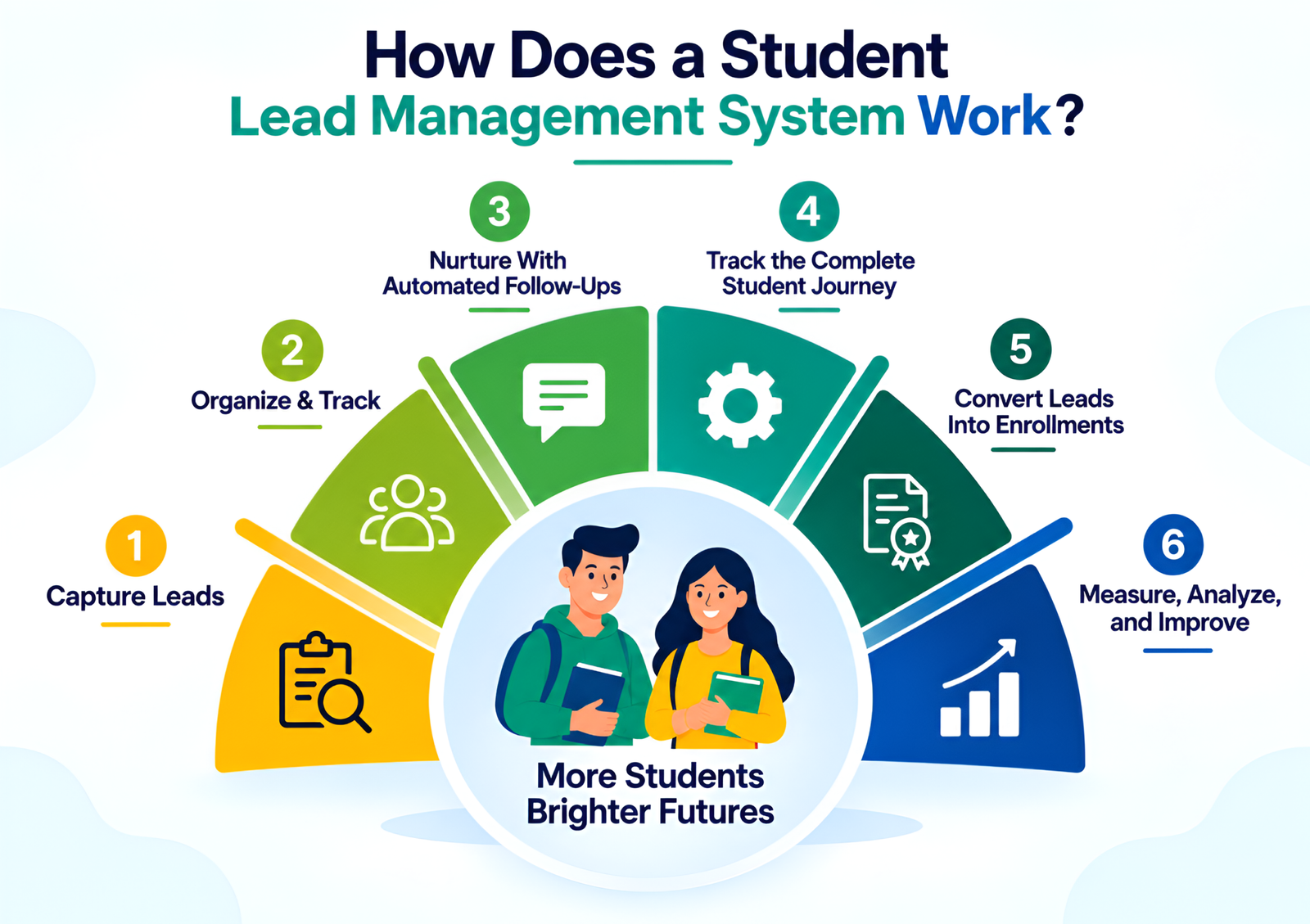
A student lead management system works by guiding every enquiry through a structured journey, capture, assign, nurture, track, convert, and analyze, so nothing falls through the cracks. Here’s how each stage works.

Step 1: Capture Every Lead, From Every Source

The system automatically collects enquiries from all your channels, website forms, Google and Meta ads, education portals, referrals, WhatsApp, and calls, into one central place. No enquiry is lost, and no lead is missed. This unified capture is the foundation of effective lead management CRM.

Step 2: Organize and Assign Leads Instantly

As soon as a lead arrives, the system organizes it and assigns it to the right counsellor automatically, by course, location, or team. Fast, rule-based assignment means students are contacted quickly, which is one of the biggest factors in whether they convert.

Step 3: Nurture With Automated Follow-Ups

Most students need several conversations before they decide. The system schedules and automates follow-ups across WhatsApp, email, SMS, and calls, with reminders so counsellors never forget. Consistent nurturing keeps your institution top of mind and moves interested students toward enrollment.

Step 4: Track the Complete Student Journey

At every stage, the system records the student’s status, enquired, contacted, counselled, application started, documents pending, admission confirmed. Your team always knows exactly where each student is and what to do next. This visibility is what separates an admission management software from a simple contact list.

Step 5: Convert Leads Into Enrollments

With every student’s history and context in one place, counsellors can have better, more personalized conversations, answer questions confidently, and guide students through applications and documents right up to confirmed enrollment. The system supports the entire admission lead management process from enquiry to enrolled.

Step 6: Measure, Analyze, and Improve

Finally, the system provides analytics on everything, which sources bring the best students, which campaigns convert, how counsellors perform, and where students drop off. These insights help you invest in what works and continuously improve your conversion rate.

How Student Lead Management Turns Lost Leads Into Enrollments

The real power of a student lead management system is in conversion. By fixing the leaks that lose leads, it directly increases how many enquiries become enrolled students, without spending more on generating new leads. Here’s the transformation it delivers:

  • Faster responses: Automated capture and assignment mean students are contacted in minutes, not days.
  • Consistent nurturing: No interested student is ever forgotten.
  • Complete visibility: Every lead is tracked, so none are dropped.
  • Better counselling: Full context leads to more personalized, persuasive conversations.
  • Smarter decisions: Analytics show what’s working, so you double down on it.

The outcome is simple but significant more admissions from the same volume of enquiries, and more revenue from the leads you already have. For most institutions, improving conversion is a far bigger opportunity than generating more leads, and a student lead management system is how you unlock it.

Key Features to Look For in a Student Lead Management System

Not every system is built for education. When evaluating an admission management software or education admission CRM, look for these essential features:

  • Multi-source lead capture: Collect every enquiry automatically, from every channel.
  • Automated lead assignment: Route leads to the right counsellor instantly.
  • Follow-up automation: Reminders and scheduled communication across WhatsApp, email, SMS, and calls.
  • Complete student tracking: A clear view of each student’s stage and history.
  • Counsellor performance tracking: Measure leads handled, follow-ups completed, and admissions converted.
  • Admission analytics and reporting: Understand which sources, campaigns, and courses drive results.
  • Ease of use: Your team should be able to use it without lengthy training.
  • Scalability: A system that grows with your institution.

A platform that combines these turns a chaotic admissions process into a smooth, measurable, revenue-generating machine.

What Is the Best Student Management System?

The best student management system is one purpose-built for admissions and lead management, not a generic tool adapted to fit. The right choice depends on your institution’s size and needs, but the best systems share the same qualities: they capture every lead automatically, automate follow-ups, track the full admission journey, offer clear analytics, and are easy for counsellors to use.

Education-focused platforms like Sensation CRM stand out because they’re designed specifically around the enquiry-to-enrollment journey, rather than being a general business CRM repurposed for schools. The “best” system for you is the one that fits your admissions workflow and consistently helps you convert more enquiries into students.

Which CRM Is Best for Lead Management?

The best CRM for lead management is one that captures every lead, assigns and nurtures it automatically, and gives you complete visibility into your pipeline. For educational institutions specifically, a dedicated education admission CRM outperforms a general-purpose CRM, because it’s built around admissions: student enquiries, counselling, follow-ups, and enrollment tracking.

A strong lead management CRM should offer multi-channel capture, automated follow-ups, clear lead tracking, and admission analytics. Sensation CRM is designed for exactly this, giving schools, colleges, universities, and coaching institutes a lead management system built for the way admissions actually work.

How to Create a Student Management System

Creating a student management system can mean building one or, far more practically, implementing a ready-made platform. Here’s a straightforward approach:

  • Map your admission journey: Define every stage from enquiry to enrollment.
  • Identify your lead sources: List every channel enquiries come from (website, ads, portals, WhatsApp, referrals).
  • Choose your approach: Building custom software is costly and slow; most institutions choose a proven education admission CRM instead.
  • Set up lead capture: Connect all your sources so every enquiry flows into one place.
  • Define assignment rules: Decide how leads are routed to counsellors.
  • Automate follow-ups: Set up reminders and communication sequences.
  • Track and analyze: Monitor each student’s stage and review analytics to improve.

For the vast majority of institutions, implementing an existing platform like Sensation CRM is faster, cheaper, and more reliable than building from scratch, you get a proven system, ongoing support, and results in weeks rather than months.

What Is a Student Database Used For?

A student database is used to store and organize information about prospective and enrolled students, their contact details, enquiry source, course interest, communication history, application status, and more, in one central, accessible place. In a student lead management system, the database powers everything: it enables lead tracking, personalized follow-ups, accurate reporting, and a complete view of each student’s journey.

A well-managed student database ensures no enquiry is lost, every interaction is recorded, and your admissions team always has the context they need to convert. It’s the single source of truth that turns scattered data into organized, actionable insight.


Logo

Want to Manage Student Information More Efficiently?

Explore how a well-structured student database can simplify data management,
improve accessibility, and support better decision-making for your institution

Market Trends: Why Lead Management Is Critical for Admissions in 2026

The shift toward lead management software in education reflects how students and parents now research and choose institutions, and why converting leads well has become the biggest growth lever available.

1. Admissions are digital and competitive: The global higher education student CRM market was valued at $3.2 billion and is projected to reach $10.4 billion by 2035, expanding at a compound annual growth rate of 16.2%. Concurrently, the broader CRM lead management software market is forecast to grow at a 12.6% annual rate as institutions prioritize data-driven enrollment pipelines.

2. Speed decides who wins: Leads contacted within 5 minutes are 21 times more likely to be qualified than those contacted after 30 minutes, and up to 100 times more likely to make contact.

3. Most leads are lost, not lacking, and that’s the 30% opportunity: A staggering 71% of internet leads are wasted due to poor follow-up. Despite companies spending significant portions of their budgets on lead generation, the majority of this investment is lost because sales teams either give up too early or respond too slowly.

4. Demand for lead generation services in India is rising, but conversion is the real edge: As competition grows, institutions are investing more in generating leads, yet generating leads you can’t convert simply wastes budget. The smartest institutions pair lead generation with a strong lead management system, so every rupee spent on enquiries actually turns into admissions.

5. AI and automation are raising the bar: Modern systems automate capture, assignment, and follow-up, and increasingly use analytics and AI to prioritize the leads most likely to enroll. Application Automation further streamlines the admissions process by reducing manual tasks and helping institutions manage student applications more efficiently. Institutions still relying on spreadsheets are falling behind those that automate.

The takeaway: in a digital, competitive admissions landscape, converting more of your existing enquiries, not just generating new ones, is the fastest and most cost-effective way to grow. A student lead management system, supported by Application Automation, is how you capture that gain.

Common Mistakes That Cost You Enrollments

Avoid these if you want to convert more leads:

  • Relying on spreadsheets that scatter data and hide leads.
  • Slow or inconsistent follow-ups that let interest go cold.
  • No lead tracking, so nobody knows a student’s stage or next step.
  • Ignoring analytics, so you keep spending on sources that don’t convert.
  • Using a generic CRM not built for the admission journey.

Fixing these, usually by adopting a dedicated system, is often the fastest way to increase enrollments.

Turn Your Lost Leads into Enrollments

Every enquiry your institution receives represents a potential student and a potential enrollment. The difference between losing them and enrolling them isn’t more marketing; it’s a better system. A student lead management system ensures every lead is captured, every follow-up happens, and every opportunity is converted.

Sensation CRM helps educational institutions do exactly that, managing the complete journey from enquiry to enrollment with automated lead capture, follow-ups, counsellor tracking, and admission analytics. Stop losing leads to slow responses and scattered spreadsheets, and start converting more of the enquiries you already have. Contact us today to discover how Sensation CRM can help your institution manage leads more effectively and increase enrollments.

Frequently Asked Questions

Q. What is a student lead management system?

A student lead management system is software that captures, organizes, tracks, and nurtures every student enquiry from first contact to enrollment. It brings all your leads into one place, automates follow-ups, tracks each student’s journey, and helps your team convert more enquiries into admissions.

Q. Which CRM is best for lead management in education?

For educational institutions, a dedicated education admission CRM is best for lead management, because it’s built around admissions rather than general sales. It should offer multi-channel lead capture, automated follow-ups, complete lead tracking, and admission analytics. Sensation CRM is designed specifically for schools, colleges, universities, and coaching institutes.

Q. How does a student lead management system increase admissions?

It increases admissions by fixing the leaks that lose leads: capturing every enquiry, responding faster, nurturing consistently with automated follow-ups, tracking every student’s stage, and providing analytics to improve. The result is more enrollments from the same volume of enquiries, without spending more on lead generation.

Q. Is admission management software different from a regular CRM?

Yes. A regular CRM is built for general sales and customer management, while admission management software is designed specifically for the education admission journey, student enquiries, counselling, follow-ups, and enrollment tracking. This makes it a far better fit for how admissions teams actually work.

Q. How much does a student lead management system cost?

Costs vary by provider, features, and institution size. Rather than building custom software (which is expensive and slow), most institutions choose a ready-made education admission CRM, which is more affordable and delivers results faster. The best way to understand pricing and fit is to request a demo.

Q. Can a student lead management system integrate with my existing tools?

Most modern systems are built to connect with your lead sources, communication channels, and existing tools, so enquiries flow in automatically and your team works from one platform. When evaluating options, confirm the integrations you need are supported.