Admission season has a sound, and it’s phones ringing. Parents ask about fees, students ask about batches, and counsellors juggle calls on personal mobiles while a missed call sits unreturned. Cloud telephony, combined with CRM Integration, helps institutes manage enquiries, connect with prospective students, and prevent admission leads from slipping away.
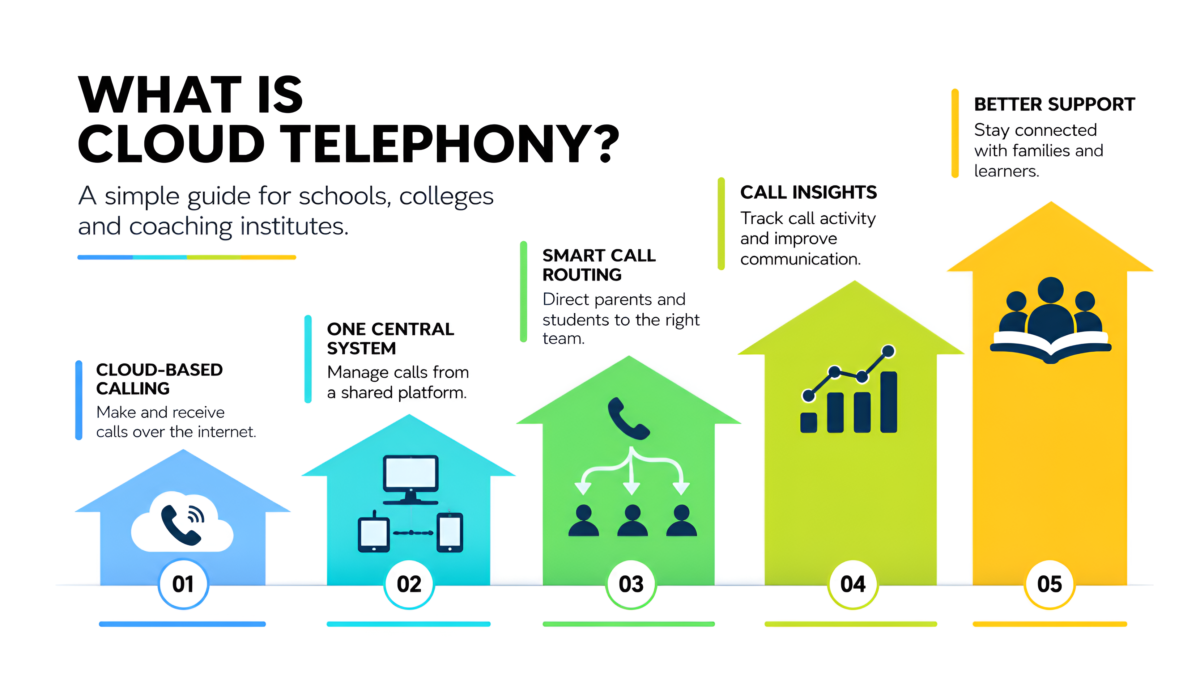
The short answer: cloud telephony is a business phone system that runs over the internet instead of on physical phone hardware. It is built on VoIP, the technology that carries voice calls over the internet, and adds features such as IVR, call routing, recording, analytics, and virtual numbers. With CRM Integration, every incoming and outgoing call can be linked to student records, allowing counsellors to track conversations, maintain enquiry history, schedule follow-ups, and monitor lead status. For an institute, this means fewer missed opportunities, better enquiry management, and a more organised admission process without investing in additional phone lines or on-site equipment.
Key Takeaways
- What it is: a hosted phone system with virtual numbers, IVR menus, call routing, recording, and call reports.
- Why it matters: speed wins enquiries. A Harvard Business Review audit of more than 2,200 US companies found that firms contacting a prospect within an hour were nearly 7 times as likely to have a meaningful conversation as firms that waited even an hour longer.
- Education has a response problem. UPCEA’s 2025 secret shopper study found 44% of inquiries to online and professional programs got no response at all.
- The big gains come with a CRM. Automatic call logging, click-to-call, and missed-call follow-up tasks are what stop leads leaking.
- Rules apply. TRAI governs outbound commercial calls, and the DPDP Act’s main duties start in May 2027, with special rules for students under 18.
- The market is growing fast. IMARC Group values India’s cloud-based contact centre market at USD 1.4 billion in 2025, projected to reach USD 7.9 billion by 2034.
How Schools, Colleges, and Coaching Institutes Use It
Schools
- A single admissions enquiry number, with an IVR that separates admissions, fees, and transport
- A parent helpline that routes calls to the right office
- Missed-call numbers on admission banners and ads, with automatic callbacks
Colleges
- Course-wise routing so a BTech enquiry reaches the BTech counsellor
- Counselling-season campaigns and application or document follow-ups
- A results-day helpline that handles spikes
Coaching institutes
- Surge handling after results and ad campaigns, when enquiries peak
- Branch routing and batch information through IVR
- Counsellor accountability, with every call logged against the lead
- Demo-class reminders and follow-ups on leads from Facebook and Google Ads
In school and coaching admissions, parents are often the decision-makers, so a phone call still matters even if a lead first arrived on WhatsApp or a form.
Cloud Telephony vs a Traditional Phone System
| | Traditional landline or PBX | Cloud telephony |
| Setup | Lines, hardware, installation | Software and numbers set up by a provider |
| Scaling | Add lines and equipment | Add users in the system |
| Call data | Limited or manual | Automatic logs, recordings, and reports |
| CRM link | Rare | Can connect to a CRM |
| Remote or multi-campus teams | Hard | Calls route to any location |
| Peak season | Busy signals and missed calls | Queues, routing, and overflow rules |
Cloud Telephony Plus a CRM: Where the Real Gains Come From
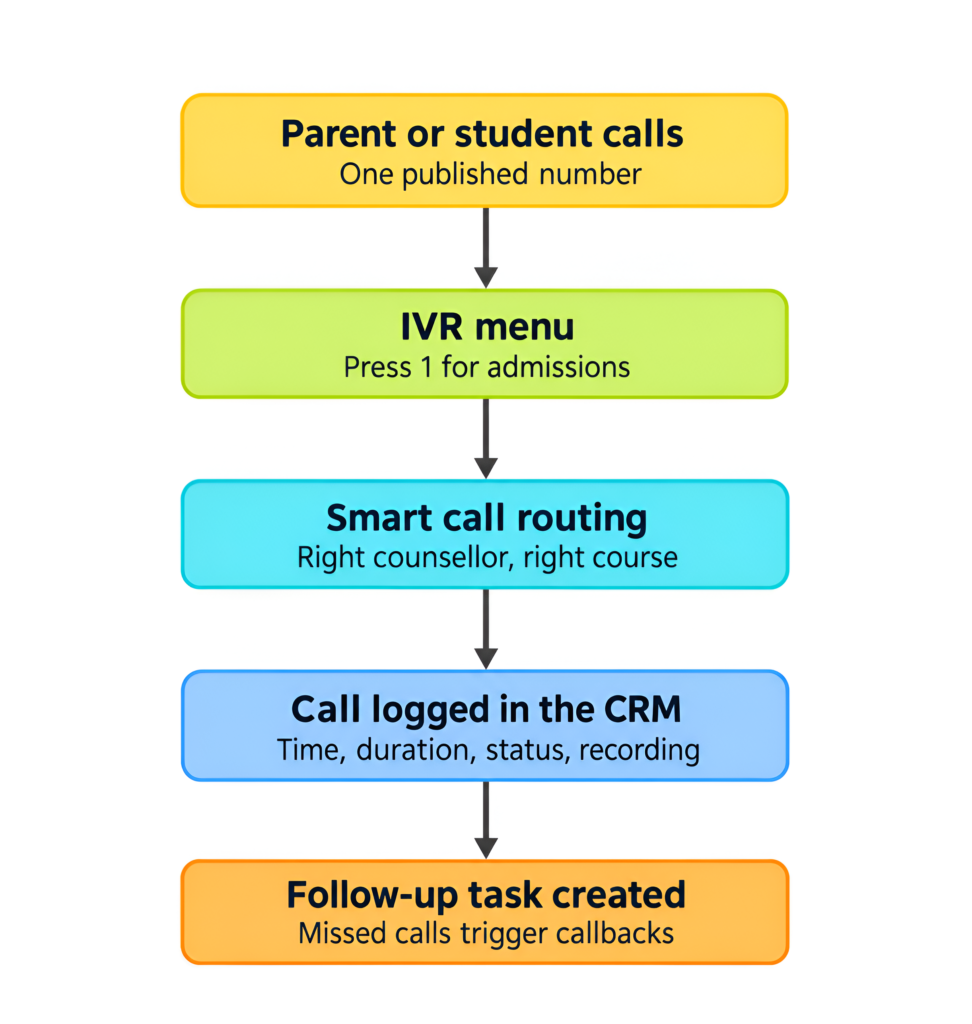
A phone system on its own tells you a call happened. Connected to a CRM, it tells you whose call it was, what was said, and what happens next. Sensation CRM cloud telephony integration shows how that works:
- It connects admissions teams to Twilio and Ozonetel, so counsellors can place and receive calls directly from lead and applicant profiles.
- Every call is automatically linked to the correct record, and call time, duration, status, and counsellor details are logged to the lead’s activity timeline.
- Missed calls can generate instant follow-up tasks, so no lead is forgotten.
- Managers can see the number of calls made and received, average call duration, follow-up response times, and conversion trends linked to calls.
- According to its FAQ, call recordings are stored and accessible within the CRM, and telephony works with WhatsApp, email, and SMS.
- It supports Twilio for global communication and Ozonetel for enterprise-grade Indian telephony.
Rules to Know: TRAI and DPDP
TRAI rules for calls
- Promotional calls use the 140 series. Promotional calls must use 140-series numbers, while certain service calls use 1600-series numbers. Using the wrong series is treated as an unregistered-telemarketer violation.
- Register and scrub. Businesses, their telemarketers, sender identities, and templates must be registered on the DLT platform, and no promotional call may reach a number on the DND list.
- Calling hours. Commercial telemarketing calls are restricted to 9 AM to 9 PM.
- Consent needs a record. One 2026 compliance guide says consent records must be uploadable to the DLT platform, so verbal or implied consent is not enough.
- Automated calls must be declared. Since TRAI’s September 2026 amendment, a call must clearly declare when it is automated.
- Inbound is different. One guide notes that inbound calls, where the customer dials your published number, do not need 140-series telemarketing headers.
- Coordinate calls with WhatsApp CRM for education leads. Educational institutions can use a WhatsApp CRM for education leads to manage admission enquiries, record communication history, and coordinate follow-ups. This helps counsellors maintain consistent communication across WhatsApp and calling channels while ensuring that promotional messages and calls follow applicable consent and compliance requirements.
- Whether a particular admissions follow-up counts as promotional or as a service call is a legal question. Confirm it with your telephony provider and legal adviser before you launch outbound campaigns.
- DPDP Act: student and parent data
- The DPDP Rules were notified on 13 November 2025, and the main duties, including consent, security safeguards, and breach reporting, take effect in May 2027.
- Every student under 18 is a child under the Act, so processing their data needs verifiable parental consent. The exemption for educational institutions covers tracking and behavioural monitoring, not every use of a student’s data.
- Penalties for children’s-data failures can reach ₹200 crore, and the 2027–28 admission cycle is the practical deadline.
Call recordings and logs contain personal data. Tell callers when a call is recorded, limit who can access recordings, set a retention period, and keep a record of consent.
How to Choose a Cloud Telephony Provider
| Check | What to look for |
| Compliance support | DLT registration help, 140-series numbers, DND scrubbing, calling-hour controls |
| Reliability | Uptime record, call quality, peak-season capacity |
| CRM integration | Native integration, not just an API you must build yourself |
| IVR and routing | Easy menu changes, routing by course, branch, language, or availability |
| Recording and storage | Retention settings, access controls, secure storage |
| Reporting | Calls per counsellor, response times, answer and missed-call rates |
| Security | Encryption and role-based access |
| Support | Onboarding help and response time |
| Pricing | Clear per-user, per-minute, number, and storage charges |
How to Set It Up in 8 Steps
- Map your call types: admissions, fees, results, transport, and general queries.
- Choose your numbers: a main admissions number and, if needed, a missed-call number for ads.
- Design a short IVR: three or four options at most, with a clear greeting.
- Set routing rules: by course, language, branch, and availability, with an overflow plan for peak days.
- Connect your CRM so every call is logged to the right lead.
- Train your counsellors: greeting, recording notice, and call notes.
- Check compliance: TRAI for outbound calls, DPDP for recordings and student data.
- Review weekly: track the metrics below and adjust.
Metrics to Track
- Answer rate and missed-call rate
- Time to first response and callback time for missed calls
- Calls per counsellor and average call duration
- Connect rate on outbound follow-ups
- Enquiry to visit or demo, and enquiry to admission, by lead source
What Does Cloud Telephony Cost?
Prices vary by provider, so ask for a sample invoice for a peak-season month. The cost usually has these parts:
- Per-user or per-seat fees
- Per-minute charges for inbound and outbound calls
- Rental for toll-free or virtual numbers
- Call-recording storage
- IVR and routing setup
- Compliance and DLT setup for outbound campaigns
- CRM integration fees, if any
Common Mistakes to Avoid
- Too many IVR options Callers hang up. Keep it to three or four.
- No missed-call callbacks A missed call is a lead. Create a task automatically.
- Recording without notice: Tell callers, and set retention rules.
- Routing everything to one counsellor Spread the load by course, branch, or availability.
- Ignoring after-hours enquiries Use a greeting or an automatic reply so the lead doesn’t go cold.
- Running outbound campaigns without checking TRAI rules.
- Keeping call data in a separate tool Without a CRM link, you’re back to spreadsheets.
- Measuring call volume only Track conversions, not just calls.
Cloud Telephony for Your Institute with Sensation CRM
Sensation CRM is an education CRM for colleges, universities, coaching institutes, training centres, education consultancies, and EdTech businesses. Its cloud telephony integration puts calling, call logging, and follow-up tasks inside the admissions workflow, so counsellors work from one screen.
Ready to see it in action? Book a free cloud telephony demo with Sensation CRM.
Book a free demo →
Frequently Asked Questions
Q. What is cloud telephony in simple words?
It is a phone system that runs over the internet and is managed by a provider, so you get virtual numbers, IVR menus, call routing, recording, and reports without physical phone hardware.
Q. How is cloud telephony different from a normal landline or PBX?
A landline or PBX needs lines and equipment on site. Cloud telephony runs in the cloud, scales by adding users, and records call data automatically.
Q. What is IVR, and is it the same as cloud telephony?
No. IVR is the automated menu that lets callers choose an option. It is one feature inside a cloud telephony system.
Q. Do schools, colleges, and coaching institutes need cloud telephony?
Any institute that handles many admission calls benefits, especially during peak season, when missed calls and slow responses cost enquiries.
Q. Can I record calls?
Cloud telephony can record calls, but you should tell callers, restrict access, and set a retention period. Recordings hold personal data covered by the DPDP Act.
Q. Is cloud telephony legal in India?
Yes, it is widely used, but compliance depends on your provider’s setup and your calling practices, including TRAI’s rules on number series, consent, and DND.
Q. How much does cloud telephony cost?
It depends on users, call minutes, numbers, storage, and setup. Ask for a sample invoice for a peak month before you commit.
Q. Can cloud telephony work with a CRM?
Yes, and that is where the value is. Calls are logged to the lead automatically, counsellors can click to call, and missed calls can trigger follow-up tasks.
Q. How fast should we respond to an admission enquiry call?
As fast as you can. Research suggests the odds of a meaningful conversation drop sharply after the first hour, and aiming for minutes is better.