Categories
Education CRM Education CRM Software

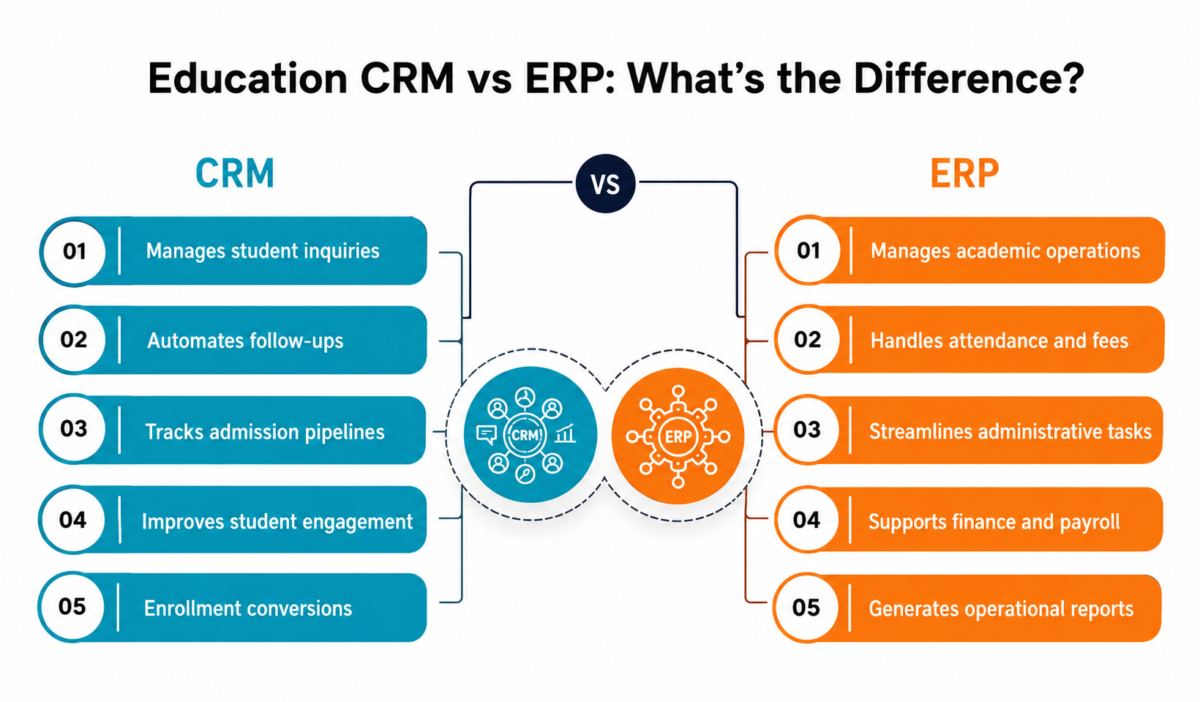
Education CRM vs ERP: What’s the Difference and What Do Educational Institutions Really Need?

Educational institutions today manage far more than admissions and academic records. Schools, colleges, universities, coaching centres, and education consultancies across India handle student enquiries, admissions, communication, fee collection, academic operations, marketing campaigns, reporting, and stakeholder engagement every day.

As digital transformation accelerates, many institutions look for solutions that improve admissions and student engagement. Whether students search for colleges near me, universities near me, or online admission options, institutions need technology that helps them respond faster and manage every enquiry efficiently. This is where Education CRM software and ERP systems play different but equally important roles.

Many institutions ask whether they need a CRM, an ERP, or both. Understanding the difference helps improve student recruitment, operational efficiency, and long-term growth. A purpose-built Education CRM software in India enables institutions to streamline admissions, automate follow-ups, improve student engagement, and increase enrollment outcomes.

Why Educational Institutions Need Digital Management Systems

The modern student journey begins long before enrollment. Prospective students interact with websites, social media, education portals, WhatsApp, email campaigns, and counselors before making admission decisions.

Managing these processes manually often leads to lost student enquiries, delayed follow-ups, disconnected data, inefficient communication, and limited visibility into admissions performance. Education CRM software helps institutions across India centralize student enquiries, automate communication, and deliver a better admission experience while improving operational efficiency.

What Is CRM for Education?CRM for Education
This is one of the most common questions educational institutions ask.

A Customer Relationship Management (CRM) system designed for education focuses primarily on student recruitment, admissions, communication, lead management, and relationship building.

An education CRM helps institutions manage prospective student interactions from the first inquiry through enrollment and beyond.

Unlike traditional business CRMs, a CRM for education industry is specifically designed to support admission workflows, student engagement, counselor management, marketing campaigns, and enrollment tracking. Understanding CRM for education features & checklist helps institutions select the right solution to streamline admissions and improve enrollment outcomes.

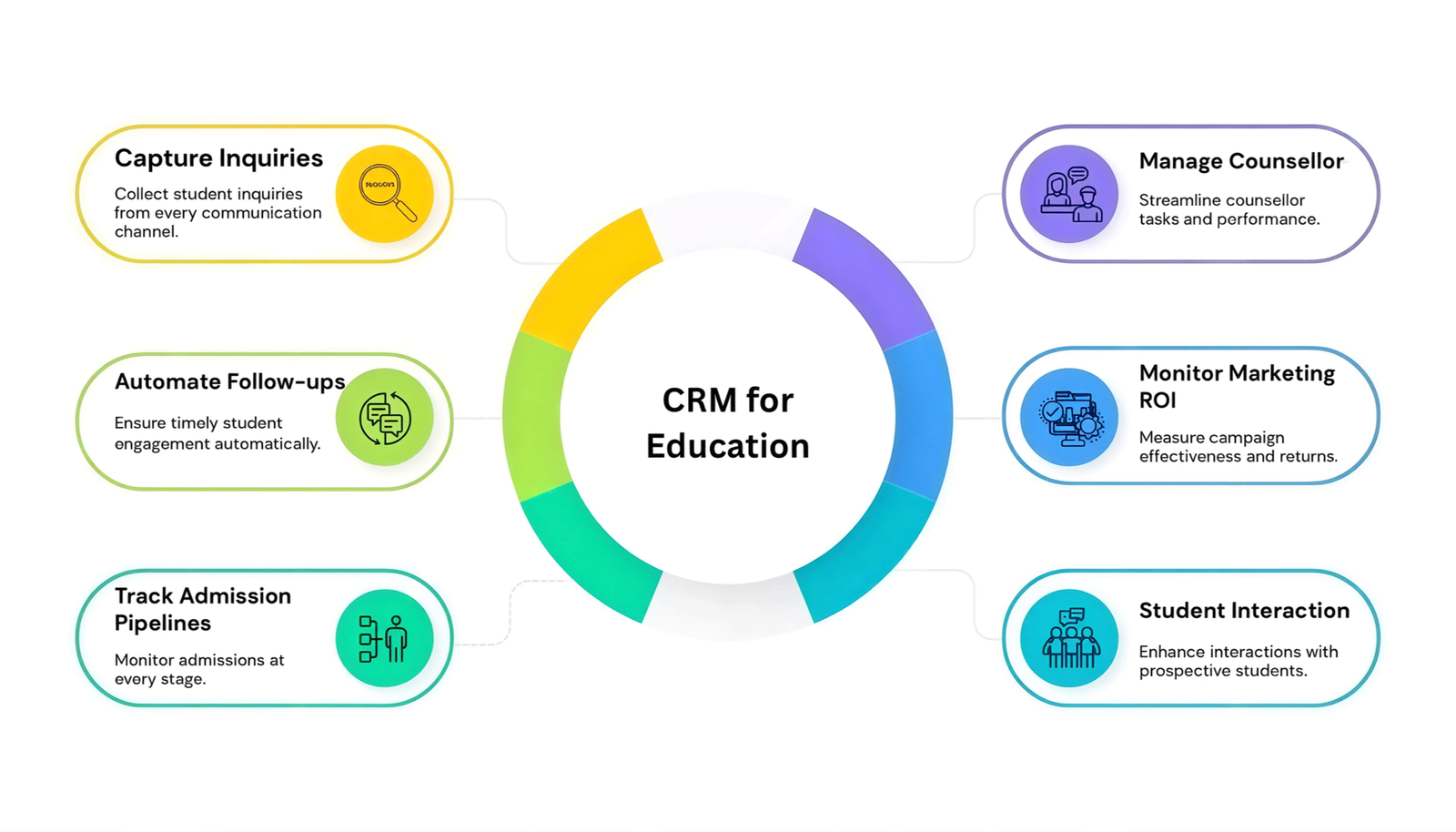
Educational institutions use CRM software to:

  • Capture inquiries from multiple channels
  • Automate follow-ups
  • Track admission pipelines
  • Manage counsellor activities
  • Monitor marketing ROI
  • Improve student communication
  • Increase enrollment conversions

A CRM focuses on helping institutions attract, engage, nurture, and convert prospective students more effectively.

What Is an ERP System in Education?

An Enterprise Resource Planning (ERP) system focuses on managing internal institutional operations. While CRM manages prospective student relationships, ERP manages the administrative and academic processes that occur after enrollment.

Educational ERP systems typically centralize:

  • Student records
  • Attendance management
  • Examination systems
  • Fee management
  • Human resources
  • Payroll
  • Timetable scheduling
  • Academic reporting
  • Library management
  • Faculty administration

ERP platforms are designed to improve operational efficiency by integrating multiple internal departments into a unified system.

Education CRM vs ERP: Understanding the Core Difference

Although CRM and ERP systems often work together, their primary objectives are different.

FeatureEducation CRMEducation ERP
Primary FocusStudent acquisition and admissionsAcademic and administrative management
User GroupAdmission teams, marketing teams, counselorsFaculty, administration, finance, HR
Inquiry ManagementYesLimited
Lead TrackingYesNo
Marketing AutomationYesNo
Student CommunicationExtensiveBasic
Academic OperationsLimitedYes
Attendance ManagementNoYes
Examination ManagementNoYes
Fee ManagementLimitedYes
Enrollment AnalyticsYesLimited
Internal AdministrationNoYes

The simplest way to understand the difference is:

CRM helps institutions acquire students. ERP helps institutions manage students after enrollment.

Which Is Better CRM or ERP?

Another frequently searched question is:

The answer depends entirely on the institution’s goals.

If your primary challenge involves generating inquiries, improving admissions, increasing enrollment conversions, and managing communication, a CRM is often the higher priority.

If your institution struggles with academic administration, student records, examinations, fee collection, and internal operations, an ERP may be more critical.

However, for most growing educational institutions, the question is not CRM versus ERP.

The real question is how both systems can work together to support the complete student lifecycle.

A CRM manages the pre-admission journey, while an ERP manages the post-admission experience.

Can ERP Replace CRM?

Many institutions assume that because ERP systems contain student information, they can eliminate the need for a CRM.

In most cases, no.

ERP systems focus mainly on academic and operational management, whereas student acquisition, engagement and lead nurturing are better managed through an education CRM.

While some ERP platforms include basic communication features, they often lack advanced capabilities such as:

  • Lead capture automation
  • Admission funnel tracking
  • Marketing campaign management
  • Lead scoring
  • Counselor activity monitoring
  • Enrollment conversion reporting
  • Multi-channel communication workflows

These functions are central to modern admissions management and are typically handled more effectively through dedicated CRM platforms.

Does an ERP Include a CRM?

Some ERP providers offer basic CRM functionality within their platforms. However, these modules are usually limited compared to specialized education CRM solutions.

A built-in CRM module may allow institutions to record inquiries and manage basic communication, but advanced features such as automation, marketing attribution, AI-driven lead scoring, and enrollment analytics are often missing.

As competition for student recruitment increases, many institutions choose specialized CRM platforms to gain greater visibility into admissions performance and marketing effectiveness.

What Are the Five ERP Modules?ERP Modules
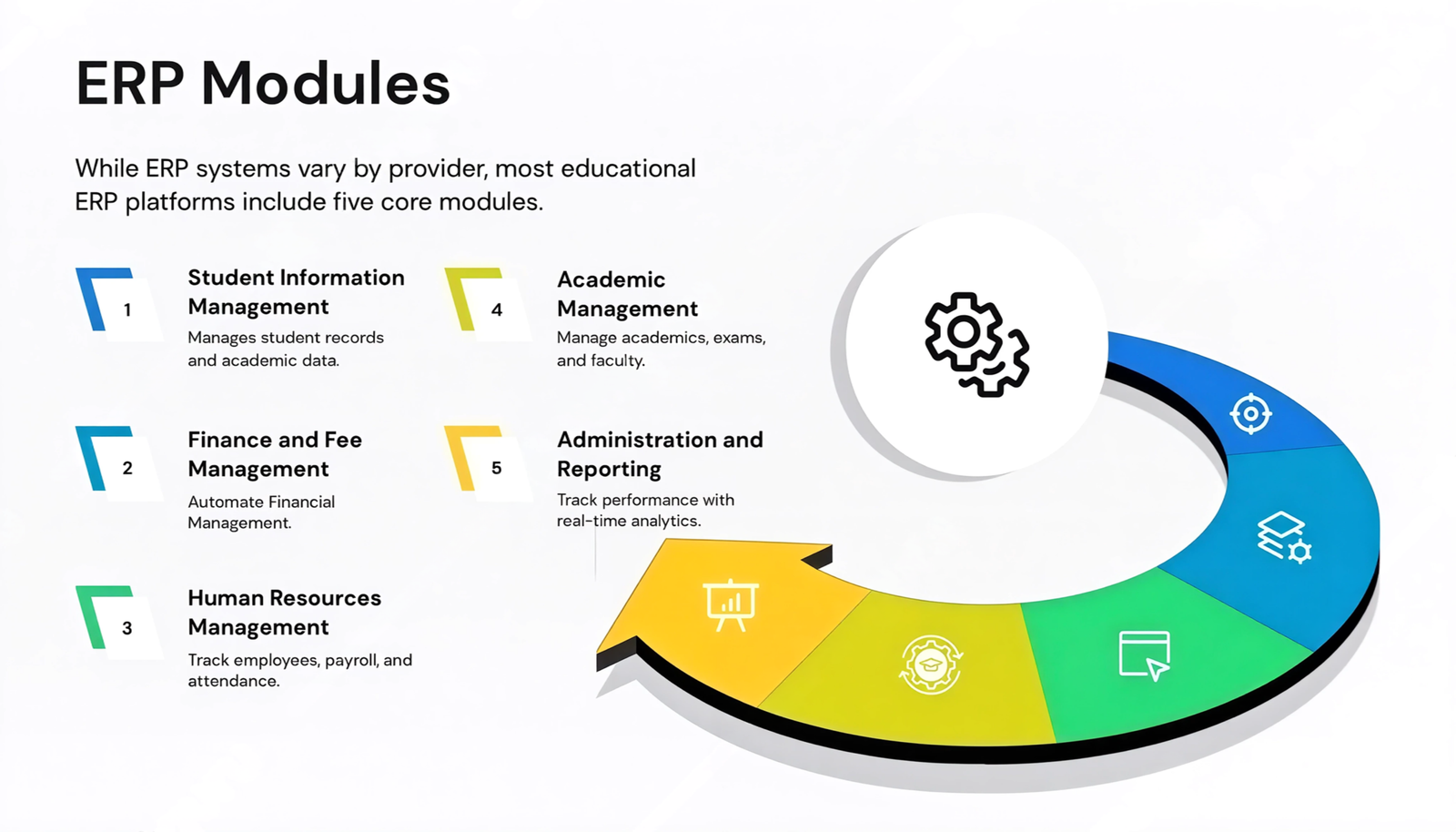
While ERP systems vary by provider, most educational ERP platforms include five core modules:

Student Information Management: This module manages student profiles, enrollment records, academic history, and institutional data.

Finance and Fee Management: Finance modules support fee collection, accounting, invoicing, budgeting, and financial reporting.

Human Resources Management: HR functionality manages employee records, recruitment, payroll, attendance, and performance tracking.

Academic Management: Academic modules support timetables, examinations, grading systems, curriculum planning, and faculty operations.

Administration and Reporting: Administrative modules provide reporting dashboards, operational analytics, compliance monitoring, and institutional performance insights.

Together, these modules create a centralized operational ecosystem for educational institutions.

Why Education CRM Is Becoming More Important in 2026

Student recruitment has become increasingly competitive across schools, colleges, universities, and education businesses. Prospective students expect personalized communication, immediate responses, and seamless digital experiences throughout the admission process.

Research consistently shows that institutions responding quickly to inquiries achieve significantly higher conversion rates than those relying on delayed manual follow-up processes.

As a result, educational institutions are investing heavily in CRM technologies that support admission automation, lead management, marketing attribution, AI-powered engagement, and student communication workflows.

The growing importance of digital-first recruitment strategies is making CRM software one of the most valuable technology investments for modern educational organizations.

How Sensation CRM Helps Educational Institutions

For institutions seeking a specialized solution for admissions and student engagement, Sensation CRM provides a purpose-built platform designed specifically for the education sector.

Unlike generic CRM platforms originally developed for corporate sales teams, Sensation CRM focuses on education-specific workflows and enrollment management processes.

The platform helps institutions:

  • Capture inquiries from multiple sources
  • Automate admission follow-ups
  • Manage counselor activities
  • Track student communication
  • Measure marketing campaign performance
  • Monitor enrollment conversion rates
  • Improve lead response times
  • Generate admission reports and analytics

By centralizing admissions and student engagement activities, Sensation CRM enables institutions to create more efficient recruitment processes while improving student experiences.


Logo

Education CRM or ERP: Find the Right Fit for Your Institution

From inquiry capture to enrollment, manage everything
in one place and never miss a potential student.

Do Educational Institutions Need Both CRM and ERP?

For many institutions, the most effective approach is not choosing between CRM and ERP but implementing both technologies strategically.

CRM platforms support student recruitment, admissions, communication, and engagement before enrollment. ERP systems support academics, finance, administration, and operational management after enrollment.

Together, they provide a complete technology ecosystem that supports the entire student lifecycle from first inquiry to graduation.

Institutions that successfully integrate CRM and ERP systems often achieve stronger enrollment outcomes, improved operational efficiency, and better student experiences.

Why Indian Colleges and Universities Are Investing in Education CRM Software

The education sector in India has become significantly more competitive over the past few years. Private universities, engineering colleges, management institutes, online learning platforms, coaching centers, and international education consultants are all competing for student attention across digital channels.

With the implementation of the National Education Policy (NEP) and the rapid growth of digital admissions, institutions can no longer depend solely on traditional recruitment methods. Students expect quick responses, personalized communication, online counseling sessions, and seamless application experiences.

As a result, educational institutions across India are increasingly adopting education CRM software to streamline admissions, improve student engagement, and gain better visibility into recruitment performance. Institutions that leverage CRM platforms are often able to respond faster to inquiries, nurture leads more effectively, and improve enrollment outcomes. Book a free demo today to see how an education CRM can transform your admission and enrollment processes.

How AI Is Transforming Education CRM Software in 2026

Artificial Intelligence is rapidly changing how colleges and universities manage admissions and student engagement. Modern CRM platforms are no longer limited to storing contact information and tracking inquiries. They now provide intelligent automation capabilities that help admission teams work more efficiently.

AI-powered education CRM software can automatically score leads based on student behavior, identify high-intent applicants, personalize communication workflows, and recommend the next best action for counselors.

Educational institutions are increasingly using AI to:

  • Predict enrollment probability
  • Automate counselor assignment
  • Trigger personalized follow-up campaigns
  • Identify inactive prospects
  • Analyze recruitment channel performance
  • Improve response times
  • Generate admission reports automatically

According to industry research from Gartner, organizations implementing AI-powered CRM systems can significantly improve operational efficiency and customer engagement through automation and predictive analytics.

For colleges and universities managing thousands of inquiries annually, AI-driven CRM platforms provide a measurable competitive advantage.

Education Technology Market Growth

The education technology market in India continues to grow as colleges and universities invest in digital transformation, student engagement, and automated admissions. With more students searching for colleges near me and online admission options, Education CRM solutions are becoming essential for improving recruitment, communication, and enrollment outcomes.

Which One to Choose – CRM or ERP?

An Education CRM helps institutions attract, nurture, and convert prospective students, while an ERP manages academic and administrative operations. For institutions aiming to improve admissions, lead management, and student communication, an Education CRM delivers faster results. Sensation CRM helps educational institutions across India streamline admissions, automate follow-ups, and increase enrollments with a purpose-built CRM solution.

Logo

Choose the Right Education CRM for Your Institution

Capture Inquiries

From all sources in one place

Automate Follow-ups

Timely reminders & communication

Monitor Performance

Track counselors & team activity

Increase Enrollments

Convert more inquiries into admissions
Frequently Asked Questions 

Q: What is CRM for education?

An education CRM is a student relationship management platform that helps schools, colleges, universities, and education businesses manage inquiries, admissions, communication, lead nurturing, and enrollment processes.

Q: Which is better CRM or ERP?

Neither is universally better. CRM focuses on admissions and student acquisition, while ERP focuses on academic and administrative operations. Most institutions benefit from using both systems together.

Q: Can ERP replace CRM?

Generally, no. ERP systems manage operational processes, while CRM platforms provide specialized tools for admissions, communication, lead management, and enrollment tracking.

Q: Does an ERP include a CRM?

Some ERP systems include basic CRM modules, but they often lack advanced admissions automation, marketing analytics, lead management, and communication capabilities offered by dedicated CRM solutions.

Q: What are the five ERP modules?

The five common ERP modules include Student Information Management, Finance Management, Human Resources, Academic Management, and Administration & Reporting.

Q: Why do educational institutions need CRM software?

CRM software helps institutions improve inquiry management, automate follow-ups, increase enrollment conversions, track marketing ROI, and enhance student engagement.

Q: How does Sensation CRM help colleges and universities?

Sensation CRM helps educational institutions centralize admissions, automate communication, track inquiries, measure marketing performance, improve counselor productivity, and increase enrollment success.

Categories
CRM for Colleges and Universities

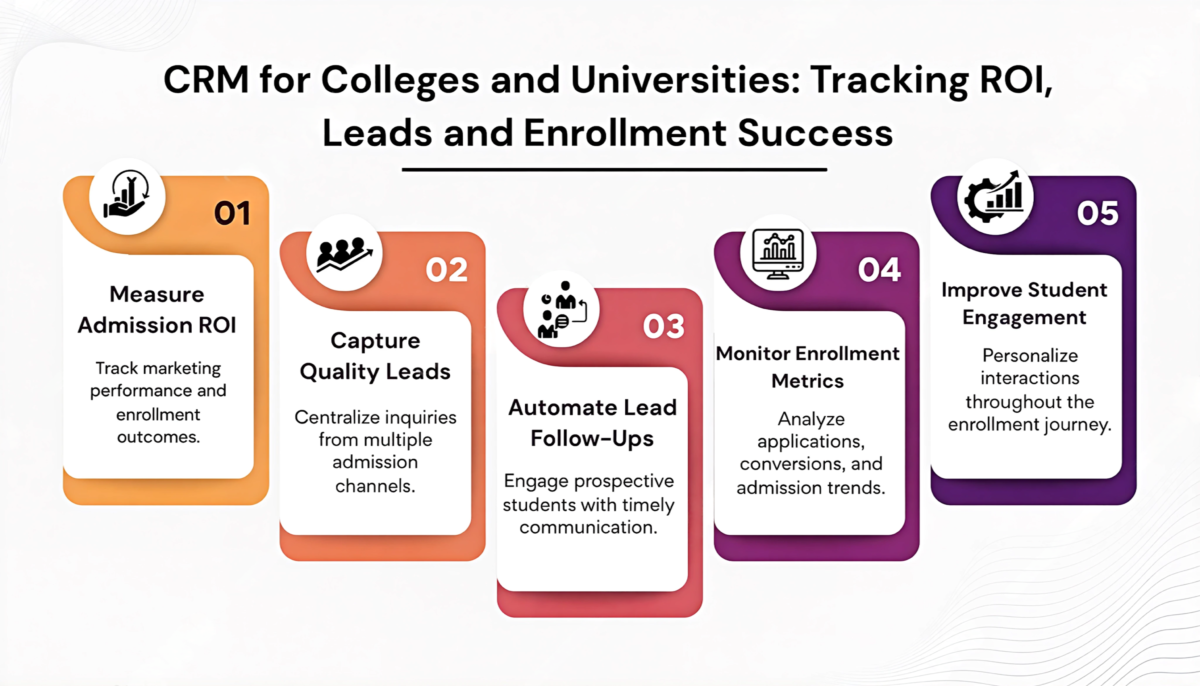
CRM for Colleges and Universities: Tracking ROI, Leads and Enrollment Success

Colleges and universities today face growing competition to attract and enroll students. As more students begin their search online, institutions need faster and more personalized ways to engage with prospective applicants.

To meet these expectations, many educational institutions are adopting CRM software that helps manage inquiries, improve communication, and track enrollment performance from a single platform. This is why colleges and universities are investing in CRM for Colleges and Universities, enabling institutions to centralize student interactions, automate communication, and gain complete visibility into the enrollment funnel. As Bill Gates once said: “How you gather, manage, and use information determines whether you win or lose.” For educational institutions, especially across India’s rapidly growing higher education sector, student data has become one of the most valuable assets for improving recruitment performance and enrollment success.

How Universities Manage Student Inquiries in 2026

One of the biggest challenges facing admission teams is handling thousands of inquiries across websites, social media platforms, education portals, WhatsApp, webinars, email campaigns, and counselling sessions.

  • Handling 2,000+ inquiries
  • Student communication challenges
  • Missed follow-ups

A modern Education CRM Software solution helps universities capture, organize, and nurture student inquiries through a structured admission workflow. Every interaction is recorded, allowing counsellors to understand student interests, communication history, and enrollment readiness. This approach is helping colleges and universities across India improve admissions efficiency and deliver a better student experience.

Logo

Ready to Improve Enrollment ROI?

Capture Inquiries

From all sources in one place

Automate Follow-ups

Timely reminders & communication

Monitor Performance

Track counselors & team activity

Increase Enrollments

Convert more inquiries into admissions
What Is the Best CRM Software for College Admissions?

The best CRM software for college admissions is one that supports the entire student lifecycle from inquiry generation to enrollment confirmation and ongoing engagement. An effective College Admission CRM should provide:

  • Lead management and student recruitment tracking
  • Automated email, SMS, and WhatsApp communication
  • Application and document management
  • Admission pipeline visibility
  • Marketing ROI reporting
  • Counselor performance tracking
  • Student enrollment analytics
  • AI-powered lead scoring
  • Multi-campus administration
  • Student lifecycle management

Unlike traditional business CRMs, education-focused platforms are designed specifically around student recruitment and admission workflows. This is one of the reasons many educational institutions across India are moving toward specialized solutions such as Sensation CRM, which has been built to address the operational requirements of colleges, universities, coaching institutes, and educational organizations.

CRM vs. ERP for Universities: What Is the Difference?

A common question among educational institutions is whether they need a CRM or an ERP system. Although both systems support institutional operations, they serve different purposes.

FeatureCRM for UniversitiesERP for Universities
Student RecruitmentYesLimited
Lead ManagementYesNo
Admission TrackingYesPartial
Marketing ROI TrackingYesNo
Student CommunicationYesLimited
Academic ManagementNoYes
Finance & PayrollNoYes
Student RecordsPartialYes
Enrollment AnalyticsYesLimited

A CRM focuses on attracting, nurturing, and converting prospective students, while an ERP manages internal academic and administrative operations. Most successful institutions integrate both systems to create a complete education technology ecosystem.

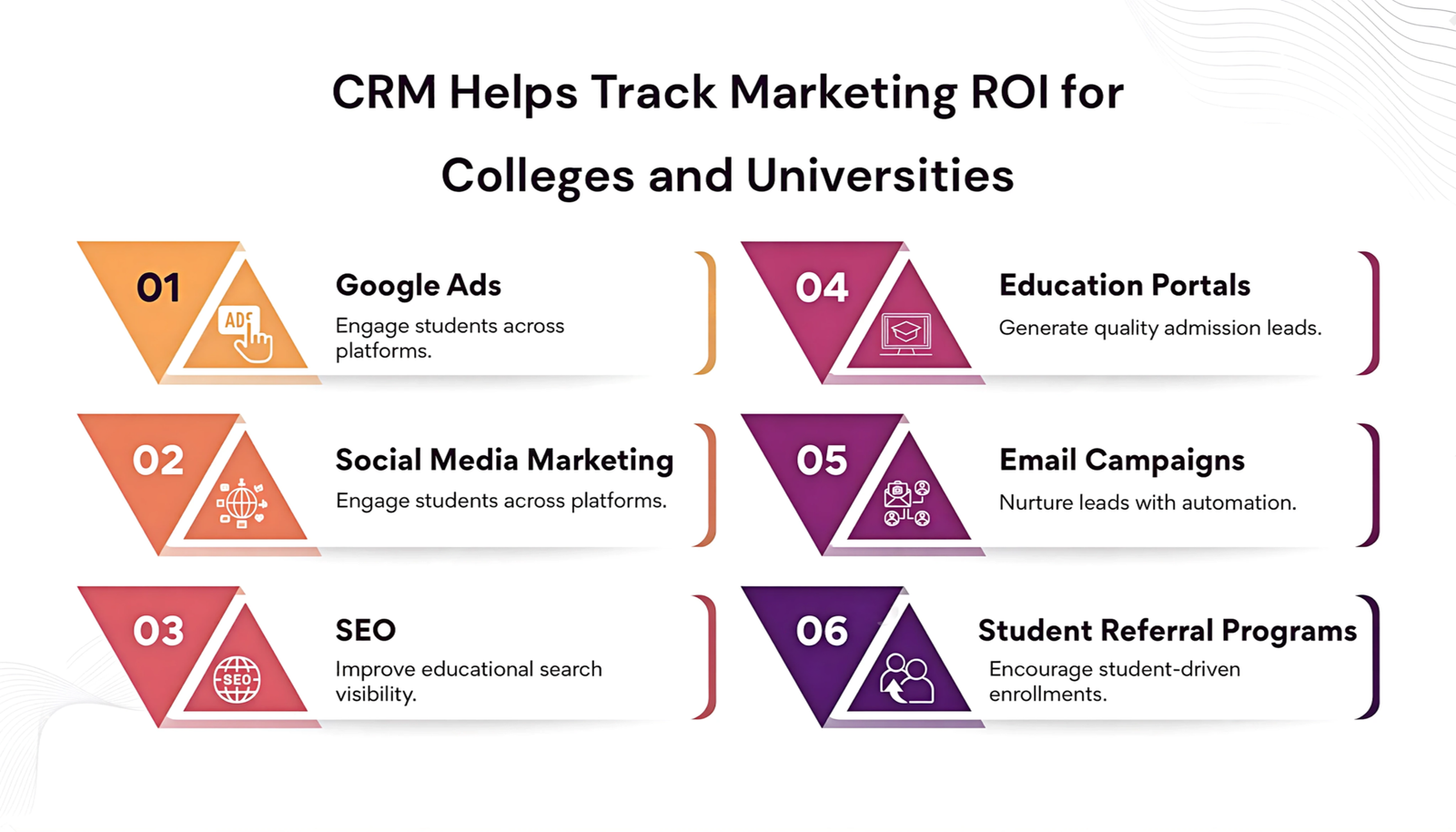
How CRM Helps Track Marketing ROI for Colleges and Universities

Track Marketing ROI for Colleges and UniversitiesEducational institutions invest heavily in digital marketing initiatives, including:

  • Google Ads
  • Social Media Marketing
  • SEO
  • Education Portals
  • Webinars
  • Email Campaigns
  • Student Referral Programs
  • Lead Generation Services

However, many institutions struggle to identify which channels actually generate enrollment. Many universities invest in Google Ads, social media campaigns, and education portals. However, admissions teams often struggle to identify which channels actually produce enrollments. CRM software provides this visibility by connecting every inquiry to its marketing source. Institutions can measure:

  • Cost per lead
  • Cost per enrollment
  • Application conversion rates
  • Counselor performance
  • Campaign effectiveness
  • Program-specific ROI

This level of visibility allows marketing teams to allocate budgets more effectively and maximize enrollment outcomes.

Can a CRM Improve Enrollment Rates?

Yes. Studies from the higher education sector consistently show that institutions using structured CRM systems experience improved response times, stronger student engagement, and better inquiry-to-enrollment conversion rates. These benefits are becoming increasingly important for colleges and universities across India as competition for student admissions continues to grow. One of the primary reasons is speed. Research indicates that prospective students are significantly more likely to engage with institutions that respond quickly to inquiries. Automated workflows ensure that every lead receives timely communication regardless of inquiry volume. CRM platforms also help admission teams prioritize high-intent students through AI-powered lead scoring, enabling counselors to focus their efforts where they are most likely to generate results.

Logo

Turn More Student Leads into Enrollments

Centralized Lead Management

Automated Follow-ups

Real-time Reports & Analytics

Secure & Reliable

Why More Universities Are Adopting AI-Powered CRM Platforms

Artificial Intelligence is becoming a major driver of innovation in higher education admissions. Modern CRM systems now leverage AI to automate repetitive tasks, identify enrollment trends, predict student behavior, and improve communication strategies. Popular AI-powered CRM capabilities include:

  • Predictive enrollment forecasting
  • Intelligent lead scoring
  • Automated follow-up sequences
  • Student engagement analytics
  • Personalized communication recommendations
  • Admission performance forecasting
 

AI is no longer a future trend in higher education admissions. It is becoming a practical tool that helps counselors prioritize leads, automate routine tasks, and identify students who are most likely to enroll.

Comparison between Generic CRM and Education CRM

Many colleges initially implement generic CRM platforms only to discover that significant customization is required. Education CRM Software vs Generic CRM explained highlights the key differences, helping institutions understand why education-focused solutions better support admissions, lead management, student engagement, and enrollment workflows. The difference becomes clear when comparing functionality.

FeatureGeneric CRMEducation CRM
Student Recruitment ManagementLimitedBuilt-In
Admission Workflow TrackingBasicAdvanced
Inquiry ManagementStandardEducation-Specific
Enrollment AnalyticsGenericAdmission Focused
Marketing ROI ReportingBasicDetailed
WhatsApp IntegrationOptionalEssential
Multi-Campus SupportLimitedExtensive
AI Lead ScoringBasicEnrollment Focused
Student Lifecycle ManagementLimitedComprehensive

This is why many institutions eventually migrate to education-focused CRM solutions that align directly with university and college admission requirements.

Why Institutions Are Choosing Sensation CRM

Sensation CRM has been developed specifically for educational institutions looking to modernize admissions, improve enrollment visibility, and enhance student engagement. The platform supports:

  • Student Recruitment Management
  • Lead Management CRM
  • University Admission Management
  • Marketing ROI Tracking
  • Multi-Campus Operations
  • WhatsApp Communication Automation
  • Counselor Performance Monitoring
  • AI-Powered Enrollment Insights
  • Student Lifecycle Management
  • Advanced Reporting Dashboards

Rather than forcing institutions to adapt to generic software workflows, Sensation CRM aligns with the unique operational requirements of colleges and universities. This enables admission teams to improve productivity, strengthen student relationships, and make more informed enrollment decisions.

Future Trends Shaping CRM for Universities

The future of higher education CRM is being shaped by automation, artificial intelligence, and data-driven decision-making. Some of the most significant trends expected to influence universities over the next few years include:

  • AI-powered admission assistants
  • Predictive enrollment analytics
  • Conversational WhatsApp admissions
  • Student lifecycle intelligence
  • Hyper-personalized communication
  • Real-time enrollment forecasting
  • Mobile-first CRM platforms
  • Automated document verification
  • Advanced marketing attribution models

Institutions that embrace these technologies early will be better positioned to attract, engage, and enroll students in an increasingly competitive educational landscape. As educational institutions across India continue to adopt digital transformation, innovative CRM solutions are becoming essential for improving admissions and student engagement. Contact us today to discover how Sensation CRM can help your institution stay ahead and achieve sustainable growth. Explore our blogs to learn more about Education CRM, admissions automation, and student relationship management, and see why Sensation CRM is trusted by modern educational institutions in India.

Frequently Asked Questions

Q: Why do colleges and universities choose Sensation CRM?

Colleges and universities choose Sensation CRM because it is built around educational workflows rather than traditional business sales processes. The platform supports lead management, student communication, admission tracking, enrollment analytics, WhatsApp automation, and multi-campus operations, making it ideal for modern educational institutions.

Q: How does Sensation CRM improve college admission success?

Sensation CRM improves admission success by centralizing student data, automating communication, reducing response delays, prioritizing high-intent leads, and providing real-time admission insights. This helps admission teams engage prospective students more effectively and increase conversion rates.

Q: Can Sensation CRM track marketing ROI for educational institutions?

Yes. Sensation CRM helps colleges and universities measure marketing performance by connecting inquiry sources, applications, and enrollments to specific campaigns. Institutions can identify which channels generate the highest-quality leads and optimize their marketing investments accordingly.

Q: Does Sensation CRM support WhatsApp and email automation?

Yes. Sensation CRM supports automated communication through WhatsApp, email, SMS, and other digital channels. This enables colleges and universities to maintain consistent student engagement throughout the admission journey.

Q: How does Sensation CRM help with lead management?

Sensation CRM automatically captures leads from websites, landing pages, social media campaigns, education portals, and inquiry forms. The platform assigns leads to counselors, tracks interactions, schedules follow-ups, and monitors conversion progress throughout the enrollment funnel.

Q: Can Sensation CRM integrate with university websites and admission portals?

Yes. Sensation CRM integrates with institutional websites, admission portals, inquiry forms, marketing platforms, and communication channels, ensuring all student interactions are captured and managed from a single dashboard.